

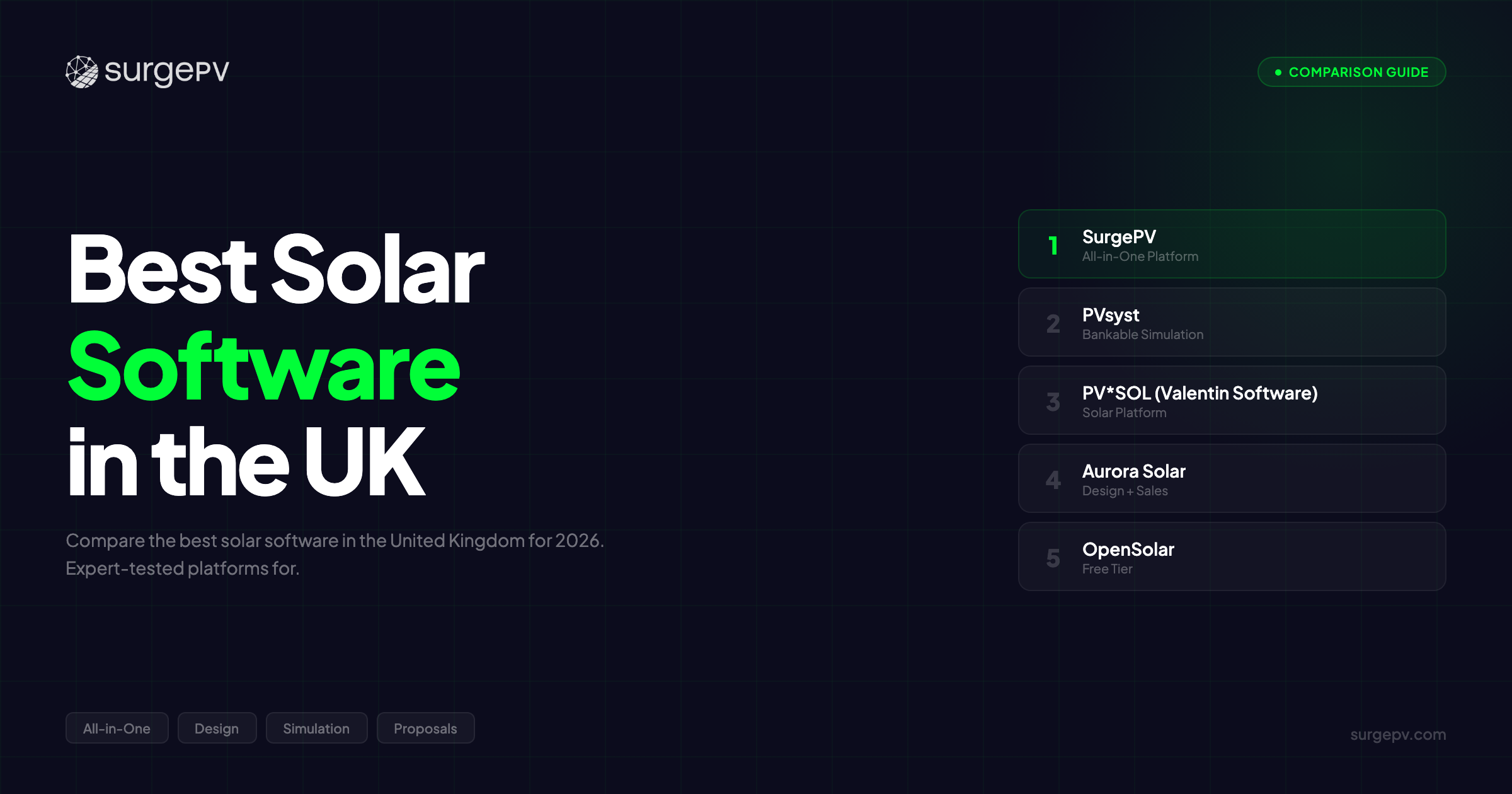
TL;DR: SurgePV ranks #1 as the best all-in-one solar software for the UK in 2026 — combining design, IEC-compliant SLD generation (5–10 min vs 2–3 hours in AutoCAD), bankable P50/P75/P90 simulations within ±3% of PVsyst, Smart Export Guarantee modelling, battery storage ROI, and professional GBP proposals in one cloud platform at ~GBP 1,199/user/year. Eliminates multi-tool workflows (vs Aurora + AutoCAD + PVsyst at GBP 7,000+/year). Runner-ups: PVsyst for bankable simulation, PV*SOL for European residential analysis, Aurora Solar for enterprise residential, and OpenSolar for budget-conscious teams.
18 GW installed. 4,000+ MCS-certified installers. Installations climbing toward 2–3 GW per year. The UK is one of Europe’s fastest-growing solar markets (Solar Energy UK), driven by electricity prices at 24–28p/kWh, 0% VAT on residential solar, and Smart Export Guarantee payments.
Finding the right solar design software is where things get complicated. Most platforms were built for the US market. No MCS documentation support. No SLDs that meet BS 7671 Section 712. No accurate Smart Export Guarantee modelling. Battery storage — now in 60%+ of UK residential installs — treated as an afterthought.
The result? UK solar businesses end up stitching together 3–5 separate tools: one for design, one for electrical documentation, one for simulation, one for proposals, maybe a spreadsheet to get the UK financial modelling right. That fragmented workflow costs time, money, and accuracy on every project.
We tested and compared the top 5 solar software platforms for the UK market, evaluating each across design capability, electrical engineering, simulation accuracy, proposal quality, and UK-specific financial modelling.
In this guide, you will find:
- Which platform delivers the most complete UK-ready workflow
- How pricing compares across all 5 tools (from free to GBP 8,000+/year)
- Which tools generate bankable reports UK lenders accept
- Our recommendation for residential installers, commercial EPCs, and solar farm developers
Who this guide is for:
- MCS-certified residential installers (3–8 kW systems, SEG-eligible)
- Commercial solar EPCs (30 kW–5 MW rooftop and ground-mount)
- Solar farm developers and consultants (5 MW+, bankable reports)
- Solar sales teams (proposals, financial modelling, customer presentations)
Quick Comparison: Top 5 Solar Software for the UK
| Platform | Best For | UK Financial | SLD | Proposals | Cloud | Pricing (GBP/yr) |
|---|---|---|---|---|---|---|
| SurgePV | End-to-end | High | Automated | Professional | Yes | ~GBP 1,199/user |
| PVsyst | Simulation | None | No | No | Desktop | GBP 980 + 280/yr |
| PV*SOL | EU residential | EUR focus | Partial | No | Desktop | GBP 1,100–1,700 |
| Aurora Solar | Enterprise | Basic | No | Professional | Yes | GBP 2,100–8,000+ |
| OpenSolar | Budget | Basic | No | Basic | Yes | Free |
Best Solar Software in the United Kingdom
SurgePV — Best All-in-One Solar Software for the UK
Best For: UK EPCs and installers needing design, SLD, simulation, and proposals in one platform
Pricing: ~GBP 1,199/user/year ($1,499) | See pricing
UK Market Fit: Excellent
Overall Score: 95/100
SurgePV is the only platform that covers the complete UK solar workflow: 3D design, automated SLD generation, bankable simulation, and professional proposals — all in one cloud-based platform. No other tool on this list does all four.
One Platform Instead of Four
The typical UK commercial EPC workflow requires Aurora or HelioScope for design, AutoCAD for electrical documentation, PVsyst for simulation, and Excel or a separate tool for proposals. That stack costs GBP 5,000–10,000+ per user per year and takes 2.5–3 hours per project. SurgePV replaces the entire stack. 30–45 minutes from design start to finished proposal. One login. One set of project data.
SLD Generation: The UK Differentiator
Automated SLD generation produces IEC-compliant electrical diagrams in 5–10 minutes. These include DC arrays, MPPT assignments, inverters, AC disconnects, protection devices (breakers, fuses, SPD), and wire sizing — all generated directly from your system design. For UK installers working under BS 7671 Section 712, this eliminates the manual AutoCAD drafting process that takes 2–3 hours and costs GBP 1,600+/year in licensing.
Bankable Accuracy That UK Lenders Accept
SurgePV’s 8760-hour shading analysis achieves ±3% accuracy compared to PVsyst. The platform provides P50/P75/P90 bankability metrics — not just the P50 estimates that Aurora Solar limits you to.
UK Financial Modelling
- Smart Export Guarantee: Supplier-specific rates (3–15p/kWh), time-of-export tariffs
- Self-consumption savings: Ofgem price cap rates (24–28p/kWh residential)
- Battery storage ROI: Self-consumption uplift, TOU arbitrage (Octopus Agile, Flux), grid services
- 0% VAT: Automatic for residential (since April 2022, extended March 2027)
- Enhanced Capital Allowances: 100% first-year tax relief for commercial
- 25-year projections: GBP cash flows with degradation and electricity price escalation
Pro Tip
SurgePV handles 70,000+ projects globally. The platform’s 3-minute average support response and 2–3 week onboarding mean your team is productive within weeks, not months. Book a demo to see the complete UK workflow.
Key Strengths
- End-to-end Platform: Design + SLD + simulation + proposals in one tool.
- Automated SLD: IEC-compliant diagrams in 5–10 minutes. No manual cross-referencing code tables, and zero risk of undersized cables failing inspection.
- Bankable: P50/P75/P90 within ±3% of PVsyst. Your financing applications include the bankability data lenders actually require.
- UK Financials: SEG, 0% VAT, ECA, Octopus Agile/Flux modelling. Every UK-specific calculation handled natively.
- Carport Design: Only platform with native carport support.
Limitations
- UK Market Presence: Newer compared to PVsyst in the UK.
- MCS Integration: UK-specific templates still expanding.
Real-World Example
A growing EPC in South East England with both residential and commercial projects was paying over $12,000/year for separate design, simulation, and CAD licences — and still spending 15 hours per week on tool-switching overhead. After consolidating to SurgePV at $4,497/year (3-user plan), they freed up two full working days per week and cut their software costs by 63%.
PVsyst has had a 30-year head start. Aurora Solar has spent hundreds of millions on marketing. SurgePV launched more recently but has already powered 70,000+ projects globally. The platform was purpose-built for the workflow gaps that legacy tools leave open, particularly automated electrical engineering, which no other platform offers natively.
Further Reading
Best All-in-One Solar Design Software — Complete platform comparison
Best Commercial Solar Design Software — EPC-focused analysis
HelioScope Review — Commercial design deep-dive
PVsyst — Best for Bankable Simulation
Best For: Solar farm developers and engineers needing lender-accepted simulation
Pricing: GBP 980 perpetual + GBP 280/year
UK Market Fit: High (simulation only)
Overall Score: 82/100
PVsyst is the global standard for bankable solar simulation, recognised alongside IEA and IRENA methodologies for energy yield assessment. Every UK lender, due diligence consultant, and project finance team accepts PVsyst reports. For solar farm developers and large commercial projects seeking UK financing, PVsyst validation is often a non-negotiable requirement.
PVsyst is a simulation engine. It does not design systems, generate proposals, create SLDs, or handle any part of the sales workflow. You need PVsyst as one piece of a 3–4 tool stack — adding design software, AutoCAD, and a proposal builder. The total cost of that stack? GBP 3,000–7,000+ per user per year.
Further Reading
For a full analysis, see our PVsyst review. We also compare simulation-focused platforms separately.
Key Strengths
- Gold Standard: Universally accepted by UK lenders.
- UK Weather Data: Excellent diffuse radiation modelling.
- Deep Simulation: Detailed loss chain analysis.
Limitations
- Simulation Only: No design, proposals, SLD, or sales workflow.
- Desktop-Only: No cloud collaboration.
- Steep Learning Curve: 4–6 weeks to proficiency.
- Requires Additional Tools: Needs 2–3 other platforms alongside.
PV*SOL (Valentin Software) — Best for European Residential Analysis
Best For: Residential installers wanting detailed battery and self-consumption modelling
Pricing: GBP 1,100–1,700 one-time
UK Market Fit: Medium–High
Overall Score: 77/100
PVSOL is a German-developed tool that brings a European perspective to solar simulation and design. For UK installers who want detailed battery storage analysis and self-consumption modelling — two features where 60%+ of residential installs now include batteries — PVSOL delivers genuine value.
PV*SOL models battery dispatch strategies against time-of-use tariffs, calculates self-consumption ratios with hourly load profiles, and includes UK weather data with proper diffuse radiation modelling. The limitations mirror PVsyst: desktop-only, no customer-facing proposals, limited SLD capability, and EUR-focused financial outputs that need manual GBP conversion for UK customers.
Key Strengths
- Battery Modelling: Detailed dispatch with time-of-use tariffs.
- One-Time Purchase: No recurring subscription.
- Self-Consumption: Hourly load profiles and optimisation.
- SEG Calculations: Export income projections.
Limitations
- Desktop-Only: No cloud collaboration.
- EUR-Focused: Financial outputs require manual GBP conversion.
- No Proposals: No customer-facing deliverables.
- Limited SLD: Partial electrical documentation only.
Aurora Solar — Best for Enterprise Residential Workflows
Best For: Large residential installers with enterprise budgets and international operations
Pricing: GBP 2,100–8,000+/year
UK Market Fit: Medium
Overall Score: 74/100
Aurora Solar dominates the US residential solar market with fast AI roof modelling, polished proposals, and deep CRM integrations. The platform is expanding into the UK, and large residential installers with enterprise budgets may find value in its design speed and proposal quality.
Aurora was built for US regulations, US tariff structures, and US financial modelling. It lacks BS 7671 SLD generation — requiring AutoCAD at GBP 1,600+/year. It does not model supplier-specific SEG tariffs or Enhanced Capital Allowances. It provides P50 production estimates only — not the P75/P90 metrics UK lenders require.
Did You Know?
The total cost of Aurora + AutoCAD for a UK team is GBP 5,440+ per user per year. SurgePV delivers more UK-specific features (SLD, P50/P90, SEG, battery ROI) at ~GBP 1,199/user/year — a saving of GBP 4,241 per user annually.
Key Strengths
- AI Roof Modelling: Industry-leading 3D design speed.
- Professional Proposals: Polished customer-facing documents.
- CRM Integrations: Salesforce, HubSpot connectivity.
Limitations
- No SLD: Requires AutoCAD (GBP 1,600+/year).
- P50 Only: No P75/P90 for UK lenders.
- US-Centric: Limited UK financial modelling depth.
- High Total Cost: Aurora + AutoCAD = GBP 5,440+/year per user.
OpenSolar — Best Free Option for Budget-Conscious Installers
Best For: Small residential installers on tight budgets
Pricing: Free
UK Market Fit: Low–Medium
Overall Score: 67/100
OpenSolar offers a genuinely free solar design and proposal platform. For small UK residential installers handling 5–10 projects per month on tight margins, it removes the software cost barrier entirely. The proposals are clean and customer-friendly. The 3D design tools handle basic residential layouts.
No SLD generation. Basic simulation that falls short of bankable standards. Limited UK financial modelling — simplified SEG calculations, basic battery analysis, no time-of-use tariff modelling. No MCS documentation support. No commercial project capabilities.
Key Strengths
- Completely Free: No licensing barrier.
- Cloud-Based: Easy access from any device.
- Customer Proposals: Basic but functional client-facing documents.
Limitations
- No SLD: No BS 7671 compliance tools.
- Basic Simulation: Falls short of bankable standards.
- Limited UK Financials: Simplified SEG and battery modelling.
- No Commercial: Not suited for larger projects.
One Platform for Your Entire UK Solar Workflow
See how SurgePV replaces 3–4 tools with design, SLD generation, bankable simulation, and professional GBP proposals in one cloud platform.
Book a DemoNo commitment required · 20 minutes · Live project walkthrough
Why Most UK Solar Companies Overpay for Software
Six criteria separate solar simulation software platforms that genuinely serve the UK market from those that treat it as an afterthought.
MCS Certification Support
The Microgeneration Certification Scheme governs small-scale renewable installations under 50 kW across the UK. MCS certification is required for Smart Export Guarantee eligibility and most government incentive programmes. With 4,000+ MCS-certified installers active, documentation that supports MCS compliance is a baseline requirement.
BS 7671 Electrical Design
BS 7671 (IET Wiring Regulations, 18th Edition) governs all electrical installations in the UK. Section 712 specifically covers PV systems. Software that generates IEC-compliant SLDs applicable to these requirements eliminates hours of manual CAD work per project.
G98/G99 DNO Grid Connection
UK solar systems connect through six Distribution Network Operators (Energy Networks Association). G98 covers simplified connections up to 3.68 kW single-phase. G99 covers everything above. Technical documentation from your software feeds directly into these DNO applications.
SEG and Battery Financial Modelling
SEG payments range from 3–15p/kWh depending on supplier and tariff structure. Self-consumption saves 24–28p/kWh at current Ofgem price cap levels. Battery storage — now in 60%+ of residential installs — adds time-of-use arbitrage opportunities. Software must model all three accurately.
Self-Consumption and TOU Optimisation
With the gap between self-consumption value (24–28p/kWh) and export value (3–15p/kWh) widening, maximising on-site usage is the primary financial driver for UK solar. Time-of-use tariffs like Octopus Agile (half-hourly pricing) and Octopus Flux (solar-optimised) add complexity — and opportunity — to system design.
UK Weather Data Accuracy
The UK’s cloudy climate means diffuse radiation accounts for a large proportion of total irradiance. Software that accurately models diffuse versus direct beam components produces more reliable energy yield predictions. Southern England sees 1,100–1,200 kWh/m²/year, while Scotland averages 850–1,000 kWh/m²/year.
Pricing Comparison: What UK Solar Businesses Actually Pay
| Approach | Annual Cost (GBP/user) | Design | SLD | Simulation | Proposals | Total Tools |
|---|---|---|---|---|---|---|
| SurgePV | ~GBP 1,199 | Yes | Yes | ±3% PVsyst | Yes | 1 tool |
| Aurora + AutoCAD | GBP 3,700–9,600+ | Yes | Yes (CAD) | P50 only | Yes | 2 tools |
| PVsyst + Design + CAD + Proposals | GBP 5,000–10,000+ | Yes | Yes (CAD) | Yes | Separate | 3–4 tools |
| PV*SOL + Design + Proposals | GBP 2,500–5,000+ | Yes | Partial | Yes | Separate | 2–3 tools |
| OpenSolar | Free (GBP 0) | Basic | No | Basic | Basic | 1 tool (limited) |
The total cost of ownership calculation is straightforward. SurgePV replaces 3–4 separate tools at a fraction of the combined cost. For a team of 5, the annual savings versus Aurora + AutoCAD alone exceed GBP 21,000.
Important
All pricing data verified against official sources as of February 2026. GBP conversions based on approximate exchange rates. Prices may have changed since publication.
Decision Shortcut
If you need electrical engineering (SLDs, wire sizing, code compliance), SurgePV is the only platform that automates this natively. If you’re simulation-only, PVsyst is the gold standard. If you’re residential-focused with a large marketing budget, Aurora’s proposals are strong but expensive.
Our Testing Methodology
Our evaluation scored each platform across five weighted criteria designed specifically for the UK market:
- UK Market Fit (35%): MCS documentation support, BS 7671 SLD generation, G98/G99 technical data, SEG modelling, battery analysis, 0% VAT and ECA
- Feature Completeness (25%): Design, electrical engineering, simulation, proposals — how many workflow stages each platform covers natively
- Workflow Efficiency (20%): Design-to-output speed, cloud collaboration, team features, onboarding time
- Bankability (15%): Simulation accuracy, lender acceptance, P50/P75/P90 reporting
- Cost-Effectiveness (5%): Total cost of ownership including all required supplementary tools
We tested each platform on three UK projects: a 4 kW residential system with 5 kWh battery in London, a 250 kW commercial flat roof in Birmingham, and a 2 MW ground-mount solar farm in East Anglia. Testing was performed by engineers with 10+ years of UK and European solar experience across 500+ commercial and utility-scale projects.
The Bottom Line
For UK EPCs and installers wanting one platform: SurgePV is the clear winner. It is the only platform covering design, electrical engineering (automated SLD), bankable simulation (P50/P75/P90 within ±3% of PVsyst), and professional GBP proposals in a single cloud workflow. At ~GBP 1,199/user/year with all features included, it replaces a 3–4 tool stack costing 3–8x more.
For solar farm developers: PVsyst remains the gold standard for bankable simulation. Use SurgePV for daily design and proposal work, export to PVsyst when financiers require specific bankable validation.
For EU-focused residential with battery analysis: PV*SOL offers strong self-consumption and battery dispatch modelling with UK weather data, at a reasonable one-time cost.
For enterprise residential teams: Aurora Solar provides fast design and polished proposals, but the UK-specific feature gaps (no SLD, no SEG detail, P50 only) and high pricing make it less competitive for UK-focused operations.
For budget-conscious small installers: OpenSolar gets you started at zero cost. Upgrade when you need SLDs, bankable simulation, or detailed UK financial modelling.
The UK solar market is not slowing down. With installations pushing toward 2–3 GW per year and over 4,000 MCS-certified installers competing for projects, the companies winning today are the ones delivering professional designs, accurate financials, and bankable reports faster than their competitors. Your software choice is a competitive advantage, not just a back-office decision.
Ready to simplify your UK workflow? Book a demo — our team will walk you through a complete UK project using your actual data. Or see pricing — transparent, all-inclusive, no surprises.
Related Guides
Best Solar Design Software (2026) — Design-focused comparison
Best Solar Proposal Software (2026) — Proposal tool comparison
Solargraf Review — Residential proposal platform analysis
Which Software Is Right for Your Use Case?
| Your Situation | Recommended Software | Why It Fits |
|---|---|---|
| Large EPC doing commercial projects | SurgePV, PVsyst, HelioScope | Need bankable simulation, electrical design automation, and grid compliance documentation for DNO approvals |
| Commercial installer (5–20 projects/month) | SurgePV, HelioScope, Aurora Solar | Balance between design accuracy and proposal speed; integrated workflow reduces tool-switching |
| Residential-focused installer | Aurora Solar, OpenSolar, SurgePV | Prioritise fast proposals with visual sales tools; moderate simulation depth sufficient for residential financing |
| Developer doing feasibility studies | PVsyst, SurgePV, HelioScope | Need accurate energy yield modeling and financial analysis for investment decisions; banks require P50/P75/P90 estimates |
| Small team (1–3 people) | SurgePV, OpenSolar | All-in-one platforms reduce software stack complexity and training time; eliminate AutoCAD dependency for SLD generation |
| Multi-regional operations | SurgePV | Cloud collaboration handles regulatory differences from single platform; flexible regional input for incentive modeling |
Pro Tip
Multi-regional EPCs managing projects across different regulatory systems save the most with SurgePV’s cloud-based collaboration. One platform, multiple regions, zero tool-switching. See how it works.
When You May Not Need Advanced Solar Software
Not every solar project requires comprehensive design and simulation platforms. Consider simpler alternatives if:
- Small residential projects with standard layouts — Basic design tools or manufacturer calculators may suffice for simple rooftop arrays with minimal shading complexity.
- Engineering is outsourced — If your company uses external engineering services, you may only need proposal and CRM tools rather than full design platforms.
- Very limited project volume — Teams handling fewer than 5 projects per year may find that manual AutoCAD workflows and spreadsheet modeling are more cost-effective than software subscriptions.
- Non-technical sales teams — Sales-focused companies without in-house engineers may only require proposal generation tools rather than technical design software.
Most EPCs, developers, and medium-to-large installers benefit from integrated solar proposal software platforms that reduce manual work and improve accuracy. With strict DNO requirements for electrical documentation, manual workflows create bottlenecks that delay project approvals and increase labour costs.
Frequently Asked Questions
What is the best solar software in the UK?
SurgePV is the best all-in-one solar software for the UK in 2026. It combines IEC-compliant SLD generation, bankable P50/P75/P90 simulations (±3% vs PVsyst), SEG modelling, battery ROI analysis, and professional GBP proposals in one cloud platform at ~GBP 1,199/user/year. For pure simulation, PVsyst is the gold standard. For free basic tools, OpenSolar works. See our best solar software hub for broader comparisons.
Do I need MCS-compatible software?
MCS certification requires proper design documentation for installations under 50 kW. SurgePV generates IEC-compliant SLDs and technical specifications applicable to MCS standards. MCS certification ultimately depends on installer credentials and documentation practices — but automated documentation saves significant time in the compliance process.
Which software handles UK battery storage modelling?
SurgePV, PVSOL, and PVsyst all model battery storage for UK systems. SurgePV and PVSOL include self-consumption optimisation, time-of-use tariff arbitrage (Octopus Agile, Flux), and payback analysis. With 60%+ of UK residential installs now including batteries, accurate storage modelling directly impacts proposal accuracy and customer trust.
How much does solar software cost in the UK?
From free (OpenSolar) to GBP 8,000+/year (Aurora Solar enterprise). SurgePV: ~GBP 1,199/user/year. PVsyst: GBP 980 perpetual + GBP 280/year. PV*SOL: GBP 1,100–1,700 one-time. Aurora: GBP 2,100–8,000+/year. Check the SurgePV pricing page for current rates.
Which solar software do UK lenders accept for bankable reports?
PVsyst is the gold standard — universally accepted by UK lenders and due diligence firms. SurgePV reports (±3% accuracy vs PVsyst, with full P50/P75/P90) are gaining acceptance for commercial and solar farm financing. HelioScope is also accepted by some UK lenders.
Can solar software model Smart Export Guarantee payments?
Yes. SurgePV and PV*SOL model SEG payments at supplier-specific rates (3–15p/kWh), including time-of-export tariffs. This is essential for accurate UK solar proposals — the difference between self-consumption value (24–28p/kWh) and export value (3–15p/kWh) fundamentally shapes system sizing and battery decisions.
Which software is best for UK commercial solar projects?
SurgePV is best for UK commercial solar EPCs. It combines design, automated SLD generation (5–10 minutes vs 2–3 hours in AutoCAD), bankable P50/P75/P90 simulation, Enhanced Capital Allowance modelling, and professional proposals in one platform. For solar farms requiring gold-standard bankable reports, add PVsyst for final validation.
Is there free solar software for UK installers?
OpenSolar is the primary free option, offering basic design and customer-facing proposals without licensing fees. Trade-off: no SLD generation, basic simulation accuracy, limited UK financial modelling, and no MCS documentation support. For installers growing beyond basic residential work, SurgePV at ~GBP 1,199/year delivers significantly more value.
Which software handles BS 7671 electrical design?
SurgePV generates IEC-compliant SLDs applicable to BS 7671 Section 712 requirements in 5–10 minutes per project. PV*SOL offers partial electrical documentation. Aurora Solar and OpenSolar lack SLD generation entirely — requiring AutoCAD (GBP 1,600+/year) for electrical documentation.
What features should UK solar software include?
Essential features for UK solar software: MCS documentation support, BS 7671 SLD generation, G98/G99 technical documentation, Smart Export Guarantee and battery financial modelling, self-consumption optimisation with TOU tariffs, UK weather data with diffuse radiation modelling, GBP proposals, and cloud collaboration. SurgePV is the only platform covering all of these in a single workflow.
Sources
- Solar Energy UK — UK solar market data and statistics. https://solarenergyuk.org/ (accessed February 2026)
- MCS Certified — Microgeneration Certification Scheme. https://mcscertified.com/ (accessed February 2026)
- Ofgem — Smart Export Guarantee. https://www.ofgem.gov.uk/environmental-and-social-schemes/smart-export-guarantee-seg (accessed February 2026)
- Ofgem — Energy price cap. https://www.ofgem.gov.uk/check-if-energy-price-cap-affects-you (accessed February 2026)
- IET — BS 7671 Wiring Regulations. https://www.theiet.org/standards/bs-7671/ (accessed February 2026)
- Energy Networks Association — G98/G99 grid connection standards. https://www.energynetworks.org/ (accessed February 2026)
- HMRC — VAT on energy-saving materials. https://www.gov.uk/guidance/vat-on-energy-saving-materials (accessed February 2026)
- National Grid ESO — UK electricity system data. https://www.nationalgrideso.com/ (accessed February 2026)
- PVsyst — Official site. https://www.pvsyst.com/ (accessed February 2026)
- Aurora Solar — Official pricing. https://aurorasolar.com/pricing/ (accessed February 2026)
- OpenSolar — Official platform. https://www.opensolar.com/ (accessed February 2026)