France’s solar market runs on one of Europe’s most structured feed-in systems — the Obligation d’Achat (OA) administered by EDF (Électricité de France). A rooftop installer in Lyon, Bordeaux, or Marseille dealing with a client asking “what does EDF actually pay?” needs a precise answer, not a general overview. This guide covers current EDF OA tariff rates by system size, how the tarif de rachat solaire is set and locked in, the autoconsommation versus vente totale decision, step-by-step OA application, and payback scenarios using real 2025–2026 figures.
TL;DR — France EDF Feed-in Tariffs 2026
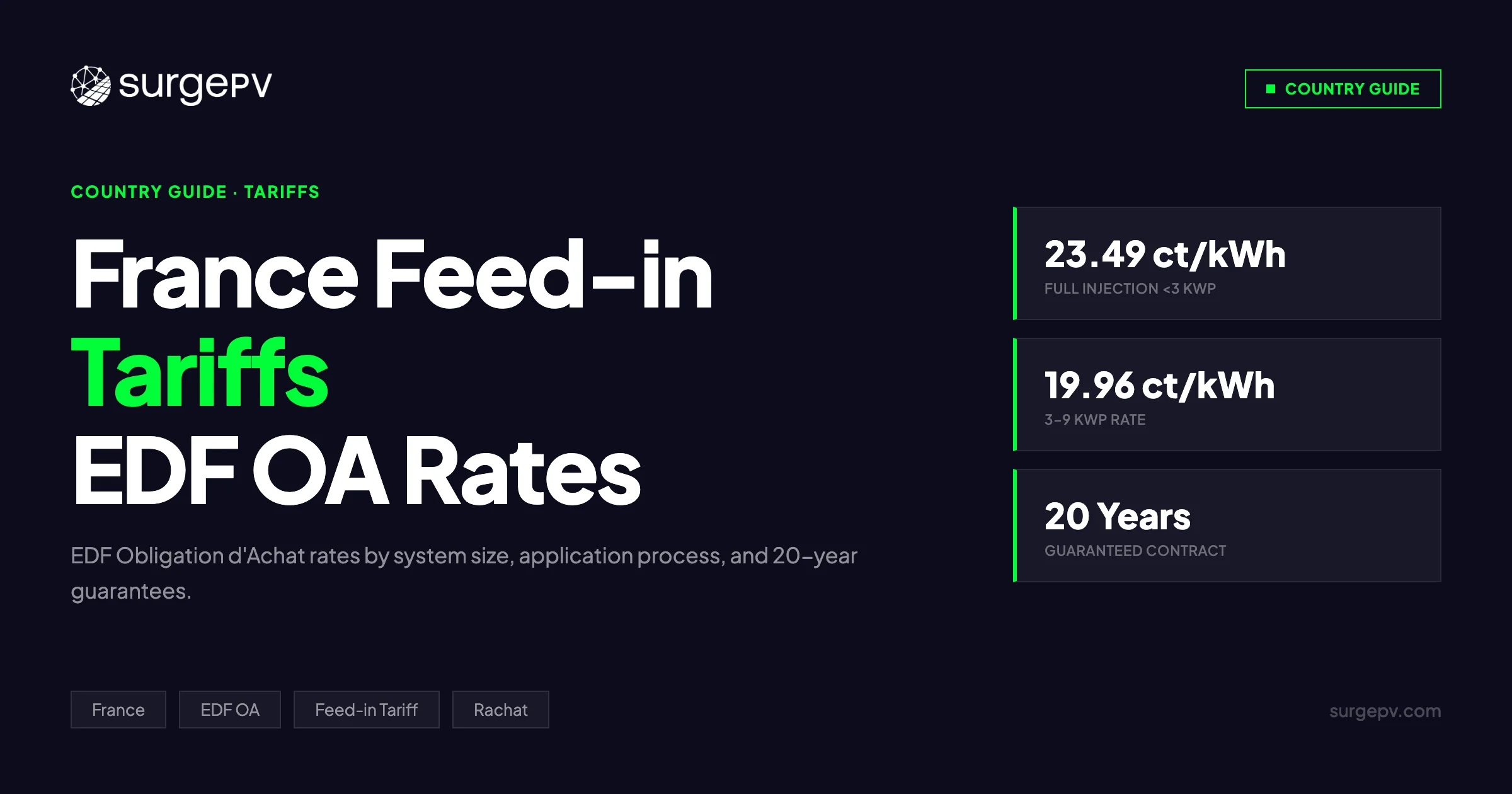
EDF pays a fixed tarif de rachat solaire under the Obligation d’Achat (OA) program — guaranteed for 20 years at signing. Q1 2026 rates: up to 23.49 ct/kWh for systems under 3 kWp (full injection), 19.96 ct/kWh for 3–9 kWp, and 13.62 ct/kWh for 9–100 kWp. Systems over 100 kWp enter the CRE tender process. Autoconsommation with surplus sale often outperforms full injection for systems under 9 kWp when combined with the Prime à l’Autoconsommation bonus. Apply within 18 months of your Enedis connection offer — late applications permanently forfeit OA eligibility.
In this guide:
- The latest 2026 updates to EDF OA tariff rates and CRE quarterly changes
- Full EDF OA tariff rate table by system size and injection model
- Autoconsommation vs vente totale — which earns more for your client’s system size
- How the tarif de rachat solaire is calculated and what locks your rate in
- Step-by-step EDF OA application process (with timeline and document checklist)
- EDF OA vs CRE appels d’offres for systems over 100 kWp
- Payback period examples using 2026 EDF rates for 6 kWp, 9 kWp, and 30 kWp systems
- Taxation on OA income — French rules for small producers
- How solar design software can model EDF OA scenarios in client proposals
Latest Updates: France Solar Feed-in Tariffs 2026
For anyone tracking french solar feed-in tariffs news, here is the full status of the EDF OA program as of March 2026.
Q1 2026 EDF OA Tariff Rates — Current Status
The CRE publishes revised tarifs de rachat quarterly. Q1 2026 rates came into effect on 1 January 2026. These apply to new OA contracts signed in this quarter — existing contracts are unaffected.
| System Size | Injection Model | Q1 2026 Rate (€/kWh) | Change vs Q4 2025 |
|---|---|---|---|
| < 3 kWp | Vente totale (full) | 0.2349 | −0.8% |
| 3–9 kWp | Vente totale (full) | 0.1996 | −1.1% |
| 9–36 kWp | Vente totale (full) | 0.1362 | −1.3% |
| 36–100 kWp | Vente totale (full) | 0.1102 | −1.5% |
| < 9 kWp | Surplus only (autoconso) | ~0.0765 | −0.9% |
| 9–100 kWp | Surplus only (autoconso) | ~0.0601 | −1.2% |
Source: CRE arrêté tarifaire, Q1 2026. Rates subject to quarterly revision. Lock in by signing your OA contract before the next quarterly adjustment.
Key Takeaway — Quarterly Degression Is Real
EDF OA tariff rates decline approximately 1–1.5% per quarter as more solar capacity is added to the French grid. A 9 kWp system signed in Q1 2026 at 19.96 ct/kWh versus Q4 2026 may receive 19.20 ct/kWh — a difference that compounds over 20 years into several thousand euros of revenue. Sign your OA contract as soon as your Enedis connection offer is received.
France Solar Policy Status — March 2026
| Program / Policy | Status | Key Notes |
|---|---|---|
| EDF OA Feed-in Tariff (<100 kWp) | Active | CRE Q1 2026 rates in force |
| Prime à l’Autoconsommation | Active | €90–€380/kWp depending on system size |
| CRE Appels d’Offres (>100 kWp) | Active | Q2 2026 tender round open |
| TVA à 10% (≤3 kWp on existing buildings) | Active | Statutory; no budget cap |
| MaPrimeRénov’ (thermal retrofit) | Active | Not combinable with OA FiT on same installation |
| France 2030 solar target (100 GW) | On track | 23 GW installed as of end-2025 |
| Agri-PV tariff premium | Active | Additional bonus for dual-use installations |
2026 Policy Changes Affecting EDF Feed-in Tariffs
Two regulatory changes took effect in 2025–2026 that every solar professional working in France should know:
1. Agri-PV premium extended. The CRE confirmed that agricultural PV installations under the OA regime receive an additional premium of 1.5–2.0 ct/kWh above standard rates, now extended through 2028. This applies to systems installed on active agricultural land with at least 70% preserved agricultural use below the panels.
2. Autoconsommation surplus tariff methodology revised. From Q3 2025, the CRE methodology for calculating surplus tarifs shifted to a reference market price basis, causing slight downward pressure on surplus rates relative to the full injection tarif. Systems under 9 kWp should model both routes carefully — the surplus model is not automatically better.
3. Mise en service notification window shortened. As of January 2026, you must submit your mise en service notice to EDF OA within 15 months of your Enedis connection offer (reduced from 18 months). Check your connection offer date carefully.
What Is the EDF Obligation d’Achat Program?
The Obligation d’Achat (OA) is France’s statutory feed-in tariff framework, written into the Energy Code (Code de l’Énergie). It legally requires EDF — as the designated obligated buyer — to purchase solar electricity from all eligible small and medium installations at CRE-set tariffs.
The program has three structural features that make it attractive compared to other European FiT schemes:
Fixed rate for 20 years. Once your OA contract is signed, your tarif de rachat solaire is locked in regardless of future market or policy changes. A system signed in 2026 at 19.96 ct/kWh earns that rate every month until 2046.
Monthly payment from EDF. EDF pays based on Enedis metering data — no manual invoicing required. Payments arrive within the standard monthly billing cycle.
CRE oversight — not political discretion. The CRE (Commission de Régulation de l’Énergie) sets rates using a transparent cost-of-production methodology. This makes the program more predictable than programs dependent on annual budget votes.
How EDF OA Metering and Payment Work
Grid connection and metering are handled by Enedis, the national distribution network operator — not EDF directly. Understanding the distinction matters for your application:
- Enedis installs the bidirectional smart meter (Linky) and records injection data in 30-minute intervals
- Enedis sends injection data monthly to EDF OA
- EDF OA calculates the payment: injection kWh × your locked tarif de rachat = monthly payment
- EDF OA credits your nominated bank account, typically within 45 days of meter data receipt
The Linky meter is mandatory for all OA connections. If your client’s property has an older meter, Enedis upgrades it as part of the connection process — at no direct cost to the system owner.
Pro Tip — Verify Meter Configuration
After commissioning, log into the Enedis customer portal (monespace-client.enedis.fr) to verify that injection is being recorded correctly. In the first 1–2 months, billing errors from incorrect meter configuration do occur — catching them early protects your client’s OA earnings from the start.
EDF OA Tariff Rates by System Size (Full Rate Table)
Vente Totale — Full Injection Rates
Under vente totale, the entire production of the solar system is exported to the grid. The system cannot be used for on-site consumption in this mode. EDF pays for 100% of production.
| System Category | Power Range | Q1 2026 Tarif (€/kWh) | 20-yr Revenue (6,000 kWh/yr) |
|---|---|---|---|
| Residential small | < 3 kWp | 0.2349 | ~€28,200 |
| Residential medium | 3–9 kWp | 0.1996 | ~€23,950 |
| Commercial / SME | 9–36 kWp | 0.1362 | ~€16,340 |
| Mid-size commercial | 36–100 kWp | 0.1102 | ~€13,220 |
Revenue example assumes 6,000 kWh/year production across the 20-year contract. Nominal, before tax.
Surplus Tarif — Autoconsommation Rates
Under autoconsommation avec vente de surplus, the system first supplies on-site loads. Only electricity that exceeds on-site demand is exported and paid at the surplus tarif.
| System Size | Q1 2026 Surplus Tarif (€/kWh) |
|---|---|
| < 9 kWp | ~0.0765 |
| 9–100 kWp | ~0.0601 |
The surplus tarif is lower than the full injection rate, but the autoconsommation model benefits from two additional income streams: electricity bill savings (valued at the grid retail rate of ~€0.25–0.28/kWh in France in 2026) and the Prime à l’Autoconsommation bonus.
Agri-PV Premium Rates
| Installation Type | Base Rate | Agri-PV Bonus | Effective Rate |
|---|---|---|---|
| Ground-mount agri (<500 kWp) | 0.1102 ct/kWh | +0.020 ct/kWh | ~0.1302 ct/kWh |
| Rooftop on agricultural building | 0.1362 ct/kWh | +0.015 ct/kWh | ~0.1512 ct/kWh |
Agri-PV bonus requires proof of active agricultural use; confirmed annually by the local DDT (Direction Départementale des Territoires).
Autoconsommation vs Vente Totale: Which Pays More?
This is the core decision for systems under 100 kWp. The answer depends on system size, on-site electricity consumption patterns, and whether the Prime à l’Autoconsommation bonus applies.
Why Full Injection Pays a Higher Tarif — But Not Always More Money
EDF pays 0.1996 ct/kWh for full injection on a 3–9 kWp system versus ~0.0765 ct/kWh for surplus under autoconsommation. The full injection tarif is 2.6× higher per kWh. But the surplus model has two additional revenue streams that change the calculation:
- Electricity bill savings from self-consumed solar (~€0.26/kWh at current French retail rates)
- Prime à l’Autoconsommation — a per-kWp bonus paid over 5 years (see table below)
Prime à l’Autoconsommation — 2026 Rates
| System Size | Bonus (€/kWp installed) | Total for 9 kWp System |
|---|---|---|
| < 3 kWp | €380/kWp | — |
| 3–9 kWp | €280/kWp | €2,520 |
| 9–36 kWp | €160/kWp | (for 9–36 kWp portion) |
| 36–100 kWp | €90/kWp | (for 36–100 kWp portion) |
Bonus paid in 5 equal annual instalments. Cannot be combined with vente totale. Source: CRE/MTE, Q1 2026.
Head-to-Head Comparison: 9 kWp System, Toulouse (1,500 kWh/kWp/year)
| Vente Totale | Autoconsommation + Surplus | |
|---|---|---|
| Annual production | 13,500 kWh | 13,500 kWh |
| Self-consumed on-site | 0 kWh | 6,750 kWh (50%) |
| Exported to grid | 13,500 kWh | 6,750 kWh |
| EDF payment rate | 0.1996 €/kWh | 0.0765 €/kWh (surplus) |
| Annual EDF income | €2,695 | €516 |
| Annual bill saving | €0 | €1,755 (at €0.26/kWh) |
| Annual Prime (5yr avg) | €0 | €504 (€2,520 ÷ 5) |
| Total annual benefit | €2,695 | €2,775 |
| 20-year cumulative | ~€53,900 |
In this example, vente totale produces slightly higher 20-year income for a system with 50% self-consumption. For households with higher daytime consumption (60–70% self-use), autoconsommation pulls significantly ahead because avoided grid electricity is worth more per kWh than the surplus tarif.
Pro Tip — Model Before Recommending
The autoconsommation vs vente totale decision should never be made on gut instinct. Self-consumption ratio — which depends on household occupancy, work-from-home patterns, EV ownership, and whether a battery is added — is the decisive variable. Use the generation financial tool to model both scenarios for your client before making a recommendation.
Decision Framework by System Size
| System Size | Typical Recommendation | Reasoning |
|---|---|---|
| < 3 kWp | Autoconsommation | Bill savings + Prime dominate; full injection rate (23.49 ct) seems high but absolute kWh volume is low |
| 3–9 kWp | Depends on usage pattern | Model self-consumption ratio; high daytime users (WFH, EV) benefit from autoconsommation |
| 9–36 kWp | Often vente totale | Higher full injection rate; less likely that commercial/mid-size sites can absorb all production |
| 36–100 kWp | Usually vente totale or CRE tender | Large export volumes better monetised via OA full injection or direct marketing |
| > 100 kWp | CRE appels d’offres | OA not available; competitive tender required |
Tarif de Rachat Solaire: How the Rate Is Set and Locked
The term “tarif de rachat solaire” (solar purchase tariff) refers to the per-kWh price EDF pays under your OA contract. Understanding how it is calculated helps you advise clients on timing.
How the CRE Sets the Tariff
The CRE uses a cost-of-production methodology updated quarterly. Key inputs include:
- Module and installation costs — CRE tracks French market prices through quarterly installer surveys
- Expected yield — based on French irradiance maps (gisement solaire) by region
- Target IRR — the tariff is calibrated to deliver an 8–9% internal rate of return for a correctly sited installation
This methodology means tariffs decline as equipment costs fall and as France’s cumulative installed capacity rises toward its 100 GW 2030 target. The degression is predictable but relentless — approximately 1–1.5% per quarter.
What Locks Your Rate In
Your tarif de rachat is locked at the moment EDF OA registers your signed OA contract. The precise sequence:
- Enedis issues a proposition de raccordement (connection offer) with a quoted rate based on the current quarter
- You accept the connection offer and progress through installation
- You submit your demande de contrat OA to EDF OA — this must happen within 18 months of the connection offer (15 months from January 2026)
- EDF OA sends the contract — you sign and return
- The tarif locked is the CRE rate for the quarter in which EDF OA registers your signed contract
A client who drags the application process past the next quarterly adjustment loses the higher rate — permanently. The 20-year calculation makes this delay costly.
Key Takeaway — The Rate Is Not Locked at Installation
Many clients assume their tarif de rachat is locked when their system is commissioned. It is not. The rate locks when EDF OA registers your signed contract. Delays between commissioning and contract return can result in a lower rate if a quarterly adjustment occurs in the interim. Prioritise contract signing immediately after commissioning.
How to Apply for the EDF OA Feed-in Tariff: Step-by-Step
The EDF OA application process involves two separate institutions: Enedis (grid connection) and EDF OA (purchase contract). Many application failures result from confusing the two or submitting documents to the wrong entity.
Required Documents
| Document | Issuing Authority | Required For |
|---|---|---|
| Proof of building ownership (titre de propriété) | Notaire | Enedis connection request |
| QualiPV installer certificate | RGE-certified installer | Enedis + EDF OA |
| Signed installer quote with technical spec | Installer | Enedis connection request |
| Demande de raccordement (DR) | Applicant → Enedis | Grid connection |
| Proposition de raccordement (PR) | Enedis → Applicant | Basis for OA tariff rate |
| Convention de raccordement signed | Applicant | Grid connection completion |
| Attestation de conformité (Consuel) | Consuel inspector | EDF OA contract |
| Mise en service notice | Enedis | Confirms injection start date |
| Signed OA contract | EDF OA → Applicant | Tariff activation |
| IBAN / RIB | Your bank | EDF OA payment setup |
Application Step-by-Step
Step 1 — Select a QualiPV-certified installer
All OA-eligible installations must be completed by an RGE-certified installer holding the QualiPV label. Verify certification at qualipv.fr before signing an install contract. An uncertified installer voids your OA eligibility.
Step 2 — Submit the demande de raccordement (DR) to Enedis
The DR is the formal grid connection request. Submit via raccordement.enedis.fr. Include your installer’s technical layout, your building’s address and cadastral reference, and your chosen injection model (total or surplus). For systems under 36 kWp, processing takes 3–8 weeks.
Step 3 — Receive and accept the proposition de raccordement (PR)
Enedis issues a formal connection offer detailing costs, technical requirements, and your tariff reference quarter. You have 3 months to accept. Accepting starts the clock on the 15/18-month OA application window. Note the tariff rate quoted — this is not yet locked, but it reflects the rate level you can expect.
Step 4 — Have the system installed and pass Consuel inspection
Once the PR is accepted, your installer proceeds with installation. After commissioning, a Consuel inspector issues an attestation de conformité — the safety certificate required before grid connection. Consuel inspection typically takes 1–2 weeks.
Step 5 — Enedis activates grid connection and installs Linky meter
Enedis schedules the Linky bidirectional meter installation and activates injection access. They issue a mise en service notice confirming the date of first possible injection. This notice is required for your EDF OA contract application.
Step 6 — Submit your demande de contrat OA to EDF OA
With the mise en service notice in hand, submit your OA contract application to EDF OA (edf-oa.fr). Required documents at this stage: Consuel attestation, mise en service notice, installer’s technical dossier, and your RIB (bank details). EDF OA processes OA contracts in 4–8 weeks for systems under 36 kWp.
Step 7 — Sign the OA contract and return to EDF OA immediately
EDF OA sends the 20-year purchase contract for your signature. Sign and return within the period specified — delays risk a quarterly tariff adjustment between your rate reference and the contract registration date. Once EDF OA registers the signed contract, your tarif de rachat is locked for 20 years.
Timelines by System Size
| System Size | Enedis Connection (Steps 2–5) | EDF OA Contract (Steps 6–7) | Total Timeline |
|---|---|---|---|
| < 9 kWp residential | 6–10 weeks | 4–6 weeks | 3–4 months |
| 9–36 kWp | 8–14 weeks | 6–10 weeks | 4–6 months |
| 36–100 kWp | 12–20 weeks | 8–14 weeks | 5–8 months |
Common Application Errors
| Error | Consequence | Prevention |
|---|---|---|
| Installer not QualiPV-certified | OA application rejected | Verify at qualipv.fr before signing |
| Applying for OA after 15/18-month deadline | Permanent loss of OA eligibility | Track PR acceptance date; set calendar alerts |
| Submitting OA documents to Enedis (not EDF OA) | Documents returned; time lost | Enedis handles connection; EDF OA handles purchase contract |
| Incorrect Consuel inspector | Certificate not accepted | Use an approved Consuel inspector; confirm with installer |
| Missing RIB / incorrect IBAN | Payment setup fails | Include bank details in OA application |
| Not using injection model declared in DR | Contract mismatch | Confirm injection model (total vs surplus) stays consistent across all documents |
Further Reading
For the broader European incentive context, see our guides to EU solar energy policies and European solar incentives. For Italian solar economics, see solar panel ROI in Italy.
EDF OA vs CRE Appels d’Offres: Systems Over 100 kWp
The EDF OA feed-in tariff program is not available for systems over 100 kWp. Larger installations must participate in competitive tenders run by the CRE — the appels d’offres (AO) process. Understanding the difference matters for commercial and industrial solar work.
How the CRE Tender Process Works
Rather than a guaranteed fixed tarif de rachat, the AO process pays a market premium — a top-up above the wholesale electricity market price. Bidders submit their required premium per kWh; the lowest bidders win contracts.
| Tender Category | Typical System Range | Recent Awarded Premium | Contract Duration |
|---|---|---|---|
| Toitures commerciales (rooftop) | 100–500 kWp | 5.5–7.2 ct/kWh | 20 years |
| Sol (ground-mount) | 500 kWp–10 MWp | 4.5–6.0 ct/kWh | 20 years |
| Agri-PV | 100 kWp–5 MWp | 6.5–8.5 ct/kWh | 20 years |
| Bâtiments publics | 100–500 kWp | 5.8–7.5 ct/kWh | 20 years |
Source: CRE AO results, 2025. Premiums above wholesale market price (EPEX Spot). Market price variability adds income uncertainty compared to the fixed EDF OA tarif.
Key Differences: EDF OA vs CRE AO
| Feature | EDF OA (<100 kWp) | CRE AO (>100 kWp) |
|---|---|---|
| Tariff type | Fixed per kWh — no market exposure | Market premium — income varies with wholesale price |
| Rate certainty | Fully locked for 20 years | Premium fixed; market price variable |
| Application | Direct — no competitive bidding | Competitive bid — must win a tender round |
| Eligibility cap | 100 kWp maximum | 100 kWp minimum |
| Processing time | 3–8 months | 6–18 months (tender cycle) |
| Payment via | EDF OA monthly | Direct marketing contract + premium |
For commercial solar projects requiring accurate yield projections to support competitive tender bids, solar design software with bankable generation modeling is important. A 5% error in projected annual yield on a 500 kWp system affects bid pricing and 20-year profitability significantly.
When to Split a System Below 100 kWp
A technically common strategy: designing multiple adjacent systems each under 100 kWp to remain within EDF OA eligibility rather than entering the AO competitive process. This is legally permissible if each system has a separate metering point and grid connection and is associated with a distinct ownership entity. CRE enforcement of this boundary has tightened — seek legal advice before structuring multi-installation sites this way.
Payback Period Examples Using 2026 EDF OA Rates
Three representative scenarios using current EDF OA tariff rates, French irradiance data, and 2026 installation costs.
Scenario 1: 6 kWp Residential — Toulouse (Vente Totale)
Toulouse (Haute-Garonne) averages approximately 1,580 kWh/kWp/year of solar irradiance.
| Parameter | Value |
|---|---|
| System size | 6 kWp |
| Annual production | 9,480 kWh |
| EDF OA rate (3–9 kWp, full injection) | €0.1996/kWh |
| Annual EDF income | €1,892 |
| System cost (installed) | ~€10,200 |
| Simple payback period | ~5.4 years |
| 20-year gross OA income | ~€37,840 |
| Net 20-year return (after cost) | ~€27,640 |
Scenario 2: 9 kWp Residential — Bordeaux (Autoconsommation + Surplus)
Bordeaux averages approximately 1,450 kWh/kWp/year. Self-consumption ratio assumed at 55% (working family, no EV).
| Parameter | Value |
|---|---|
| System size | 9 kWp |
| Annual production | 13,050 kWh |
| Self-consumed | 7,178 kWh (55%) |
| Exported (surplus) | 5,873 kWh |
| Surplus tarif | €0.0765/kWh |
| Annual EDF surplus income | €449 |
| Annual bill saving (€0.26/kWh) | €1,866 |
| Prime à l’Autoconsommation (annualised over 5yr) | €504 |
| Total annual benefit | €2,819 |
| System cost (installed) | ~€14,500 |
| Prime total (lump sum over 5yr) | €2,520 |
| Net cost after Prime | ~€11,980 |
| Simple payback (net cost / annual benefit) | ~4.9 years |
Scenario 3: 30 kWp Commercial Rooftop — Lyon (Vente Totale)
Lyon averages approximately 1,420 kWh/kWp/year. Commercial rooftop, full injection.
| Parameter | Value |
|---|---|
| System size | 30 kWp |
| Annual production | 42,600 kWh |
| EDF OA rate (9–36 kWp, full injection) | €0.1362/kWh |
| Annual EDF income | €5,802 |
| System cost (installed) | ~€33,000 |
| Simple payback | ~5.7 years |
| 20-year gross OA income | ~€116,040 |
| Net 20-year return | ~€83,040 |
Payback Summary by System Size and Region
| Scenario | System | Region | Model | Annual Benefit | Payback |
|---|---|---|---|---|---|
| Small residential | 3 kWp | Paris (1,280 kWh/kWp) | Vente totale | ~€902 | ~8.0 yr |
| Medium residential | 6 kWp | Toulouse | Vente totale | ~€1,892 | ~5.4 yr |
| Large residential | 9 kWp | Bordeaux | Autoconso + surplus | ~€2,819 | ~4.9 yr |
| Small commercial | 30 kWp | Lyon | Vente totale | ~€5,802 | ~5.7 yr |
| Mid commercial | 80 kWp | Marseille (1,620 kWh/kWp) | Vente totale | ~€14,271 | ~5.1 yr |
Assumptions: 2026 EDF OA Q1 tariffs, French retail electricity price €0.26/kWh, system costs from ADEME 2025 installer survey. Payback calculations are simplified (undiscounted). Use a financial model for client-specific scenarios.
For detailed ROI modeling by region and system size, the generation financial tool allows you to input Enedis irradiance data, self-consumption profiles, and current EDF OA rates to produce client-ready payback projections.
Taxation on EDF OA Feed-in Income
EDF OA income is taxable in France. Small producers benefit from substantial exemptions that most residential and small commercial installations fall under.
Tax Rules for Solar Producers
| Annual EDF OA Income | Tax Treatment |
|---|---|
| < €305/year | Fully exempt — no declaration required |
| €305–€70,000/year | Micro-BIC regime: 71% flat deduction, only 29% of income is taxable |
| > €70,000/year or with battery storage commerce | Régime réel (standard business accounting) |
For a 6 kWp residential system generating ~€1,892/year in OA income under vente totale:
- Annual income: €1,892
- Micro-BIC applies: 71% deduction → taxable amount = €548
- At 30% marginal tax rate: additional tax ≈ €164/year
- After-tax annual income: ~€1,728
The Micro-BIC deduction reflects the French state’s recognition that solar production involves ongoing operating costs even for small installations.
TVA on Solar Installations
| System Size | Building Age | TVA Rate |
|---|---|---|
| < 3 kWp on existing residential building (>2 years) | > 2 years | 10% |
| 3–100 kWp on residential/commercial building | Any | 20% (standard) |
| Any system, new building | < 2 years | 20% |
The 10% reduced TVA rate for small systems on older buildings is a meaningful saving — on a €4,500 installation, the difference is €450 versus standard rate.
Combining EDF OA with Other French Solar Incentives
France’s incentive stacking rules are more restrictive than Germany’s. Understanding what can and cannot be combined prevents application rejections.
What Can Be Combined
| Combination | Permitted? | Notes |
|---|---|---|
| Autoconsommation OA surplus + Prime à l’Autoconsommation | Yes | Standard autoconsommation setup |
| Vente totale OA + TVA at 10% | Yes | Different program types; no conflict |
| OA surplus + CEE (Certificats d’Economie d’Energie) | No | Double-subsidy prohibition |
| OA surplus + MaPrimeRénov’ (same installation) | No | Cannot combine with PV on same install |
| OA vente totale + Prime à l’Autoconsommation | No | Prime requires autoconsommation model |
| OA any + Agri-PV bonus (if qualifying) | Yes | Agri-PV bonus is supplementary to base OA tarif |
The Double-Subsidy (Cumul) Prohibition
French energy law prohibits receiving two direct state subsidies for the same solar installation. This means:
- A system that received a local authority (collectivité) grant may be ineligible for the OA tarif without specific exemption
- CEE bonuses tied to solar installation are incompatible with OA
- The Prime à l’Autoconsommation is the only direct cash bonus that can be combined — but only with the autoconsommation surplus model, not vente totale
If your client received any direct subsidy from a regional or local authority for their solar installation, verify compatibility with a CRE-qualified advisor before submitting the OA application.
Grid Saturation and Rural Injection Limits
Not every location in France has unlimited grid capacity for solar injection. Rural grid saturation is a growing issue — particularly in Occitanie, Nouvelle-Aquitaine, and Bretagne.
Where Saturation Occurs
Grid saturation occurs when a local transformer or feeder circuit is already carrying more generation than the local demand can absorb, or more than the physical cable ratings allow. In these zones, Enedis may:
- Impose an injection cap (plafond d’injection) — limiting how much power the system can export at any time
- Require the owner to install an injection power limiter (bridée à la puissance)
- Issue a connection refusal (refus de raccordement) pending grid reinforcement works
Injection caps directly reduce OA income because capped production cannot be exported or credited.
How to Check Grid Capacity Before Quoting
Enedis provides a grid saturation map at enedis.fr/raccordement-solaire. The map shows saturation levels by commune and voltage zone. For systems over 36 kWp, commission a formal Enedis grid study (étude de raccordement) before committing to a system size.
In saturated zones, autoconsommation with a battery often becomes the preferred technical solution — reducing grid injection needs while maintaining financial returns through self-consumption savings. Solar shadow analysis software used alongside a consumption profile analysis helps design optimally sized systems for constrained grid zones.
Pro Tip — Use Saturation Data in Your Proposals
When quoting a system in a potentially saturated zone, run the Enedis grid check before finalising system size. Proposing a 30 kWp system that will be injection-capped at 15 kWp means your client’s payback period doubles from what you quoted. Credible proposals acknowledge grid constraints upfront.
EDF OA for Solar Professionals: Using Software to Win More Proposals
Solar installers and EPCs operating in France increasingly differentiate on the quality of their financial proposals — not just on panel brand or price. Clients who receive a clear, accurate EDF OA income projection, showing the locked tarif, monthly payments, and 20-year ROI, make decisions faster than those presented with vague estimates.
Solar proposal software that integrates EDF OA tariff data — quarterly rates by system size, autoconsommation vs vente totale comparison, and Prime à l’Autoconsommation calculation — removes the manual spreadsheet work for every client.
For accurate yield projections that feed into OA income calculations, solar design software with French irradiance data (from Meteo-France or PVGIS) and 3D shading modeling ensures that the kWh production figure you present is defensible, not optimistic.
Model EDF OA Income in Your Client Proposals
SurgePV calculates current EDF OA tariff income, autoconsommation vs vente totale comparison, and 20-year ROI — integrated with French irradiance data and accurate 3D shading analysis.
Book a DemoNo commitment required · 20 minutes · Live project walkthrough
France 2030 Solar Target and EDF OA Program Outlook
France’s national energy plan sets a target of 100 GW of installed solar capacity by 2030. As of end-2025, approximately 23 GW is installed — meaning France must add roughly 11 GW per year through 2030, compared to 4–5 GW added per year recently. This acceleration has policy implications for the EDF OA program.
What the 100 GW Target Means for Feed-in Tariffs
Tariff degression will accelerate. As deployment volumes increase toward target, the CRE’s quarterly downward adjustments are likely to become more pronounced — potentially 2–2.5% per quarter rather than the current 1–1.5%.
Grid investment will expand. Enedis has committed to €96 billion in grid investment through 2035, much of it driven by solar integration needs. Rural grid saturation should improve in medium-density zones over the next 3–5 years.
Large-scale tender competition will intensify. The CRE appels d’offres for >100 kWp systems are already oversubscribed in some categories. Winning premiums in future rounds may be lower as more developers compete.
OA program structure is stable through 2028. The current legislative framework for the OA program is written into the Energy Code through at least 2028. No policy proposal currently threatens the program’s existence — only tariff rate adjustments through normal CRE quarterly processes.
For solar professionals building a French market practice, the takeaway is clear: the program is durable, but rates are on a downward path. Helping clients lock in current OA rates now — rather than delaying — is a concrete financial service with measurable value.
Conclusion
France’s EDF Obligation d’Achat program is one of Europe’s most reliable solar income mechanisms — 20-year fixed tariffs, monthly EDF payments, and a transparent CRE rate-setting process. For your clients, the decisions are:
- Autoconsommation vs vente totale — model self-consumption ratio first; don’t default to full injection without running the numbers
- Apply early — quarterly tariff degression of 1–1.5% means every quarter of delay costs real money over a 20-year contract
- Track the 15-month OA application window — missing the post-connection offer deadline permanently forfeits OA eligibility
For installers and EPCs in France, solar design software that integrates EDF OA rates, regional irradiance data, and autoconsommation modeling is the foundation for a high-conversion proposal process. Clients who see accurate EDF OA income projections in their proposal — with a clearly explained tarif de rachat and 20-year ROI — make faster decisions.
Three actions for your next French solar project:
- Check Enedis grid saturation at your client’s address before finalising system size
- Confirm installer’s QualiPV certification before signing the install contract
- Submit the Enedis DR before installation — not after — and track the connection offer acceptance date carefully
For the broader European context, see our guide to European solar incentives. For Germany’s parallel FiT framework, see our Germany solar subsidies guide.
Frequently Asked Questions
What is the EDF feed-in tariff rate in France in 2025–2026?
EDF OA feed-in tariff rates in France for Q1 2026 are: 23.49 ct/kWh for systems under 3 kWp (full injection), 19.96 ct/kWh for 3–9 kWp (full injection), 13.62 ct/kWh for 9–36 kWp (full injection), and 11.02 ct/kWh for 36–100 kWp (full injection). Surplus rates for autoconsommation are approximately 7.65 ct/kWh for systems under 9 kWp. Rates are revised quarterly by the CRE and decline by approximately 1–1.5% per quarter.
How does the EDF Obligation d’Achat (OA) program work?
EDF is legally required to purchase solar electricity from eligible small and medium installations under the Obligation d’Achat program. EDF pays a fixed tarif de rachat per kWh, set by the CRE quarterly. Enedis records grid injections via the Linky smart meter and shares the data with EDF OA monthly. EDF pays the system owner’s bank account within 45 days. The rate is locked at OA contract signing for 20 years.
What is the difference between autoconsommation and vente totale for French solar?
Vente totale exports 100% of production to the grid and pays the higher OA tarif per kWh. Autoconsommation consumes solar on-site first, exports only the surplus, and receives a lower surplus tarif — but also saves on grid electricity bills and qualifies for the Prime à l’Autoconsommation bonus. For systems under 9 kWp with daytime occupants (WFH households, small businesses with daytime loads), autoconsommation typically delivers equal or better financial returns over 20 years.
How do I apply for the EDF OA feed-in tariff in France?
The seven-step process: (1) engage a QualiPV-certified installer; (2) submit a demande de raccordement to Enedis; (3) accept the proposition de raccordement within 3 months; (4) have the system installed and pass Consuel inspection; (5) Enedis installs the Linky meter and issues a mise en service notice; (6) submit your OA contract application to EDF OA with Consuel certificate and mise en service notice; (7) sign and return the EDF OA contract immediately. The OA application must be submitted within 15 months of the Enedis connection offer (from January 2026).
What is the tarif de rachat solaire in France?
The tarif de rachat solaire is the per-kWh price EDF pays for solar electricity under the Obligation d’Achat. It is set quarterly by the CRE based on a cost-of-production model and declines by approximately 1–1.5% each quarter. Once your OA contract is signed and registered by EDF OA, your tarif is locked for 20 years regardless of future CRE adjustments.
Can France solar feed-in tariffs be combined with other incentives?
The autoconsommation surplus OA model can be combined with the Prime à l’Autoconsommation. TVA at 10% is compatible with both OA models for systems under 3 kWp on buildings over 2 years old. Neither OA model can be combined with CEE bonuses or MaPrimeRénov’ PV grants on the same installation. The vente totale model cannot be combined with the Prime à l’Autoconsommation.
What happens to France EDF OA tariff rates for systems over 100 kWp?
Systems over 100 kWp do not qualify for the standard EDF OA fixed feed-in tariff. They must enter the CRE competitive tender (appels d’offres) process, winning a market premium above wholesale electricity prices. Recent CRE tender awards range from approximately 5.5–8.5 ct/kWh above market depending on category. The income is less certain than EDF OA because the market price component varies.
How long is the EDF feed-in tariff guaranteed period in France?
The EDF OA tarif de rachat is guaranteed for 20 years from the date of first grid injection. The rate cannot be changed by EDF or the CRE for the duration of your signed contract. After 20 years, the system owner can seek a new OA contract under prevailing tariffs, enter a direct marketing arrangement, or negotiate a corporate PPA.