
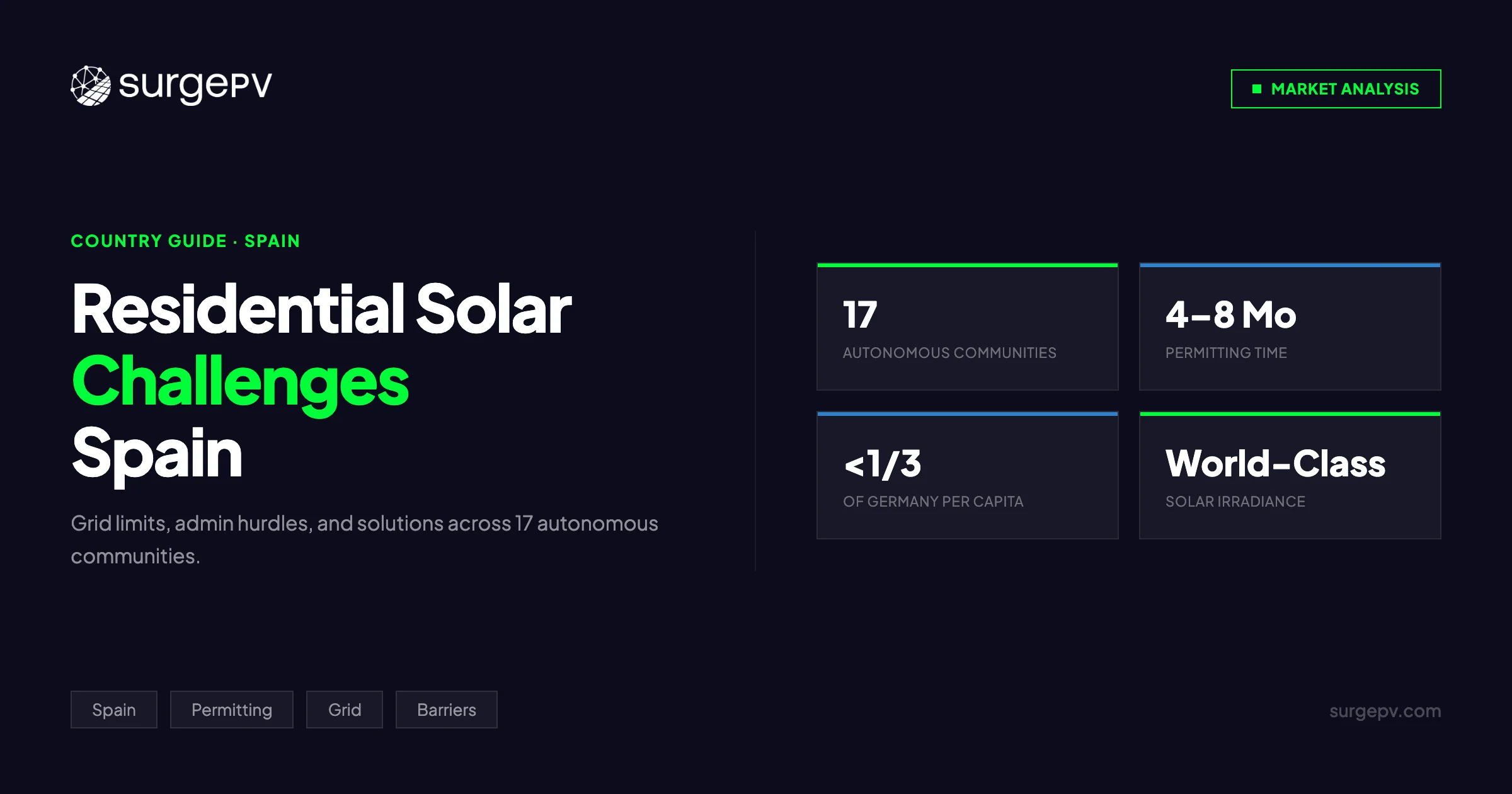
Spain absorbs more solar energy per square metre than almost any country in continental Europe. Seville and Almería average 300 days of sunshine a year. The levelised cost of utility-scale solar in the Iberian Peninsula has fallen below €30/MWh. And yet, Spain’s per-capita rooftop photovoltaic capacity is less than one-third of Germany’s — a country that receives roughly half the irradiance.
The gap is not a lack of sunlight. It is a stack of regulatory, administrative, technical, and financial barriers that dampen residential uptake at every step of the installation journey. For solar installers and their clients, understanding exactly where the friction originates — and how to navigate it — is the difference between a profitable, growing business and a pipeline full of stalled projects.
This guide maps every major challenge that residential solar faces in Spain in 2026, draws on the most current regulatory data, and explains the practical tools — including the right solar design software — that the best installers are using to move faster and convert more deals.
TL;DR — Spain Solar Challenges at a Glance
Spain’s residential solar market is held back by 17 different regional permit regimes, distributor grid-connection queues that can run 4–6 months, a Ley de Propiedad Horizontal that requires community votes in apartment blocks, a net-billing system that introduces ROI variability, and financing gaps for lower-income households. The good news: each barrier has a workaround, and the right design and proposal workflow eliminates the technical errors that make rejections more likely.
Key challenges covered in this article:
- Regional administrative complexity across Spain’s 17 Comunidades Autónomas
- Grid connection bottlenecks with Endesa, Iberdrola, and regional distributors
- Community property law (LPH) voting requirements for apartment buildings
- Autoconsumo colectivo and net-billing limitations under RD 244/2019
- VAT treatment and IBI tax exemption status by municipality
- Financing gaps and low-income household access
- Voltage rise and power quality issues in rural distribution networks
- How experienced installers navigate each barrier
- How purpose-built solar design software reduces design errors and permit rejections
Latest Updates: Spain Residential Solar Regulation 2026
The regulatory environment shifted considerably between 2019 and 2026. Here is the current state of play as of March 2026:
Royal Decree 244/2019 remains the core framework for self-consumption (autoconsumo), establishing both individual and collective modalities, defining compensation mechanisms, and setting administrative simplification thresholds. Systems under 15 kW on a single-family home with a single supply point continue to qualify for simplified notification rather than full project authorisation — in theory.
Royal Decree-Law 23/2020 introduced emergency measures to accelerate renewable deployment at industrial scale. Its downstream effects on residential permitting have been modest: municipalities still control building permits, and distributors still control grid connection timelines.
The 2023 PNIEC revision (Plan Nacional Integrado de Energía y Clima) raised the 2030 renewable electricity target to 81%. The government has signalled further simplification of residential permitting, but as of early 2026 the implementing regulations have not yet been approved at the CCAA level in most regions.
VAT reduction on solar equipment: The temporary reduction of VAT on solar panels from 21% to 10% (applied from April 2023) was extended through the end of 2025 and has now lapsed, returning to 21% as of January 2026. This has added roughly €800–€1,200 to the upfront cost of a standard 5–6 kWp residential system and dampened early-2026 demand in some regions.
Grid connection queue reforms: Red Eléctrica de España (REE) and MITECO published updated access and connection regulations in 2024 aimed at clearing the backlog at the transmission level. However, the residential bottleneck sits at the distribution level — managed by Endesa, Iberdrola, Naturgy, UFD, and E-Distribución — and those queues remain congested in urban and peri-urban areas.
Pro Tip
Check the REE transformer capacity portal (Consulta de Capacidad de Acceso) before scoping any residential project. The portal provides downloadable CSV data on available capacity at each substation node, allowing you to identify grid headroom constraints before committing to a system size that may face a connection refusal.
Administrative Permit Complexity: 17 Regions, 17 Rule Sets
Spain’s constitutional structure grants its 17 Comunidades Autónomas substantial legislative autonomy in energy and urban planning matters. In practice, this means a solar installer in Sevilla follows a materially different permitting process than one in Barcelona, Bilbao, or Palma de Mallorca.
The Three-Layer Permit Problem
Every residential solar installation in Spain must satisfy three overlapping regulatory layers simultaneously:
1. National framework (MITECO / IDAE): Sets the overarching rules — which systems qualify for simplified procedures, how compensation is calculated, what technical standards apply (UNE-206006, UNE-EN 62548, IEC 62109).
2. Regional (CCAA) authorisation: Each autonomous community has transposed the national framework through its own energy regulations. Castilla y León, for example, requires registration in its regional renewable energy registry before the system can be connected. Catalonia has its own declaració responsable process. The Basque Country (País Vasco) routes applications through its regional energy agency (EVE). Andalucía has implemented a delegated authorisation system through its Agencia Andaluza de la Energía.
3. Municipal building permit (licencia de obras): Most installations below 15 kW qualify for a comunicación previa (prior notification) rather than a full licencia, but many municipalities — particularly smaller ones without dedicated technical staff — still process these as if they were full projects, adding 4–8 weeks.
Documentation Variance by Region
The documentation requirements vary significantly across communities. A standard package might include:
- Technical memory (memoria técnica de diseño) with electrical calculations
- Site plan and roof layout (plano de situación y cubierta)
- CAD elevation drawings showing panel placement
- Single-line electrical schematic
- Inverter and panel data sheets (fichas técnicas)
- Structural load calculation or statement of no structural modification
- Certificado de instalador autorizado (IDAE registry number)
- Cédula de habitabilidad or equivalent occupancy certificate
- DNI/NIE of the property owner
Some communities additionally require:
- Environmental impact declaration (declaración de impacto ambiental) for systems above certain thresholds
- Heritage protection clearance (for historic zone properties)
- Condominium approval documentation (for shared rooftops)
The lack of a unified national portal for residential solar applications — something Italy’s GSE provides through its Gestore dei Servizi Energetici platform — means installers must maintain separate workflows for each region they operate in.
Key Takeaway
The most effective mitigation for administrative complexity is documentation standardisation. Installers who pre-build region-specific documentation templates — and use design software that auto-generates technical schematics, electrical calculations, and panel layout drawings — consistently report 3–4 week reductions in permitting timelines compared to those assembling files manually per project.
Fast-Track Is Not Always Fast
RD 244/2019 established that systems under 15 kW on a single-family home should benefit from a simplified administrative process — essentially a declaración responsable to the distributor, plus the prior notification to the municipality. However, “simplified” in the Spanish regulatory context does not mean “fast.”
The distributor (DSO) still has up to 30 days (extendable to 60 in some cases) to respond to a connection application. If the distributor requests corrections or additional documentation, the clock resets. In congested urban distribution networks — central Madrid, Barcelona’s eixample, coastal Valencia — first-time rejection rates for connection applications run at 15–25% due to technical deficiencies in the submitted files, most commonly undersized cable specifications, incorrect protection relay settings, or inverter models not on the distributor’s approved list.
This is precisely where accurate solar software pays its way: generating documentation that passes first-time technical review eliminates the single largest source of controllable delay in the Spanish permitting process.
Grid Connection Bottlenecks: The Distributor Queue
Spain’s electricity distribution network is dominated by five major distributors: Endesa (E-Distribución), Iberdrola (I-DE), Naturgy, UFD (Unión Fenosa Distribución), and Viesgo (now EDP Distribuição). Each operates its own technical standards, application portals, documentation requirements, and internal review timelines.
How the Connection Process Works
For a standard residential system under 15 kW, the connection process involves:
-
Pre-feasibility check: Installer checks the distributor’s capacity portal for available transformer headroom at the relevant substation. This step is informal but critical — proceeding without it risks a connection refusal weeks later.
-
Connection application (solicitud de conexión): Submitted to the distributor with full technical documentation. The distributor has 30 days to respond under RD 1183/2020, though extensions are common.
-
Technical conditions document (documento de condiciones técnicas): If the application passes review, the distributor issues this document specifying the exact connection point, protection requirements, metering configuration, and any reinforcement works required at the homeowner’s expense.
-
Works and commissioning: Installer completes works per the technical conditions. Distributor must attend for inspection and connection within 30 days of notification.
-
CUPS registration and metering activation: The distributor registers the installation against the CUPS (Código Unificado de Punto de Suministro), activates bidirectional metering, and enables the compensation mechanism.
In practice, end-to-end grid connection timelines of 3–5 months are typical for urban installations. Rural installations served by overhead MV lines can stretch to 6–8 months if the connection point requires distributor infrastructure upgrades.
The 11-Month Case
The live page for this article references one documented case of a 4.5 kWp system that waited 11 months for grid approval in a peri-urban area of Madrid. This is not an outlier — it reflects a systemic pattern in areas where distribution transformers are already operating near capacity and the distributor’s internal queue for residential connection inspections is long. The homeowner in that case was technically entitled to the simplified procedure but was routed through the full authorisation process by the local distributor office due to an ambiguity in the regional CCAA transposition rules.
Pro Tip
When scoping a project in Endesa or Iberdrola territory, always request the distributor’s technical conditions document before signing the installation contract. This step, which costs nothing but time, confirms that the grid connection is feasible at the proposed system size and that no costly reinforcement works are required at the client’s expense.
Distributor Variation: A Practical Comparison
| Distributor | Application Portal | Typical Response Time | Key Documentation Quirks |
|---|---|---|---|
| E-Distribución (Endesa) | Portal Instaladores | 30–45 days | Requires inverter on approved equipment list |
| I-DE (Iberdrola) | SICA portal | 35–60 days | Strict cable sizing verification; self-calculation tool available |
| Naturgy | Portal Autoconsumo | 30–50 days | Regional variation between Galicia and rest of network |
| UFD | SUIS portal | 40–70 days | Often requests additional structural reports |
| Viesgo/EDP | Direct submission | 45–80 days | Smallest network; longest average response times |
Community Property Law (LPH): The Apartment Block Barrier
Spain’s housing stock is distinctive in European terms: approximately 56% of the population lives in apartments (pisos en bloque). For the residential solar market, this creates a structural challenge that countries with predominantly detached housing — Germany, the Netherlands — simply do not face at the same scale.
How the Ley de Propiedad Horizontal Works
The Ley de Propiedad Horizontal (LPH) governs the rights and obligations of co-owners in buildings divided into individually owned units with shared common elements (comunidades de propietarios). The roof is almost always a common element, which means any modification — including solar panel installation — requires community approval.
The voting threshold for solar installations under the LPH was reformed by the Ley 10/2022, which implemented EU Directive 2018/2001 (the Renewable Energy Directive) into Spanish law. Under the current rules:
-
Individual apartment installations (e.g., a single owner installs panels on a rooftop terrace they have exclusive use rights to): Requires majority vote at a community meeting, with a simplified procedure if the installation is for one or several specific owners’ benefit and does not affect the building’s structure or communal systems.
-
Collective autoconsumo installation (panels shared across multiple units): Requires the approval of three-fifths (60%) of owners and participation quotas at a community meeting (junta de propietarios). If the meeting fails to achieve quorum, a second meeting can be called where decisions are made by a simple majority of those attending.
-
Structural modifications (penetrating the roof membrane, adding structural supports): May trigger higher thresholds and require a technical report from a qualified architect (técnico competente).
Practical Barriers
The legal threshold is one thing; the practical reality of community meetings is another. Key friction points:
Scheduling: Communities must give sufficient notice (minimum six days under LPH) for ordinary meetings. Extraordinary meetings can be called more quickly but require justification. In practice, a community may only meet twice a year — meaning a project can be delayed six months simply waiting for the right meeting.
Information gaps: Many property owners in comunidades de propietarios do not understand how collective autoconsumo works, how costs and savings would be allocated, or what the installation involves structurally. Installers who provide a clear, visual proposal — showing each unit’s projected savings, the payback period, and how the allocation mechanism works — consistently achieve higher approval rates.
President gatekeeping: The community president (presidente de la comunidad) has significant influence over what appears on the meeting agenda. An unsympathetic president can delay the vote or frame the proposal unfavourably.
Absentee owners: Buildings with a high proportion of rental properties or holiday flats often struggle to achieve meeting quorum. Absentee votes (delegación de voto) are legally valid but require advance organisation.
Key Takeaway
For apartment building projects, the permitting challenge is as much a communications challenge as a legal one. Installers who bring a professional proposal — with per-unit financial modelling, a clear allocation mechanism, and a visual system design — to the community meeting are far more likely to secure the votes needed. Solar proposal software that can generate building-level financial analyses and per-unit savings breakdowns is particularly valuable in this context.
Net Metering vs. Net Billing: The Autoconsumo Colectivo Limitation
Spain’s self-consumption compensation framework, established by RD 244/2019, uses a net-billing model rather than true net metering. Understanding this distinction is essential for setting realistic client expectations and accurate financial projections.
Net Billing vs. Net Metering: The Core Difference
Under net metering (compensación de energía), surplus electricity exported to the grid is credited on a kWh-for-kWh basis against energy consumed from the grid in a different period. One exported kWh cancels one imported kWh, regardless of when either transaction occurs.
Under net billing (compensación económica simplificada), exported surplus is credited at a monetary value — typically the hourly pool price (PVPC) or a contracted fixed rate — against the household’s electricity bill. One exported kWh is worth whatever the pool happens to be paying at that hour of export, which may be dramatically lower than the retail rate paid for imported energy.
This creates two problems for Spanish residential solar:
1. Hourly price volatility: Spain operates one of Europe’s most granular real-time electricity markets. The PVPC can fall to near zero or even negative during midday hours in spring and autumn — precisely when rooftop solar is exporting most. A system sized for a household’s annual consumption can achieve self-consumption rates of only 38–45% without battery storage, exporting a large proportion at low pool prices.
2. ROI unpredictability: Homeowners on variable PVPC contracts face a payback period that can vary by 2–3 years depending on market conditions. Those on fixed retail contracts (Plan Estable from Iberdrola, Tarifa Fija from Endesa, etc.) get a more predictable but typically lower compensation rate for exports.
Self-Consumption Rate Benchmarks
| Configuration | Typical Self-Consumption Rate | Impact on Payback |
|---|---|---|
| 4–5 kWp, no battery, south-facing | 38–45% | Longer (6.5–8.5 years) |
| 4–5 kWp + 5 kWh battery | 68–75% | Shorter (5.5–7 years) |
| System sized to consumption, EV charging | 55–65% | Variable |
| Collective autoconsumo, 6-unit building | 50–60% collective | Better per-unit economics |
Collective Autoconsumo Limitations
Autoconsumo colectivo — where a single rooftop installation serves multiple consumption points in the same building or nearby buildings — was introduced by RD 244/2019 to enable apartment-block solar. However, the framework has practical limitations:
-
Association coefficient: Each participating unit receives a fixed percentage of the shared generation based on an agreed allocation key (typically floor area or contracted power). Rebalancing this coefficient requires community agreement.
-
100-metre rule: Until 2022, collective autoconsumo was restricted to consumption points within 500 metres connected to the same low-voltage substation. A 2022 amendment extended this to “colectivos a través de red” allowing connections up to 2 km, but distributor implementation has been inconsistent.
-
Retailer coordination: Each participating household’s retailer must be informed and must update the billing configuration to reflect the compensation. If different units have different retailers, this coordination burden multiplies.
-
Minimum participation: Some distributors require a minimum number of participating units before they will process a collective application, effectively excluding small buildings of 3–4 units.
Use the generation and financial modelling tool to run accurate self-consumption rate projections under both fixed and variable compensation scenarios before presenting numbers to a client.
VAT, IBI, and Tax Incentives: The Current State
VAT on Solar Equipment (IVA)
The temporary reduced VAT rate of 10% on solar panels — introduced in April 2023 — expired on 31 December 2025. As of January 2026, solar PV panels are once again subject to the standard 21% VAT rate. This increase adds approximately:
- €630–€840 to a 3 kWp system (at €1,000/kWp before VAT)
- €1,050–€1,260 to a 5 kWp system
- €1,260–€1,680 to a 6 kWp system
Installation labour, which was already subject to the reduced 10% VAT rate for home renovations under a separate provision, remains at 10%. Inverters and mounting hardware are also subject to 21%.
Some installers have explored structuring contracts to maximise the 10% labour component, but tax authorities have scrutinised this practice. The safest approach is to apply the correct rates to each line item and ensure clients understand the full cost breakdown.
IBI Tax Exemption
The Impuesto sobre Bienes Inmuebles (IBI) is Spain’s property tax, set and administered at the municipal level. Under Article 74 of the Ley Reguladora de las Haciendas Locales, municipalities may — but are not required to — grant IBI exemptions or reductions for properties with solar installations.
The situation as of 2026:
- Barcelona: 50% IBI reduction for up to 3 years for residential solar installations. Application required at time of installation.
- Madrid: No general solar IBI reduction at city level, though individual districts (distritos) have occasionally offered bonuses.
- Seville: 50% reduction for 5 years for installations meeting minimum efficiency requirements.
- Valencia: 40% reduction for 3 years; expanded to 50% for low-income households.
- Smaller municipalities: Many have no formal programme, but some will negotiate on request.
The patchwork nature of IBI benefits — like so much else in the Spanish solar market — requires installers to maintain up-to-date municipal databases. Including the applicable IBI reduction (where it exists) in a client’s financial projection meaningfully improves the payback calculation and can tip a borderline decision.
IRPF Deduction for Energy Efficiency
The Deducción por obras de mejora de eficiencia energética — introduced by Real Decreto-ley 19/2021 and extended through subsequent legislation — allows homeowners to deduct between 20% and 60% of qualifying energy renovation costs from their IRPF (income tax), subject to a maximum deductible base of €5,000–€15,000 per year depending on the improvement achieved.
Solar PV installations can qualify if they are accompanied by an official energy performance certificate (certificado de eficiencia energética) issued before and after the works, demonstrating an improvement in the property’s energy rating. The pre-installation energy certificate is an often-overlooked documentation requirement that must be planned ahead of the installation date, as obtaining it takes 2–4 weeks.
Pro Tip
Always order the pre-installation energy certificate at the same time as submitting the permit application. Clients who miss the pre-installation certificate lose access to the IRPF deduction entirely, which can represent €1,500–€4,000 in lost tax savings on a typical residential system.
Financing Challenges for Low-Income Households
Spain’s residential solar financing market is less developed than Germany’s or the Netherlands’. The structural reasons are several: a banking system that remains cautious about unsecured consumer energy loans; a high proportion of rental housing where investment decisions are split between landlord and tenant; and a lack of national on-bill financing mechanisms of the type that have accelerated adoption in the UK and Ireland.
Available Financing Mechanisms
ICO Green Loans (Línea ICO Empresas y Emprendedores — Eficiencia Energética): The Instituto de Crédito Oficial offers credit lines through participating banks for energy efficiency and renewable energy investments. Terms in early 2026: loans up to €12.5 million (much higher than needed for residential), interest rates typically 3.5–5.5% fixed, terms of 5–20 years, with a 2-year grace period option. The practical problem: ICO loans are channelled through commercial banks, which apply their own credit risk criteria. Households with variable income, part-time employment, or limited credit history are routinely rejected.
MOVES III (for EV, but instructive): Spain’s successful MOVES III subsidy programme for electric vehicles demonstrated that a combination of direct grants and low-interest loans can dramatically accelerate adoption. A MOVES-equivalent programme specifically for residential solar has been repeatedly discussed but not implemented at the national level as of early 2026.
Regional grants: Several autonomous communities offer direct grants for residential solar:
- Catalonia: Subvencions per a instal·lacions d’autoconsum — typically 20–40% of eligible costs, subject to annual budget caps
- Andalucía: Programa de Incentivos — up to 45% for self-consumption with storage
- País Vasco: EVE grants — up to 35% for residential installations
- Comunitat Valenciana: Programa GES — varies annually
The limitation of regional grants is their unpredictability: budget caps are reached early in the year in popular programmes, and annual allocations fluctuate with regional government priorities.
Community energy financing (financiación colectiva): Crowdfunding models — exemplified by platforms like EnergoAcció and Goteo — allow apartment communities to raise installation capital collectively. This is nascent but growing, particularly in urban cooperatives and eco-community buildings.
Solar lease and PPA models: Power purchase agreements (PPAs) and solar lease models — where a third party owns and operates the system, charging the homeowner only for energy consumed — are technically legal in Spain but have not scaled to the mass market. Regulatory ambiguity around who bears responsibility for grid connection, insurance, and permit compliance in a third-party-ownership model has deterred most installers from offering these structures.
The Renter Gap
Perhaps the most structurally underserved segment is the rental market. Spain has a large rental sector — approximately 24% of households rent, rising to over 30% in major cities — but the regulatory framework does not provide clear mechanisms for landlords to invest in solar and pass the benefit to tenants through reduced bills, or for tenants to invest in installations they do not own.
The European Energy Efficiency Directive (EED) revision and the parallel Buildings Directive (EPBD) recast are pushing member states toward solutions — including the concept of “split incentive” tools — but Spain has not yet transposed these provisions in a way that creates a workable landlord-tenant solar investment mechanism.
Technical Challenges: Voltage Rise in Rural Distribution Grids
Urban and suburban solar installers deal primarily with administrative and grid-connection queue challenges. Rural installers face an additional layer: the physical limitations of Spain’s rural distribution infrastructure.
Why Voltage Rise Happens
When a rooftop solar system exports surplus generation to the grid, it pushes current back through the distribution transformer and low-voltage lines toward other connected loads. On a well-dimensioned urban distribution network serving many consumers, this surplus is absorbed without difficulty. On a rural feeder line serving 10–20 homes over several kilometres of overhead aluminium conductor, the same export can cause the local voltage to rise above EN 50160 limits (nominal 230V ±10%, with 95% of 10-minute averages within ±10%).
When voltage at the inverter’s AC terminals exceeds the upper limit (typically 253V for a 230V nominal system), the inverter is required by IEC 62109 and the distributor’s technical conditions to curtail output or disconnect. This automatic curtailment reduces the system’s actual generation and, in severe cases, causes the inverter to trip multiple times per day.
Affected Regions
Voltage rise is most prevalent in:
- Interior Castilla y León and Castilla-La Mancha: Long rural feeder lines, sparse consumption, low transformer saturation
- Extremadura: High irradiance driving strong lunchtime generation coinciding with minimum rural load (agricultural load peaks in morning)
- Aragón and La Rioja rural areas: Mixed agricultural-residential feeders with voltage profiles that vary seasonally
- Galicia: Relatively low irradiance mitigates the problem somewhat, but old overhead LV infrastructure in rural areas creates occasional issues
Technical Solutions
Export limitation (limitación de inyección a red): The distributor’s technical conditions document may require zero-export or limited-export configuration. A zero-export inverter or energy management system (EMS) monitors grid export in real time and curtails inverter output to prevent any surplus from flowing backward. This resolves voltage rise but can significantly reduce the system’s financial return — eliminating the compensation mechanism entirely.
Reactive power control: Some modern string inverters can provide reactive power compensation (Q regulation) to manage voltage locally. This requires the inverter to operate at a non-unity power factor, which reduces active power output marginally but can prevent voltage exceedances without requiring hard export limits.
Battery storage as buffer: Adding battery storage allows surplus midday generation to be stored rather than exported, effectively resolving the voltage rise issue while preserving the energy and maximising self-consumption. The economic case for batteries is strongest in rural areas where voltage rise would otherwise require export limitation.
Distributor-funded grid reinforcement: Where voltage rise is caused by systematically inadequate infrastructure rather than oversized individual systems, the distributor is technically responsible for reinforcement. In practice, securing distributor commitment to infrastructure upgrades is slow and uncertain. Installing within the grid’s current capacity — using accurate modelling to size the system at a level that does not cause voltage problems — is the more reliable near-term solution.
Key Takeaway
In rural Spain, system sizing must account for the local grid’s voltage characteristics, not just the household’s consumption profile. A system sized purely for annual energy balance may be technically non-compliant if it causes voltage exceedances at the inverter’s AC connection point. Accurate simulation software that models hourly export profiles against the local grid’s voltage sensitivity is essential for rural project design.
How Installers Navigate the Challenges
Spain’s most effective residential solar installers have developed systematic approaches to each of the barriers described above. The common thread is preparation, standardisation, and technology.
Regional Documentation Libraries
Leading installer businesses maintain a documentation library organised by autonomous community, with template technical memories, pre-formatted electrical schematics, and region-specific checklist matrices. When a new project comes in from a region they regularly serve, the documentation package is assembled in hours rather than days. This approach requires initial investment but pays back across every project.
Distributor Pre-Coordination
Rather than submitting a connection application and waiting for a response, experienced installers proactively contact the distributor’s technical office before submission to clarify any local requirements, confirm the preferred inverter list, and establish a point of contact for the review. This informal pre-coordination — particularly with smaller district offices — can significantly reduce the probability of a first-time rejection.
Community Presentation Service
For apartment block projects, the best installers offer a structured community presentation service: attending the junta de propietarios meeting, presenting a professional proposal with per-unit financial modelling, and answering technical questions directly. This service — often provided at cost or as part of the installation fee — materially increases vote approval rates and positions the installer as a trusted expert rather than a vendor.
Stacking Incentives
A well-structured residential solar proposal in Spain in 2026 should stack every available financial benefit:
- Available regional grants (submitted before installation)
- IRPF energy efficiency deduction (requires pre- and post-installation energy certificates)
- IBI reduction (applied for after installation)
- ICO loan or bank green loan (pre-approved before installation)
- PVPC or fixed compensation from the retailer
Stacking these correctly — and presenting the net cost and net payback accurately — is a significant differentiator in a competitive installer market. Use solar proposal software that can incorporate all these elements into a professional client-facing document that answers the questions a homeowner and their bank will ask.
Stop Losing Projects to Permit Rejections
SurgePV generates technically precise schematics, accurate energy yield calculations, and professional proposals — everything Spanish distributors and municipalities need to approve your projects first time.
Book a DemoNo commitment required · 20 minutes · Live project walkthrough
How Software Reduces Design Errors and Permit Rejections
The connection between design software quality and permit approval rates is direct and measurable. Most first-time connection application rejections in Spain cite one of three categories of technical deficiency:
-
Cable sizing errors: The proposed cable cross-sections do not meet the voltage drop and current carrying capacity requirements specified in the distributor’s technical conditions or the Reglamento Electrotécnico de Baja Tensión (REBT).
-
Protection relay mismatch: The proposed protection configuration does not meet the distributor’s specific requirements for anti-islanding protection, over/under-voltage thresholds, and reconnection delay timings.
-
Documentation incompleteness: Missing data sheets, incorrect CUPS reference, missing structural declaration, or absent certification numbers.
Categories 1 and 2 are design errors. Category 3 is a process error. Both are preventable.
What Good Solar Design Software Does
Purpose-built solar design software for the Spanish market should:
Generate IEC/UNE-compliant electrical calculations automatically, using entered system parameters (inverter model, module count, cable route lengths, installation method) to calculate voltage drop, short-circuit current, and protection coordination — producing output that matches what distributors expect to see.
Maintain updated inverter and module databases reflecting each major distributor’s approved equipment lists, flagging if a proposed inverter model is not on Iberdrola or Endesa’s list before the application is submitted.
Produce bilingual documentation: Many project documents in Spain must be submitted in both Spanish (Castilian) and the relevant co-official language (Catalan, Basque, Galician, Valencian). Software that generates documentation templates in the correct format for each region eliminates a common source of rejection in bilingual communities.
Model self-consumption rates accurately using hourly TMY (typical meteorological year) data for the installation location, rather than simplified annual averages. This matters for financial projections: a system in Murcia has a different self-consumption profile than the same-sized system in Bilbao, because the irradiance curve, the household load pattern, and the pool price correlation all differ.
Integrate financial modelling covering all available compensation mechanisms, tax incentives, grant amounts, and financing costs — producing a single, defensible number for the client’s payback period. For the generation and financial tool, accurate location-specific yield data is the foundation.
The First-Time Approval Rate Advantage
Installers using professional solar design software consistently report higher first-time approval rates from distributors — in the range of 75–85% versus industry averages of 55–70%. Across a portfolio of 50–100 projects per year, this translates to:
- 15–30 fewer resubmissions per year
- 2–4 weeks saved per resubmission
- 750–2,000 hours of saved engineering time annually
- Faster cash conversion cycles (projects close and get paid sooner)
The software also creates a professional impression that matters in a market where homeowners are making a significant financial decision and want to trust the installer’s technical competence.
Future Simplification: What the Regulations May Bring
The Spanish government has signalled a desire to further simplify residential solar permitting. The directions most likely to materialise over 2026–2028:
National Digital Permitting Portal
A unified national portal for small-scale self-consumption applications — similar to France’s Espace Pro on the network operator side, or Italy’s GSE portal — has been under discussion since 2022. A working group within MITECO proposed a framework in 2024 that would allow installers to submit permit applications, distributor connection requests, and registry notifications through a single digital interface. Implementation depends on CCAA cooperation and has been slow to progress, but political pressure from the solar industry and EU climate commitments makes some form of simplification likely by 2027.
Faster Distributor Response Mandates
The EU’s revised Renewable Energy Directive (RED III, transposed by 2025) requires member states to establish specific timelines for grid connection approvals for self-consumption installations. Spain’s transposing legislation (expected in 2026) is likely to set a maximum of 15 working days for installations under 10.8 kW — a significant tightening from current practice. Distributors may contest this timeline, but the direction of travel is toward faster approvals.
Collective Autoconsumo Expansion
Regulatory changes to enable neighbourhood-level collective self-consumption — allowing apartment buildings in the same street or block to share a single generation installation via the grid — are in draft form. The current 2 km limit is expected to be extended, and the distributor coordination burden is expected to be simplified, making collective autoconsumo more commercially viable.
Community Energy Legislation
Spain is transposing the EU’s Energy Communities directive, which will create a formal legal framework for citizen energy communities (comunidades de energía renovable). This framework will clarify property rights, liability, and billing arrangements for collective energy projects, removing some of the legal uncertainty that currently deters apartment-block installations.
IBI and IRPF Alignment
There is political pressure to make IBI solar bonuses mandatory rather than optional at the municipal level, and to extend the IRPF energy efficiency deduction permanently rather than through temporary legislation. Neither change has been legislated as of March 2026, but both have cross-party support.
For Spanish solar installers, the trajectory is positive: the regulatory direction of travel favours simplification, and the businesses that build strong processes now — using the right tools and documentation systems — will be best positioned to scale when the barriers fall.
To understand how adoption rates are responding to these challenges and opportunities, see our analysis of residential solar adoption in Spain and the specifics of Spain’s net metering benefits. For a broader European context, our guide to European solar incentives covers how Spain’s framework compares to Germany, Italy, France, and the Netherlands.
Frequently Asked Questions
What are the main challenges for residential solar in Spain?
The primary challenges are administrative complexity across Spain’s 17 autonomous communities, which each impose their own permitting requirements and timelines; grid connection bottlenecks managed by Endesa, Iberdrola, and regional distributors; the Ley de Propiedad Horizontal (LPH) voting requirements that can block apartment rooftop installations; and a net-billing model that creates ROI uncertainty compared to a fixed net-metering scheme. Financing gaps for low-income households and voltage rise problems in rural distribution grids add further friction for many homeowners.
How long does it take to get solar permission in Spain?
Permitting timelines vary significantly by autonomous community. The national framework technically allows simplified notification procedures for systems under 15 kW, but coordination with the distributor (DSO) for grid connection can add 2–6 months on top of municipal approvals. In practice, end-to-end timelines of 4–8 months are common for a standard residential system, and installations in historic districts or UNESCO-protected zones can stretch to 12 months or more. Pre-compiling all documentation — technical memory, electrical schematics, CAD layouts, and inverter data sheets — before submitting can shave 3–4 weeks off the total wait.
What is the LPH and how does it affect apartment solar in Spain?
The Ley de Propiedad Horizontal governs co-ownership rights in Spanish apartment buildings. Because rooftops are typically common property, any solar installation requires a community vote — typically a three-fifths (60%) majority for collective autoconsumo systems. In practice, scheduling the vote, securing quorum, and achieving the required majority can delay a project by 6–12 months in buildings where absentee owners are common or where the community president is unsympathetic to the project.
Is net metering available in Spain?
Spain uses a net-billing (compensación económica simplificada) model rather than true net metering. Surplus electricity exported to the grid is compensated at the hourly pool price or a contracted fixed rate — not credited on a kWh-for-kWh basis. This means self-consumption rates of 38–45% without battery storage, and payback period variability of 2–3 years depending on market conditions. Battery storage, sized correctly, can improve self-consumption to 68–75% and materially shorten the payback period.
Are there VAT reductions for solar panels in Spain in 2026?
The temporary 10% VAT rate on solar panels expired on 31 December 2025. As of January 2026, solar PV panels are subject to the standard 21% VAT. Installation labour remains at 10% under the home renovation reduced rate. The return to 21% adds approximately €800–€1,200 to the upfront cost of a standard 5–6 kWp residential system compared to 2025.
How can solar design software reduce permit rejections in Spain?
Most first-time application rejections in Spain cite cable sizing errors, protection relay mismatches, or incomplete documentation — all of which are preventable with the right tools. Professional solar design software generates IEC/UNE-compliant electrical calculations automatically, maintains updated approved equipment lists for each major distributor, and produces region-specific documentation templates. Installers using dedicated solar software consistently report first-time approval rates of 75–85%, compared to an industry average of 55–70%, saving weeks per project and significantly improving cash flow.