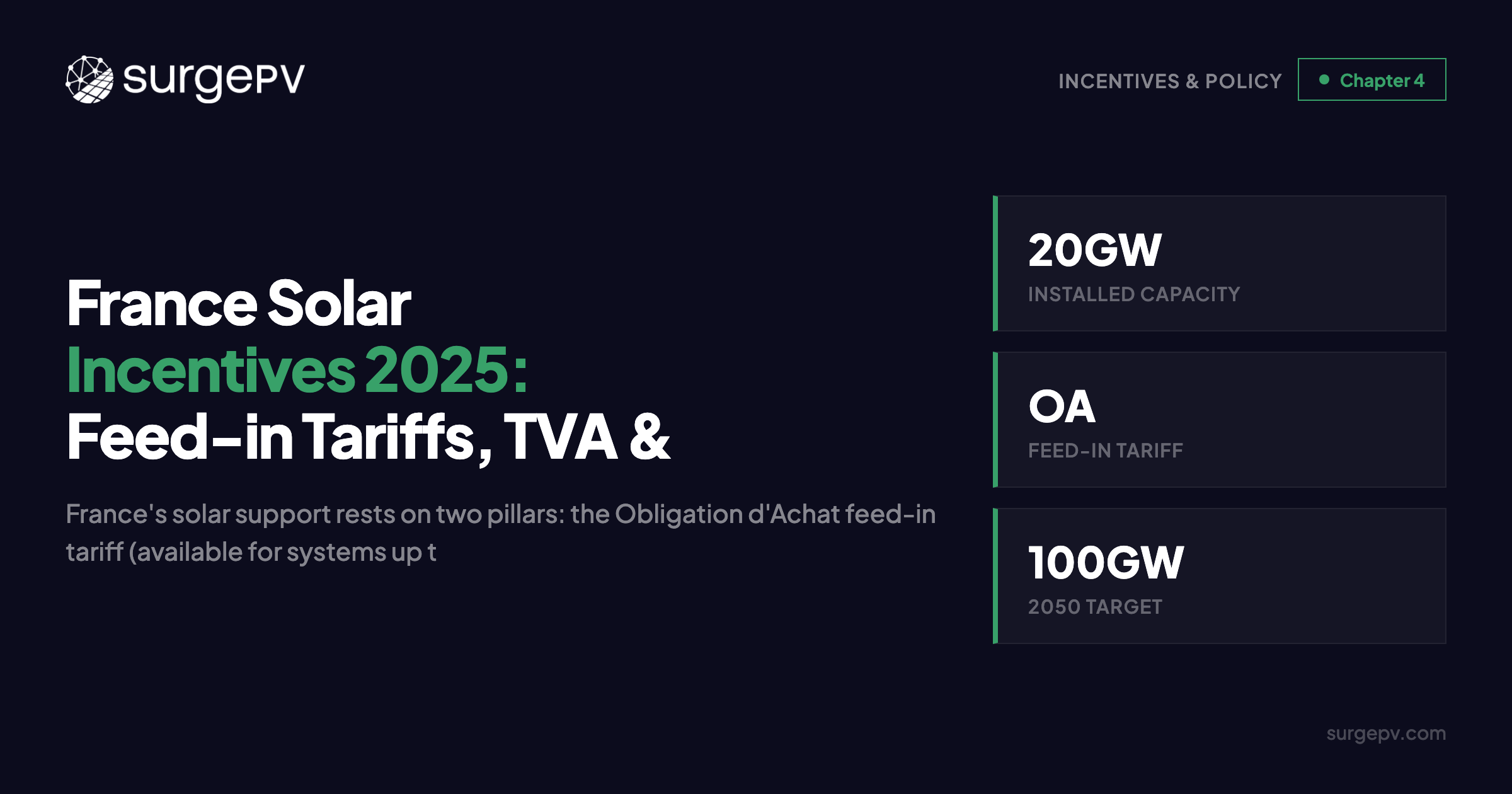
France's solar market has grown steadily since 2010, driven by a combination of feed-in tariffs, reduced VAT, and zero-interest loans. In 2026, the framework remains attractive: a 20-year guaranteed purchase contract for systems up to 500 kWp, a 5.5% TVA rate for small residential systems, and a structured autoconsommation regime that rewards self-consumption.
This chapter covers every incentive available to solar installers and homeowners in France — what they are, the exact rates, who qualifies, and how to apply. If you design or sell solar in France, use the generation and financial tool to model OA income and payback periods for each project.
What you'll learn in this chapter
- The Obligation d'Achat (OA) feed-in tariff: rates, eligibility, and contract structure
- Full injection vs autoconsommation avec injection — which model pays better
- TVA réduite at 5.5% and 10% for residential installations
- Éco-PTZ zero-interest loans and how to combine them
- MaPrimeRénov' eligibility in 2026
- CONSUEL certification and the Enedis grid connection timeline
- How to maximize total incentive value on a typical 6 kWc system
France Solar Incentives: Quick Reference (2026)
| Program | Type | Current Rate | Who Qualifies | How to Apply |
|---|---|---|---|---|
| Obligation d'Achat (OA) — ≤36 kWp | Feed-in tariff | ~12–16 ct/kWh (varies quarterly) | New residential and small commercial | EDF OA via installer |
| Obligation d'Achat — 36–500 kWp | Feed-in tariff | ~8–10 ct/kWh | Commercial, community | Tender with EDF OA |
| Autoconsommation avec injection | Net surplus + tariff | Surplus at OA rate | Any grid-tied system | CONSUEL + Enedis |
| TVA réduite 5.5% | Reduced VAT | 5.5% instead of 20% | Systems ≤3 kWc on existing buildings | Automatic at invoice |
| TVA 10% | Reduced VAT | 10% for 3–9 kWc | On existing buildings | Automatic at invoice |
| Éco-PTZ | Zero-interest loan | 0% up to €30,000 | Homeowners for energy renovation | Via partner bank |
Latest Updates: France Solar 2025
| Date | Update |
|---|---|
| Q1 2025 | OA tariff rates updated quarterly — current ≤36 kWp rate ~14.5 ct/kWh (confirm at CRE.fr for current quarter) |
| 2024 | Simplified procedure introduced for ≤3 kWc systems (Procédure Simplifiée d'Autoconsommation) |
| 2024 | New SolarAid France program for low-income households launched via ANAH |
| 2025 | REPowerEU French implementation — Enedis committed to faster grid connection timelines |
The Obligation d'Achat: France's Feed-in Tariff
The Obligation d'Achat (OA) is France's legal obligation requiring energy buyers — EDF OA or local distributors — to purchase solar electricity at government-set prices. It was first introduced in 2000 and restructured multiple times since, but the core mechanism remains: a guaranteed purchase contract at a fixed tariff, locked in at commissioning, for a 20-year period.
Key features:
- Contract duration: 20 years
- Rate locked at commissioning date
- Quarterly rate revisions — new installations get the rate in force at commissioning
- For systems up to 100 kWp (standard residential/small commercial): rates set by arrêté tarifaire
- For 100 kWp–500 kWp: simplified tender (appel d'offres simplifié)
- Above 500 kWp: full competitive tender
2025 rate structure for ≤36 kWp residential systems (check CRE.fr for current quarter):
| Orientation | Rate (full injection model) |
|---|---|
| South, 30–35° | ~14–16 ct/kWh |
| East/West, 30° | ~12–14 ct/kWh |
| Flat roof | ~13–15 ct/kWh |
| BIPV/integrated | Premium +10–15% |
Two Business Models
French installers need to present two options to residential customers:
- Full injection (injection totale): Export all generation, buy back at market rate. Best for unused daytime households — both partners working outside, no EV charging, minimal daytime loads.
- Partial injection (autoconsommation avec injection): Consume what you generate, export surplus at OA rate. Best for households with daytime consumption, working from home, or EV charging.
Key Takeaway
For most residential homeowners in 2026, autoconsommation avec injection is the better model. Self-consumption saves €0.25–0.30/kWh in avoided grid electricity cost, while export earns ~€0.14–0.16/kWh. Self-consumption is worth almost twice as much per kilowatt-hour.
How to Apply for an OA Contract
- Choose a QUALIFELEC-certified or equivalent RGE installer
- Installer submits a connection request (Convention de Raccordement) to Enedis
- Installer files the OA application to EDF OA or local distributor
- Receive the Contrat d'Obligation d'Achat (typically 4–8 weeks after commissioning)
- CONSUEL inspection and certificate (mandatory before grid connection)
Autoconsommation Framework
Since 2017, France has had a clear legal framework for autoconsommation (self-consumption). The key variant for most installers is autoconsommation individuelle — for a single property — as opposed to autoconsommation collective (shared solar for multiple tenants or properties).
Autoconsommation Individuelle Process
- Install an RGE/QUALIFELEC-certified system
- Get CONSUEL certificate (electrical safety compliance)
- Sign Contrat de Raccordement with Enedis
- Notify Enedis of autoconsommation mode
- Enedis installs bidirectional smart meter (Linky)
- Surplus exported at OA tariff or sold at spot price
Autoconsommation Collective
Autoconsommation collective (since 2017) allows multiple properties in the same building or nearby — served by the same HTA/HTB substation — to share solar output. A management entity (typically an SCI or cooperative) distributes generation according to consumption keys agreed in advance. This model is growing for apartment buildings, SME clusters, and industrial parks.
Pro Tip
When designing for autoconsommation collective projects, use solar design software that can model generation profiles by hour for each consumption point. The distribution key is only optimized when you have accurate hourly data for each participant.
Reduced VAT (TVA Réduite)
France applies reduced VAT rates to solar installations on existing residential buildings. This is automatic — no application required — but only when the installer invoices correctly.
| System size | TVA rate | Condition |
|---|---|---|
| ≤3 kWc | 5.5% | On buildings more than 2 years old |
| 3–9 kWc | 10% | On buildings more than 2 years old |
| >9 kWc | 20% (standard) | All buildings |
Practical impact: A 6 kWc system costing €9,000 ex-VAT: at 10% TVA you pay €9,900. At 20% standard rate you'd pay €10,800. Saving: €900.
For a smaller ≤3 kWc system (e.g., €4,500 ex-VAT): TVA at 5.5% = €247.50 instead of €900 at 20%, saving €652.50.
Installers must apply the correct TVA rate. If they invoice at 20% when 10% or 5.5% applies, you can request a corrected invoice. Customers should check this before signing.
Éco-PTZ: Zero-Interest Loans
The Éco-Prêt à Taux Zéro (Éco-PTZ) lets French homeowners borrow up to €30,000 at 0% interest for energy renovation, including solar PV when combined with other measures.
Key conditions:
- Property must be a primary residence built before 2021
- Loan combined with at least one other energy renovation measure (insulation, heat pump, etc.)
- Installer must hold RGE (Reconnu Garant de l'Environnement) certification
- Maximum: €30,000 at 0% interest, up to 20 years repayment
How to apply: Via any Éco-PTZ partner bank (BNP Paribas, Société Générale, Crédit Agricole, etc.). Submit RGE installer quotes and energy audit. The bank submits to the state guarantor. Approval typically takes 3–6 weeks.
Key Takeaway
The Éco-PTZ works best for homeowners doing a broader renovation — solar + insulation, or solar + heat pump. If the customer is installing solar only, the Éco-PTZ does not apply under the standard "par geste" route. Always check current eligibility rules at service-public.fr before quoting.
MaPrimeRénov' and Solar
MaPrimeRénov' is France's primary home improvement grant program (replacing CITE since 2021). In 2026, solar PV falls into two different tracks:
- Parcours accompagné (full renovation with a Mon Accompagnateur Rénov' advisor): Solar PV is eligible as part of a broader renovation package. This is the route for substantial multi-measure projects.
- Parcours par geste (individual measures): Solar PV is not directly eligible as a standalone measure under standard MaPrimeRénov' in 2026.
Solar thermal water heaters remain eligible for individual-measure grants. For photovoltaic systems, the practical position in 2026 is: if the customer is doing a comprehensive renovation, MaPrimeRénov' can contribute. Solar-only installations are not eligible for direct grants through this program — the OA tariff and TVA reduction are the primary support mechanisms instead.
Model French Solar Economics With OA Tariffs
SurgePV calculates OA feed-in income, autoconsommation savings, and Éco-PTZ financing together in a single dashboard.
Book Free DemoNo commitment required · 20 minutes · Live project walkthrough
CONSUEL: The Mandatory Safety Certificate
Before Enedis can connect a solar system to the grid, the installation must pass a CONSUEL inspection confirming compliance with NFC 15-100 electrical safety standards. CONSUEL is non-negotiable — Enedis will not connect without it.
Process:
- Installer completes wiring, connects inverter, installs protective devices
- Installer or owner requests CONSUEL inspection (online at consuel.com, ~€70)
- CONSUEL inspector visits (typically within 2–3 weeks)
- If compliant: CONSUEL certificate issued (same day or within 48 hours)
- Submit certificate to Enedis with grid connection request
Budget 3–5 weeks from installation completion to grid connection when factoring in CONSUEL scheduling. It is the critical path item for France grid connection.
Grid Connection Timeline
France's grid connection process through Enedis is structured but slower than Germany or the Netherlands. For solar installers, this timeline determines when customers first receive OA payments.
| Step | Body | Typical time |
|---|---|---|
| Connection request (Demande de Raccordement) | Enedis | 15 days to acknowledge |
| Technical study + quote | Enedis | 2–4 weeks |
| Accept quote and pay connection fees | You / installer | 1–2 days |
| Physical connection work | Enedis | 4–8 weeks |
| Smart meter installation | Enedis / Linky | Same day as connection |
| OA contract activation | EDF OA | 1–2 weeks post-connection |
Total: expect 3–4 months from installation completion to receiving the first OA payment. Set customer expectations accordingly — French homeowners often underestimate this timeline.
The shadow analysis and system design stages happen before installation, but use the full timeline model in your solar proposal software so customers see a realistic switch-on date from day one.
How to Maximize France's Solar Incentives
For a typical residential system (6 kWc, south-facing, existing home built before 2021):
- Choose autoconsommation avec injection — maximizes self-consumption value (€0.25+/kWh) plus OA export income. Full injection only makes sense for properties empty during the day.
- Combine with Éco-PTZ if doing other renovations — free financing worth thousands over the repayment period.
- Confirm 10% TVA applies — check before signing. On a €9,000 system, this saves €900 versus the standard rate.
- Certify the installer as RGE — required for Éco-PTZ and some regional or municipal grants.
- File CONSUEL early — request the inspection as soon as the wiring is done. It is the bottleneck that delays grid connection.
Total incentive value on a €9,000 system (ex-TVA):
| Incentive | Estimated value |
|---|---|
| 10% TVA saving vs 20% | €900 |
| OA feed-in income (20 yrs, partial injection) | ~€3,000–4,000 cumulative |
| Éco-PTZ interest saving (if applicable) | €500–1,500 |
| Estimated total subsidy equivalent | €4,500–6,400 |
Pro Tip
When building France proposals in solar software, break out OA income, self-consumption savings, and TVA reduction as separate line items. French customers respond better to seeing each component individually than to a single payback figure.
Frequently Asked Questions
Is the full injection or partial injection (autoconsommation) better for France?
For most homeowners with daytime electricity use, autoconsommation avec injection is better. The self-consumption value (€0.25–0.30/kWh avoided) exceeds the OA export tariff (~€0.14–0.16/kWh). Only households absent all day — both partners working outside, no EV charging — may prefer full injection.
How do OA tariff rates change over time?
Rates are set quarterly by the Ministry of Energy based on national solar capacity additions. As more solar is installed, rates trend downward. The rate you receive is locked at commissioning — so earlier installations on higher rate tranches continue to receive those rates for the full 20-year contract. This creates a real incentive to commission as early as possible.
Can I sell my OA contract if I sell my house?
OA contracts attach to the installation, not to the person. When the property is sold, the new owner inherits the remaining contract at the same rate. For homes with recently commissioned systems on favorable tariff tranches, this can be a genuine selling point worth highlighting in any property listing.
What is the difference between CONSUEL and a CERFA declaration?
CONSUEL is an independent electrical safety inspection required for all grid-connected solar systems. CERFA is a form number used for various administrative declarations — for solar, the relevant CERFA is the Déclaration Préalable de Travaux (an urban planning declaration not always required for small roof-mounted systems). They are separate requirements covering different aspects of the approval process.
Design French Solar Projects With Accurate OA Modeling
SurgePV's financial tool models OA feed-in income by quarter, autoconsommation savings, and payback period — all in one proposal.
Book Free DemoNo credit card · Full access · Unlimited projects
About the Contributors

CEO & Co-Founder · SurgePV
Keyur Rakholiya is CEO & Co-Founder of SurgePV and Founder of Heaven Green Energy Limited, where he has delivered over 1 GW of solar projects across commercial, utility, and rooftop sectors in India. With 10+ years in the solar industry, he has managed 800+ project deliveries, evaluated 20+ solar design platforms firsthand, and led engineering teams of 50+ people.