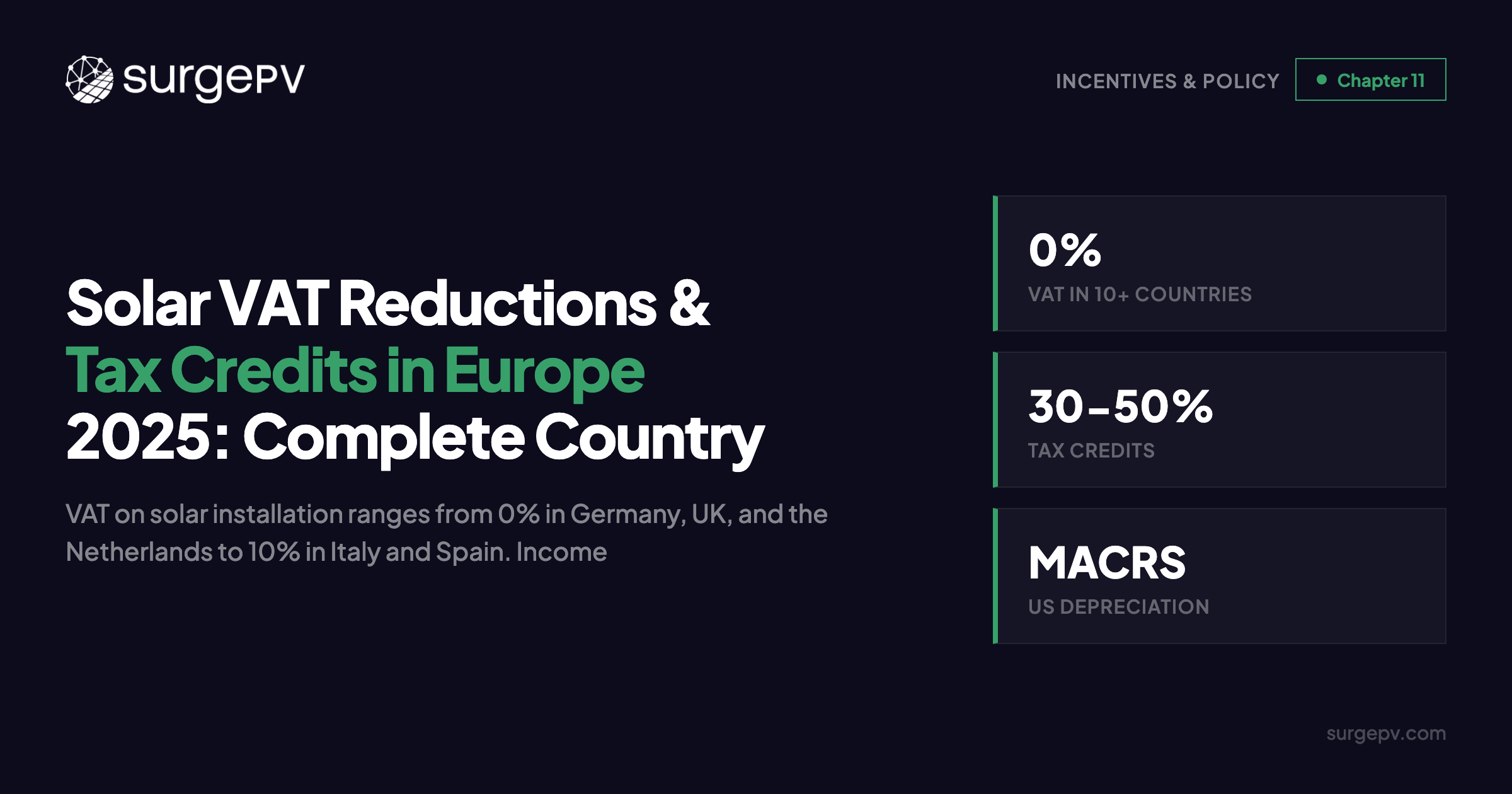
Tax treatment of solar is where most installers leave money on the table. A customer asking only about the feed-in tariff may be unaware they're also entitled to zero VAT, an income tax deduction spread over 10 years, and a property tax break from their municipality. Each one compounds the financial case. This chapter covers every major tax benefit — VAT, income tax, and property tax — by country.
What You'll Learn in This Chapter
- VAT rates on solar installation across all major European markets
- Which countries offer income tax deductions and how to calculate their value
- Property tax exemptions and municipal benefits
- Business tax incentives: full expensing, depreciation, and VAT recovery
- How to stack multiple tax benefits on a single installation
Solar Tax Incentives: Country Summary (2026)
| Country | VAT on Solar | Income Tax Deduction | Property Tax | Business Allowances |
|---|---|---|---|---|
| Germany | 0% (since Jan 2023) | None (income tax exempt on FiT ≤30 kWp) | Varies by municipality | Immediate depreciation (§7g EStG) |
| UK | 0% (since Apr 2022) | None for residential | None standard | Full expensing, AIA |
| Netherlands | 0% BTW (since Jan 2023) | None for residential | None | Normal depreciation |
| France | 5.5% (≤3 kWc), 10% (3–9 kWc), 20% (>9 kWc) | None (CITE abolished) | None national | Normal depreciation |
| Italy | 10% (existing buildings) | 50% Ecobonus (10 yrs) | None national | 110/70% Superbonus for qualifying |
| Spain | 10% IVA (residential installation) | 15–30% IRPF (region-dependent) | IBI deduction (municipality-dependent) | Normal depreciation |
| Belgium | 6% BTW (buildings >10 yrs) | None federal | None | Normal depreciation |
| Poland | 8% VAT (residential) | None standard | None | Accelerated depreciation |
VAT Rates: The Biggest Immediate Tax Saving
VAT (called TVA in France, BTW in Netherlands/Belgium, IVA in Spain, USt in Germany) is the most universal solar tax benefit — it applies at point of sale regardless of income or tax situation.
Countries with Zero VAT (0%)
Germany — 0% since 1 January 2023: Applies to solar panels, inverters, batteries, mounting systems, and installation labor for residential systems up to 30 kWp. One of the most comprehensive zero-rate implementations in Europe.
- Saving on €10,000 system: €0 vs €1,900 (previous 19% rate)
- Saving vs standard 19%: €1,900
United Kingdom — 0% since 1 April 2022: Applies to all energy-saving measures including solar PV, solar thermal, insulation, and heat pumps on residential properties. No size restriction.
- Saving on £9,000 system: £0 vs £450 (previous 5% rate)
- Saving vs standard 20%: £1,800
Netherlands — 0% BTW since 1 January 2023: Applies to solar panels and installation on residential buildings. No minimum age requirement.
- Saving on €7,000 system: €0 vs €1,470 (previous 21% rate)
- Saving vs standard 21%: €1,470
Countries with Reduced VAT
France — 5.5% TVA (≤3 kWc) / 10% (3–9 kWc): Buildings must be more than 2 years old. Standard 20% applies to new builds and larger systems.
- 3 kWc system, €5,000 ex-VAT: 5.5% = €275 vs 20% = €1,000 (saving €725)
- 6 kWc system, €9,000 ex-VAT: 10% = €900 vs 20% = €1,800 (saving €900)
Belgium — 6% BTW (buildings >10 years old): Standard 21% applies to newer buildings. The 6% rate covers installation on properties completed more than 10 years ago.
- €8,000 system: 6% = €480 vs 21% = €1,680 (saving €1,200)
Italy — 10% IVA (existing residential buildings): Buildings more than 2 years old. New residential and commercial at 22%.
- €10,000 system: 10% = €1,000 vs 22% = €2,200 (saving €1,200)
Spain — 10% IVA (residential installation): Mixed goods/service supplies for installation. Applies when installer invoices a combined supply-and-install contract.
- €8,000 system: 10% = €800 vs 21% = €1,680 (saving €880)
Poland — 8% VAT (residential): Social housing infrastructure includes single-family homes. Standard 23% applies to commercial installations.
- PLN 30,000 system: 8% = PLN 2,400 vs 23% = PLN 6,900 (saving PLN 4,500, ~€1,050)
Income Tax Deductions
Income tax deductions reduce your annual tax bill. Their value depends on your income and tax rate.
Italy: Ecobonus 50%
The most valuable income tax deduction in Europe. Italian taxpayers can deduct 50% of installation costs from IRPEF income tax, spread over 10 years.
Example: €12,000 system → 50% = €6,000 deduction → €600/year for 10 years.
To get full value: household taxable income should be at least €1,200+/year to absorb the full annual deduction. If the income tax bill is below €600/year, some deduction goes unused.
Documents required: Bonifico parlante proof, installer invoices at 10% IVA, ENEA online notification.
Spain: IRPF by Autonomous Community
Spain's income tax (IRPF) deduction for solar is regional:
| Region | Rate | Annual maximum |
|---|---|---|
| Canary Islands | 30% | €2,000 |
| Catalonia | 15% | €1,500 |
| Region of Murcia | 20% | €1,000 |
| Extremadura | 25% | Uncapped |
| Andalusia | 15% | €2,500 |
| Other regions | 0% | — |
Claiming: Annual IRPF return (Agencia Tributaria). Section for regional deductions (Deducciones autonómicas).
Germany: Income Tax Exemption on FiT
Not a deduction, but an exemption: feed-in tariff income from systems ≤30 kWp is exempt from income tax since 2022. No commercial registration required. It's worth €0 in direct deduction but removes the administrative burden of filing a commercial tax return — a significant time saving for residential owners.
Property Tax Benefits
Spain: IBI Deduction
More than 500 Spanish municipalities offer IBI (annual property tax) deductions of 30–50% for 3–7 years for solar installations. On an average IBI of €1,000/year, a 50% deduction for 5 years saves €2,500.
Not available in all municipalities — check with your ayuntamiento before installation.
Germany: Property Tax (Grundsteuer)
No national property tax exemption for solar. Individual municipalities set Grundsteuer rates, but solar installations rarely affect the assessment.
Italy: IMU (Property Tax)
Solar panels installed on rooftops generally don't affect Italian IMU (property tax) valuations — they're not counted as permanent structural improvements for assessment purposes. No formal deduction, but no increase either.
Business Tax Incentives
UK: Full Expensing
Companies can deduct 100% of solar investment in the year of purchase (Finance Act 2023 — "full expensing" for main rate assets, which includes solar).
Calculation (25% corporate tax rate, £100,000 solar installation):
- Tax saving year 1: £25,000
- Effective net cost: £75,000 (before SEG income)
Annual Investment Allowance (AIA): Covers the first £1 million of qualifying plant and machinery — sufficient for virtually all but the largest commercial solar projects.
Germany: §7g EStG and Sofortabschreibung
German businesses can use Sofortabschreibung (immediate write-off) for investments up to €800. Larger solar systems use normal declining balance depreciation (AfA).
For installations above €800: standard depreciation over 20 years, or accelerated options under §7g EStG for small businesses (Investitionsabzugsbetrag — up to €200,000 pre-investment deduction).
Italy: Business Ecobonus and Superbonus
Businesses can claim the 50% Ecobonus on commercial properties (not just residential). For large commercial operations, IRAP (regional production tax) deductions may also apply for energy investment.
Model Solar Tax Benefits for Any European Market
SurgePV's financial tool includes VAT savings, income tax deductions, and property tax breaks in its payback calculation for all major EU markets.
Book Free Demo20 minutes · Live walkthrough · No commitment
Combining Tax Incentives
The power of tax incentives comes from stacking. Each benefit is independent — and together they can cover the majority of system cost.
Italy example (residential, 6 kWp + 5 kWh battery, total €14,000):
- 10% IVA saving: €1,400 vs 22%
- Ecobonus 50%: €7,000 over 10 years
- Incentivo Accumulo grant (battery): €2,000
- Total: €10,400 reduction on €14,000 system = 74% subsidized
Germany example (residential, 10 kWp, €18,000):
- Zero VAT saving: €3,420 vs 19%
- KfW loan at 3.5% vs market 6%: ~€1,200 saving over 10 years
- EEG income tax exemption: no filing burden (value: administrative time)
- Total: €4,620 in financial benefits + favorable financing
Spain example (Canary Islands, residential, 5 kWp, €10,000 inc. IVA):
- 10% vs 21% IVA: €880
- IRPF Canary Islands 30%: €2,700 over time
- IBI deduction (if municipal): €2,000–3,000
- Total: €5,580–6,580 in tax benefits (56–66% of system cost)
Pro Tip
Use SurgePV's generation and financial tool to calculate the combined effect of VAT savings, income tax deductions, and property tax breaks in a single payback projection. Presenting a stacked incentive total changes the customer conversation from cost to value.
Frequently Asked Questions
Does zero VAT apply if I buy panels and arrange installation separately?
In Germany and the Netherlands, the zero VAT rate applies to both supply-only (panels) and installation. You don't need to buy a combined supply+install contract. However, installation labor charged separately may need to be invoiced correctly by a certified installer to attract the zero rate.
What documentation do I need to claim the Italian Ecobonus?
You need: signed installation contract, all invoices (at 10% IVA rate), proof of payment via bonifico parlante with the correct legislative reference, installer's dichiarazione di conformità (compliance declaration), and ENEA online notification submitted within 90 days of completion.
Can a business in Germany claim full VAT refund on solar installation?
Yes. German businesses registered for VAT can reclaim input VAT on solar installations as a business expense, even for systems at 0% output VAT (since the output from the system is sold via EEG at effectively 0% for residential). Commercial installations that sell electricity commercially at 19% VAT can reclaim all input VAT.
About the Contributors

CEO & Co-Founder · SurgePV
Keyur Rakholiya is CEO & Co-Founder of SurgePV and Founder of Heaven Green Energy Limited, where he has delivered over 1 GW of solar projects across commercial, utility, and rooftop sectors in India. With 10+ years in the solar industry, he has managed 800+ project deliveries, evaluated 20+ solar design platforms firsthand, and led engineering teams of 50+ people.