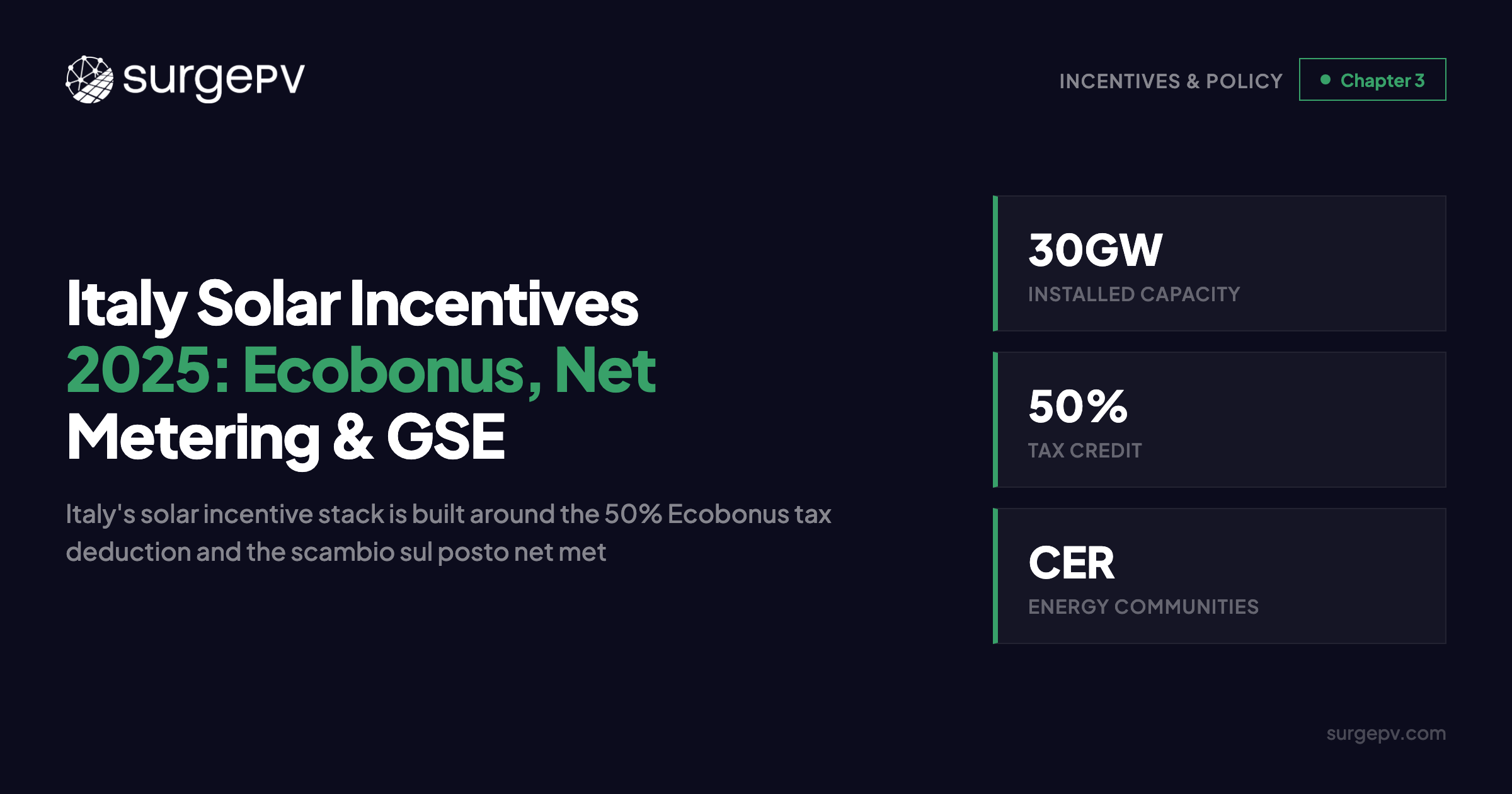
Italy has one of the most complete residential solar incentive stacks in Europe. Unlike Germany's feed-in tariff or Spain's self-consumption framework, Italy combines a long-running tax deduction program (Ecobonus), a financial net metering scheme (Scambio sul Posto), a battery storage grant, and reduced VAT — all stackable on a single installation. The result is that a well-structured Italian residential installation can have 70–80% of its cost recovered through public support over 10 years, without requiring a separate grant application before work starts.
This chapter covers each program in detail: who qualifies, what it pays, how to apply, and how to combine them for maximum value. The final section works through a full example with numbers.
What you'll learn in this chapter
- The 50% Ecobonus: how it works, what it covers, and how to claim it
- Scambio sul Posto: Italy's net metering system and what GSE pays you
- Battery storage grants: current 2025 rates and how to apply
- Reduced VAT (10%) for existing buildings
- Superbonus status in 2026
- How to stack all programs for maximum return
Italy Solar Incentives: Quick Reference (2026)
| Program | Type | Current Rate/Amount | Who Qualifies | How to Apply |
|---|---|---|---|---|
| Ecobonus (Detrazione 50%) | Tax deduction | 50% of costs, 10-yr spread | Homeowners, residents | Annual tax return (730/UNICO) |
| Scambio sul Posto (SSP) | Net metering | Retail rate credit for surplus | Grid-tied systems ≤500 kW | GSE application |
| Incentivo Accumulo (battery) | Capital grant | Up to €3,000 for battery | New solar + battery installations | GSE portal |
| Superbonus 70% (2026) | Tax deduction | 70% for qualifying renovation | Condominiums, specific cases | ENEA + tax return |
| IVA al 10% | Reduced VAT | 10% instead of 22% | Installation on existing buildings | Automatic at invoice |
Latest Updates: Italy Solar 2025
| Date | Change | Status |
|---|---|---|
| 2023 | Superbonus rate fell from 110% to 90% (residential first homes) | Closed for new applications at 90% |
| 2024 | Superbonus reduced to 70% for condominiums, 65% for single-family homes | Active at 70% for eligible projects |
| 2025 | Ecobonus 50% confirmed in 2026 Budget Law — no change | Active and stable |
| 2025 | Incentivo Accumulo program reopened with new funding tranche | Applications open — tranche dependent |
| 2025 | Scambio sul Posto contracts capped at 20 years from connection date | Active — applies to new connections |
Key Takeaway
The Ecobonus at 50% is Italy's workhorse incentive. It requires no upfront grant application, no pre-approval, and has been renewed every year since its introduction. For standard residential installations in 2026, it is the primary program to plan around.
Ecobonus 50%: Italy's Primary Solar Incentive
The Ecobonus allows Italian taxpayers to deduct 50% of solar installation costs from their IRPEF income tax, spread equally over 10 annual installments. It operates under Article 16-bis of the TUIR (DPR 917/1986) — the same legislation that covers building renovation deductions, which gives it legislative stability.
Key parameters:
- Maximum deductible: €96,000 per property unit
- Split: 10 equal annual deductions (5% per year of total cost)
- Qualifying costs: Solar panels, inverter, installation labor, electrical connections
- Battery storage: Qualifies as a separate deduction under the same 50% rule
Example — 6 kWp system, total cost €12,000 including VAT:
- Total deduction: 50% × €12,000 = €6,000
- Annual tax saving: €600/year for 10 years
- Effective system cost after deductions: €6,000 (50% subsidized)
Who can claim: IRPEF-paying residents who own or hold a rental agreement for the property. Joint ownership means the deduction splits proportionally between co-owners.
How to claim: File your annual tax return (Modello 730 for employees, Modello UNICO for self-employed). In the building renovation section (Ristrutturazione edilizia), declare the installation costs. Keep all invoices, installer certifications, and bank transfer proof.
Pro Tip: Bonifico Parlante
Payments must be made via bonifico parlante — a traceable bank transfer with a specific reference code. Cash or regular bank transfers do not qualify. The transfer must reference: "Detrazione 50% ai sensi dell'art. 16-bis del DPR 917/1986." This is the most common mistake on Ecobonus claims.
Scambio sul Posto: Italy's Net Metering System
Scambio sul Posto (SSP) is Italy's compensation mechanism for grid-connected solar systems. It is not a feed-in tariff — it does not pay a fixed rate per kWh exported. Instead, it lets you offset the cost of grid electricity you consume against the credit value of electricity you export, creating a net financial settlement.
How SSP works:
- Your solar system generates electricity throughout the day
- You consume what you can immediately (self-consumption — free, no accounting needed)
- Surplus exports to the grid via your bidirectional smart meter
- GSE (Gestore dei Servizi Energetici) calculates your annual net energy position
- If exports exceed imports: GSE sends a check or credit for the value difference
- If imports exceed exports: You pay only the net remaining balance
What GSE compensates: SSP payment covers three components of your electricity bill:
- Energy cost (componente energia)
- Grid distribution charges (componente distribuzione)
- Grid transmission charges (componente trasporto)
The combined compensation reaches 85–90% of the retail tariff for surplus exports — substantially better than countries that compensate at wholesale prices only. This is what makes SSP more valuable than a standard export tariff for typical residential usage patterns.
How to apply for SSP:
- After installation and DSO connection, contact GSE via their online portal (gse.it)
- Submit: CIL (Comunicazione Inizio Lavori), plant data sheet, compliance declaration
- GSE reviews and issues confirmation within 30–60 days
- Meter data is read annually; compensation appears on your bill or as a direct GSE payment
SSP limitations to know:
- Available for systems up to 500 kW only
- Not available if the system already receives a Conto Energia tariff (legacy program)
- Maximum contract duration: 20 years from first connection date
Key Takeaway
SSP is not a feed-in tariff and does not pay you per kWh exported. It is a financial offset — the most useful way to think of it is that your grid electricity bill approaches zero when annual generation roughly matches annual consumption. For a well-sized system, SSP can eliminate 80–100% of the grid electricity cost.
Battery Storage Incentive: Incentivo Accumulo
Italy operates a specific capital grant for battery storage systems, administered directly by GSE. The program has opened in tranches since 2021, with new funding allocated periodically.
2025 grant rates (subject to tranche confirmation):
| Battery Size | Grant Amount |
|---|---|
| ≤3 kWh | €1,500 |
| 3–6 kWh | €2,000 |
| 6–10 kWh | €3,000 |
| >10 kWh | €500/kWh, maximum €7,500 |
Eligibility: New solar plus battery systems commissioned after the program tranche opening date. Existing solar systems adding battery storage also qualify — the grant covers battery and associated installation separately from any prior solar installation.
Application: Via the GSE portal at gse.it. Applications open when a tranche is funded and close when funds run out. The program has historically closed within days of opening when a popular tranche launches. Subscribe to GSE email notifications to be alerted when the next tranche opens.
Reduced VAT: 10% for Solar on Existing Buildings
For solar installations on existing residential buildings, Italian law applies a reduced VAT rate of 10% instead of the standard 22% rate.
Conditions for 10% VAT:
- Building must have been completed more than 2 years before the installation date
- Installation must be for energy renovation purposes
- Applies to panels, inverter, mounting hardware, and installation labor
Practical impact: On a €10,000 system (pre-VAT), the difference between 10% and 22% VAT is €1,200 — a direct saving that requires no application or paperwork. Your installer applies the rate automatically; just ensure your invoice states the applicable condition.
For new builds completed within the last 2 years, standard 22% VAT applies. Installers working on renovation projects should confirm building age before quoting.
Superbonus: Status in 2026
The Superbonus, which originally offered 110% tax deduction for major energy renovation including solar, has been cut significantly:
| Category | 2025 Rate | Requirement |
|---|---|---|
| Single-family homes (first residence) | 70% | Part of wider energy renovation project |
| Condominiums | 70% | Coordinated condominium renovation |
| All others | 50% (standard Ecobonus) | None beyond standard Ecobonus rules |
The 110% and 90% phases are closed for new applications. The remaining Superbonus at 70% requires:
- Solar must be part of a wider energy renovation project
- ENEA pre- and post-certification of energy performance improvement
- APE (Attestato di Prestazione Energetica) before and after renovation
For most standard residential solar installations in 2026, the 50% Ecobonus is the applicable program — it is simpler, requires no renovation project, and has no ENEA certification overhead. The Superbonus 70% is only worth pursuing when a broader renovation is already planned.
Grid Connection: How GSE and ARERA Work
Italy's solar grid connection involves several separate bodies, which confuses many installers working in the Italian market for the first time.
| Body | Role |
|---|---|
| Terna | National transmission grid operator |
| DSO (Distributori) | Local grid operators — Enel Distribuzione, A2A Reti Elettriche, others |
| GSE | Manages incentives, SSP contracts, and generation monitoring |
| ARERA | Energy regulator — sets tariff rules and consumer protections |
Connection process step-by-step:
- Submit STMG (preventive connection study request) to your local DSO
- DSO provides a technical and economic proposal — typically 30–60 days
- Accept the proposal and pay connection costs
- Installer performs installation plus electrical compliance check
- Submit completion documents to DSO and request meter upgrade to bidirectional
- DSO installs smart meter — 1–4 weeks from request
- Apply to GSE for SSP contract
Timeline: Full process from initial application to first SSP payment typically takes 4–6 months. The longest steps are the DSO connection study (step 2) and the smart meter installation (step 6) — both are outside the installer's control.
Use solar design software that generates accurate energy models early in the process. The DSO connection study often requests generation estimates, and having a bankable simulation ready cuts back-and-forth time significantly. SurgePV's generation and financial tool produces the hourly profiles and annual yield estimates DSOs accept.
Calculate Italy Solar ROI Including Ecobonus
SurgePV's financial tool models the full Italian incentive stack — Ecobonus spread over 10 years, SSP net metering credits, and battery grant combined.
Book Free DemoNo commitment required · 20 minutes · Live project walkthrough
How to Maximize Italy's Solar Incentives
Optimal strategy for an Italian residential installation (6–10 kWp with battery):
- Claim Ecobonus 50% — no grant application, just file your tax return. Worth €3,000–5,000 over 10 years depending on system size.
- Register for Scambio sul Posto via GSE — takes 1–2 months but delivers ongoing bill credits that can eliminate most of your electricity costs.
- Add battery and apply for Incentivo Accumulo — extra €1,500–3,000 depending on battery size, paid directly by GSE.
- Pay by bonifico parlante — mandatory for the Ecobonus. Missing this step invalidates the entire deduction claim.
- Request 10% VAT from installer in writing before work begins — confirms the reduced rate applies to your property.
Full combination value on a €12,000 solar system + €3,000 battery:
| Incentive | Value | Timing |
|---|---|---|
| Ecobonus 50% on solar (€12,000) | €6,000 | Spread over 10 years via tax return |
| Ecobonus 50% on battery (€3,000) | €1,500 | Spread over 10 years via tax return |
| Incentivo Accumulo (6–10 kWh battery) | €3,000 | Upfront grant from GSE |
| 10% vs 22% VAT saving (on €13,636 pre-VAT) | ~€1,636 | Immediate — at invoice |
| Total effective subsidy | ~€12,136 | ~80% of gross installation cost |
This assumes the battery grant tranche is open at time of installation. Even without the battery grant, the Ecobonus plus reduced VAT brings the effective cost to around 60% of the sticker price — before accounting for SSP electricity savings over the system's 25-year life.
Pro Tip: Design for Self-Consumption First
SSP compensates you well for exports, but self-consumption is always more valuable — you avoid buying grid electricity at full retail price rather than receiving an export credit at 85–90% of retail. Size the system to cover 80–90% of your annual consumption, then let SSP handle the remaining imbalance. A well-sized 6–8 kWp system for a typical Italian household hits this sweet spot. Use a solar design tool to model the self-consumption ratio before finalizing system size.
Frequently Asked Questions
Can I transfer the Ecobonus to someone else?
Yes. Since 2020, you can transfer the Ecobonus deduction to a third party — typically a bank or specialist company — via cessione del credito. This route has been significantly tightened since 2022 following widespread fraud. Today, only certain qualified intermediaries can accept the transfer, and the process involves additional documentation and compliance checks. For most homeowners, claiming the deduction directly in your own annual tax return is faster and less complicated.
Is there a deadline to apply for Scambio sul Posto?
Apply to GSE within 12 months of commissioning your system. There is no hard close date (unlike grant programs that have application windows), but every month you delay enrollment is a month without SSP credits. GSE calculates your SSP position from the date your enrollment is confirmed — not from the installation date — so early application matters financially.
Does the Ecobonus apply to solar thermal (hot water) panels too?
Solar thermal collectors qualify for a 65% deduction under the Risparmio Energetico incentive if they meet specific efficiency criteria certified by ENEA. That rate is higher than the 50% Ecobonus for PV panels. If you are planning a combined PV plus solar thermal installation, the two deductions apply separately — the thermal system under the 65% rule, the PV system under the 50% rule. Worth noting on larger residential renovation projects.
What documents do I need to keep for the Ecobonus?
Keep the following for 10 years from the final tax return claiming the deduction:
- Signed contract with installer
- All invoices showing 10% IVA rate applied
- Bonifico parlante receipts (with the law reference text)
- Installer compliance declaration (dichiarazione di conformità)
- Building permit or CILA where required by your municipality
- ENEA online notification submitted within 90 days of work completion
The ENEA notification is easy to miss — it is a short online form at bonusfiscali.enea.it, but missing it can void the deduction claim on audit.
Design Italian Solar Projects with Accurate Incentive Modeling
SurgePV calculates Ecobonus savings, SSP credit projections, and battery grant value automatically — no spreadsheets required.
Book Free DemoNo credit card · Full access · Unlimited projects
About the Contributors

CEO & Co-Founder · SurgePV
Keyur Rakholiya is CEO & Co-Founder of SurgePV and Founder of Heaven Green Energy Limited, where he has delivered over 1 GW of solar projects across commercial, utility, and rooftop sectors in India. With 10+ years in the solar industry, he has managed 800+ project deliveries, evaluated 20+ solar design platforms firsthand, and led engineering teams of 50+ people.