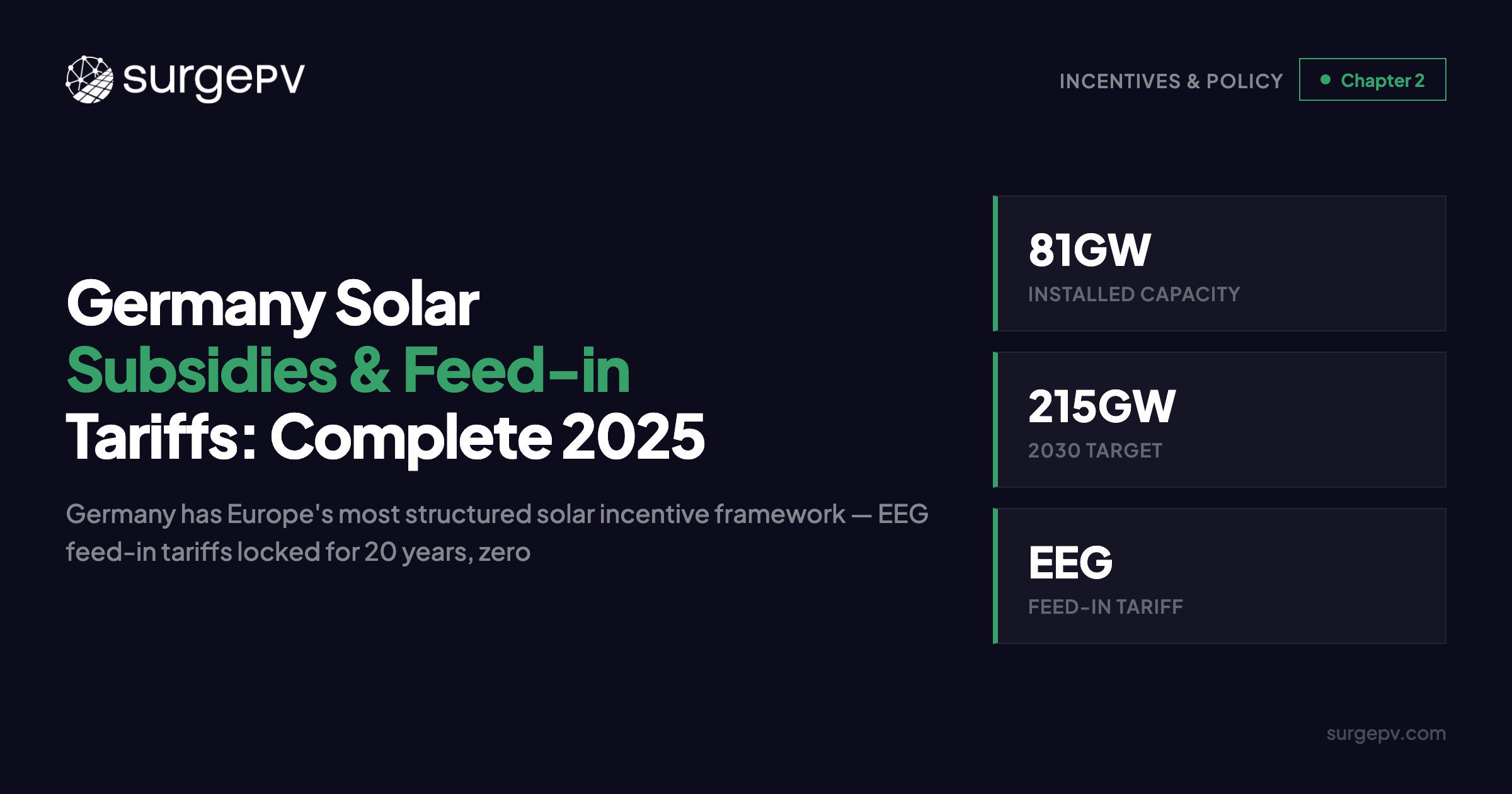
Germany is the world's fourth-largest solar market and Europe's most systematic one. It doesn't have the highest subsidies — Italy's Superbonus once topped 110% of system cost — but Germany's incentive framework is more predictable, more durable, and more consistently applied than almost anywhere else. The EEG has guaranteed 20-year feed-in tariff contracts since 2000. The zero VAT rule introduced in January 2023 cut installation costs by up to €2,500 for a typical residential system overnight. KfW government loans cover the rest.
This chapter covers every incentive available to solar installations in Germany in 2026: how the EEG feed-in tariff works, what zero VAT covers, how to apply for KfW financing, what MaStR registration requires, and how state-level programs stack on top of federal ones.
What you'll learn in this chapter
- Current EEG feed-in tariff rates and which model to choose
- Exactly what zero VAT covers (and what it doesn't)
- How KfW 270 and KfW 358/359 loans work
- Step-by-step MaStR registration process
- State-level programs in Bavaria, Berlin, and Baden-Württemberg
- The 800W Balkonkraftwerk rules for renters
- How to combine all incentives for maximum return
Germany Solar Incentives: Quick Reference (2026)
| Program | Type | Current Rate/Amount | Who Qualifies | How to Apply |
|---|---|---|---|---|
| EEG Feed-in Tariff (≤10 kWp) | Feed-in tariff | ~8.2 ct/kWh | Any grid-connected system | Via grid operator |
| EEG Feed-in Tariff (10–40 kWp) | Feed-in tariff | ~7.1 ct/kWh | Any grid-connected system | Via grid operator |
| Zero VAT (Umsatzsteuerbefreiung) | Tax exemption | 0% on installation & components | Residential ≤30 kWp | Automatic at purchase |
| KfW 270 Renewable Energy | Low-interest loan | From 3.45% effective | Any solar installation | Via partner bank |
| KfW 358/359 Battery Storage | Low-interest loan | From 3.45% effective | Solar + battery | Via partner bank |
| Balkonkraftwerk (800W rule) | Simplified connection | Up to 800W plug-in | Renters and owners | Notify grid operator |
Latest Updates: Germany Solar 2025
| Date | Update | Impact |
|---|---|---|
| January 2023 | Zero VAT (0% USt) introduced for residential solar ≤30 kWp | Saves €2,000–3,000 upfront on typical residential system |
| April 2024 | EEG tariff rates revised downward as installed capacity grows | New systems get slightly lower rates; existing 20-year contracts unchanged |
| Q1 2025 | Balkonkraftwerk limit raised from 600W to 800W | More generation potential for renters and plug-in solar owners |
| 2024 | MaStR deadline enforcement tightened — systems must be registered within 1 month of commissioning | Late registration now delays EEG payments; fines possible for persistent non-compliance |
The EEG Feed-in Tariff: How It Works
Germany's Erneuerbare-Energien-Gesetz (EEG) guarantees a fixed payment for each kWh your solar system injects into the grid. The rate is set at time of commissioning and guaranteed for 20 years.
Current 2025 rates for new systems, revised quarterly:
| System size | Full feed-in model | Self-consumption + export model |
|---|---|---|
| ≤10 kWp | 8.20 ct/kWh | 5.74 ct/kWh (surplus export) |
| 10–40 kWp | 7.10 ct/kWh | 4.87 ct/kWh |
| 40–100 kWp | 5.82 ct/kWh | 4.10 ct/kWh |
| >100 kWp | Tendering required | — |
Two models exist: the full feed-in model, where you export everything and buy back from the grid, or the self-consumption model, where you use what you generate and export surplus at a lower rate. For systems ≤10 kWp with high daytime consumption, the self-consumption model typically wins once grid electricity costs above 25 ct/kWh.
Key Takeaway: EEG 2023 Income Tax Change
Systems ≤30 kWp are now exempt from income tax on feed-in payments (Liebhaberei-Regelung). No commercial tax return needed for small solar income. This change alone removes a significant administrative burden for residential owners.
Calculation Example
A 6 kWp system in Munich on the full feed-in model:
- Annual generation: ~6,000 kWh (1,000 peak sun hours × 6 kWp)
- EEG income: 6,000 × €0.082 = €492/year
- Over 20 years at current rate: €9,840 guaranteed income
That's before factoring in any self-consumed electricity savings, which at current German electricity prices of ~30 ct/kWh would add several hundred euros annually for the self-consumption model. Use SurgePV's generation and financial tool to model the exact numbers for any project location and system size.
Zero VAT on Solar: What It Covers
Since 1 January 2023, the sale and installation of solar PV systems are zero-rated for VAT (Umsatzsteuer) under §12 Abs. 3 UStG. This applies to:
- Solar modules and components
- Installation labor
- Inverters, mounting systems, cables
- Battery storage systems when installed together with solar
- Retrofit battery storage for existing solar systems
Who qualifies: Residential systems up to 30 kWp on or near private dwellings, apartment buildings, and public-benefit buildings. Commercial properties above this threshold still pay 19% VAT but can reclaim it as input tax.
Practical saving: On a €12,000 system (excluding VAT), the old 19% rate would have added €2,280. Zero VAT removes that entire amount upfront — the equivalent of a direct grant with no application process.
Pro Tip
Zero VAT is automatic — no application, no paperwork. The installer applies the 0% rate at point of invoice. If an installer quotes you a price including 19% VAT for a residential system under 30 kWp, challenge it. They are required by law to apply zero rate.
KfW Government Loans
KfW (Kreditanstalt für Wiederaufbau) is Germany's state development bank. Its two solar-relevant programs offer below-market interest rates that can save thousands over the loan lifetime compared with personal credit.
KfW 270 — Renewable Energy Standard
- Loan amount: €3,000 to €150,000 per project
- Interest rate: From 3.45% effective annual rate (2026)
- Repayment: 5–20 years
- For: PV systems, inverters, grid connection
- How to apply: Through any KfW partner bank (Sparkasse, Volksbank, Deutsche Bank, etc.)
KfW 358/359 — Solar + Battery Storage
- Loan amount: Up to €150,000
- Rate: From 3.75% effective (2026)
- For: New PV + battery systems, or retrofit battery to existing PV
- Maximum battery size: 2× peak kWp of PV system
Application process: Visit your bank, request a KfW loan, and complete the KfW loan application — not through KfW directly, always through a partner bank. The bank submits to KfW. Approval takes 2–4 weeks. The loan must be approved before installation begins (pre-approval principle). Starting work before approval disqualifies the application.
Key Takeaway
The rate differential between KfW 270 and a standard personal loan is typically 2–3 percentage points. On a €15,000 loan over 10 years, that's roughly €1,500–2,000 in interest savings. Always compare KfW rates against your bank's personal loan rates before deciding.
Marktstammdatenregister (MaStR): Registration Requirement
Every solar system in Germany must be registered in the Marktstammdatenregister (MaStR), the Federal Network Agency's (Bundesnetzagentur) register of energy installations. This is not optional — unregistered systems cannot legally receive the EEG tariff.
What to register: System location, size (kWp), module type, inverter, commissioning date, grid connection point.
Deadline: Within 1 month of commissioning. Since 2024, enforcement has tightened — late registration delays EEG payments and may result in administrative penalties.
How to register: Online at marktstammdatenregister.de. Create a user account, then register your installation unit. The installer can (and usually does) register on your behalf — confirm this before they leave the site.
What you receive: A MaStR number, which you pass to your grid operator to start EEG payments.
Pro Tip
Ask your installer in writing who will handle MaStR registration before signing the contract. Many installers include it as standard; some charge extra. Either way, confirm the deadline of 1 month from commissioning is in the project plan. Missed registration is the single most common reason for delayed first EEG payments.
Model German System Economics Before You Buy
SurgePV's financial tool calculates exact EEG income, KfW loan repayments, and payback period for any German installation scenario.
Book Free DemoNo commitment required · 20 minutes · Live project walkthrough
Regional Additions: State-Level Programs
Beyond federal programs, several German states (Länder) run additional support schemes. These stack on top of EEG, zero VAT, and KfW — they are not substitutes.
| State | Program | What It Offers |
|---|---|---|
| Bayern (Bavaria) | Bayerische Klimaschutzförderung | 10% state grant for storage batteries, max €3,000 |
| Berlin | BerlinSolar | Free solar potential analysis and subsidized consulting |
| Baden-Württemberg | Photovoltaik-Förderung | Grants for community energy projects |
| NRW | Progres.NRW | Grants for commercial and community systems |
State programs have separate application processes and often exhaust their annual budgets by Q2. Apply early in the calendar year. Check your state's energy ministry website (usually under "Klimaschutz" or "Erneuerbare Energien") for current availability.
Balkonkraftwerk: The 800W Plug-in Solar Rule
Since April 2024, plug-in solar devices (Balkonkraftwerke) are permitted up to 800W AC output without special installation requirements. These work for renters or homeowners who aren't ready for a full roof system.
Key rules:
- Maximum 800W AC output, 2,000W peak PV
- Connection via standard household socket (Schuko CEE type)
- Registration required in MaStR (simplified registration available)
- Grid operator notification required but simplified since 2024
- Zero VAT applies since 2023
Economics: An 800W system costs €300–600 and generates roughly 700–900 kWh/year in Germany. At €0.30/kWh, that's €210–270 in annual savings. Payback runs 1.5–3 years, making these among the fastest-paying solar investments available.
How to Maximize Germany's Solar Incentives
The optimum combination for a residential system in 2026:
- Size to ≤30 kWp to qualify for zero VAT and income tax exemption on EEG income.
- Choose the self-consumption model if daytime electricity load exceeds 40% of your expected annual generation — typically the right choice for households with heat pumps, EVs, or home offices.
- Finance with KfW 270 instead of a personal loan. The rate differential saves real money over a 10–15 year term.
- Add battery with KfW 358/359 if your time-of-use tariff exceeds 25 ct/kWh in evening hours — storage increases self-consumption and accelerates payback.
- Register in MaStR within 1 month of commissioning. Don't leave this to chance — confirm in writing with the installer before work begins.
- Check state programs before installation — Bavaria, Berlin, and NRW require pre-application. An application submitted after installation is disqualified.
Further Reading
For the EU-level policy context behind Germany's EEG, see Chapter 10: EU-Wide Solar Policy & REPowerEU. For how to design the financial model for a German installation, see SurgePV's generation and financial tool.
Frequently Asked Questions
Is the EEG feed-in tariff paid on all generated electricity or just surplus?
It depends on which model you choose. Under the full feed-in model, you export all generation and receive the full EEG rate on every kWh. Under the self-consumption model, you use what you generate and receive a lower rate only for surplus exported to the grid. Grid operators set which model applies at point of connection — confirm with yours before installation if you have a preference.
Do I need a commercial license to receive EEG payments?
No. Since 2022, small solar systems (30 kWp or less on residential buildings) are treated as private use, not a commercial activity. You don't need a Gewerbeschein, you don't pay Einkommensteuer on EEG income, and you don't charge VAT to the grid operator. The 2022 EEG reform specifically introduced the Liebhaberei-Regelung to remove this barrier for residential owners.
How long does it take to get the EEG tariff started?
Once MaStR registration is complete and the grid operator receives your installation report, expect the first payment within 6–8 weeks of commissioning. EEG payments are made monthly or quarterly depending on your grid operator. Delays almost always trace back to incomplete MaStR registration or a missing installation notification to the grid operator.
Can I change from self-consumption to full feed-in model?
Generally not once the system is connected. The model is locked at the time of grid connection and MaStR registration. Some grid operators allow a one-time switch under specific circumstances — usually within the first year — but this is not a legal right. Choose carefully at the time of installation, and use a financial model to compare both options against your actual consumption profile.
Design German Solar Projects with Accurate Financial Models
SurgePV calculates EEG income, KfW repayments, and payback period for every German project — from address to bankable proposal.
Book Free DemoNo credit card · Full access · Unlimited projects
About the Contributors

CEO & Co-Founder · SurgePV
Keyur Rakholiya is CEO & Co-Founder of SurgePV and Founder of Heaven Green Energy Limited, where he has delivered over 1 GW of solar projects across commercial, utility, and rooftop sectors in India. With 10+ years in the solar industry, he has managed 800+ project deliveries, evaluated 20+ solar design platforms firsthand, and led engineering teams of 50+ people.