

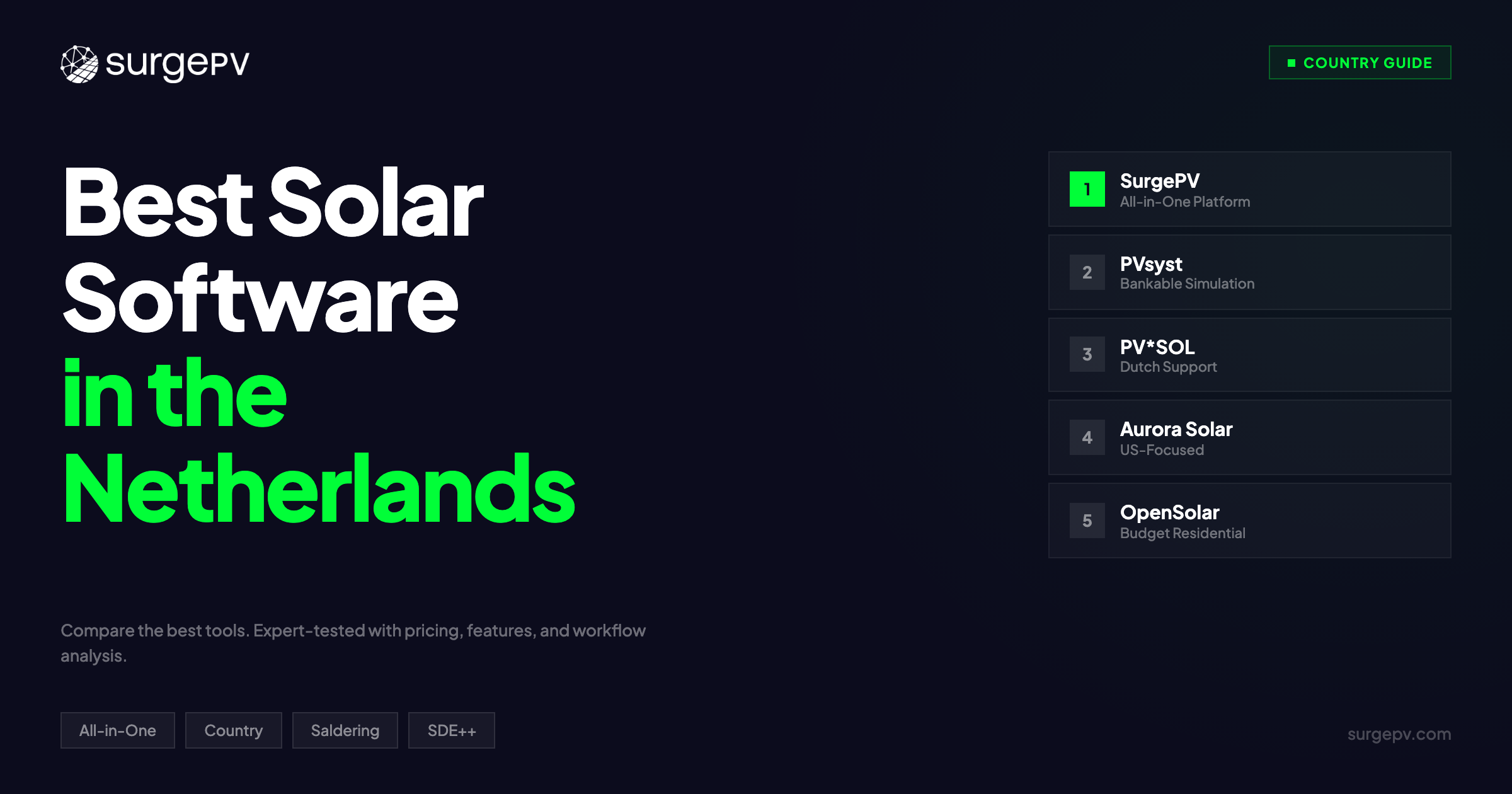
TL;DR: SurgePV is the best all-in-one platform for Dutch solar installers and EPCs — automated SLD generation, saldering transition modeling, SDE++ subsidy calculations, and bankable P50/P90 simulation in one tool at EUR 633/user/year. PVsyst remains the gold standard for bankable simulation reports required by Dutch banks and SDE++ audits. PV*SOL offers strong simulation with German engineering rigor and good Dutch market support. Aurora Solar leads on proposal design but lacks Dutch regulatory automation. OpenSolar is the budget option for simple residential projects.
The Netherlands added 2.08 GW of new solar capacity in 2025, bringing cumulative installed capacity to 29.7 GW. The country is forecast to reach 50 GW by 2029 and 79.9 GW by 2035. Residential electricity prices sit at EUR 0.23–0.27/kWh, while commercial rates range from EUR 0.15–0.18/kWh depending on connection size and contract terms.
The problem for most Dutch solar businesses: the regulatory environment is shifting fast. The salderingsregeling (net metering) ends on 1 January 2027, fundamentally changing residential project economics. SDE++ subsidies are transitioning to contracts for difference (CfDs) starting in 2027. TenneT grid congestion limits feed-in capacity across large parts of the country. And Energielabel requirements, NEN standards, and BAG/3DBAG building data integration add layers of complexity to every project.
The right solar software platform handles all of this without spreadsheet workarounds.
We tested 5 solar platforms for the Dutch market — evaluating each on workflow completeness (design, engineering, simulation, and proposals), Dutch electrical standards compliance, saldering transition modeling, SDE++ subsidy automation, and total cost of ownership. For focused comparisons, also see our guides to the best solar design software in the Netherlands, best solar proposal software in the Netherlands, and best solar shading analysis software in the Netherlands.
In this guide, you’ll find:
- 5 solar platforms reviewed for the Dutch market
- Saldering phase-out impact and self-consumption modeling comparison
- SDE++ subsidy and CfD transition analysis
- Total cost of ownership breakdown (multi-tool stacks vs. all-in-one)
- Bankability requirements for Dutch lenders (ING, Rabobank, ABN AMRO)
- Use-case recommendations by company type and project scale
Who this guide is for:
- Dutch solar installers and EPCs (residential and commercial)
- Commercial and residential solar companies operating in the Netherlands
- Energy consultants and adviseurs working on solar feasibility studies
- International solar companies expanding into the Dutch market
Quick Comparison: Dutch Solar Software
| Software | Best For | SLD Generation | Saldering Modeling | SDE++ Subsidies | Starting Price |
|---|---|---|---|---|---|
| SurgePV | Full-service EPCs, all segments | Automated | Yes | Yes | EUR 633/user/year |
| PVsyst | Bankable simulation, due diligence | No | Manual input | Manual input | EUR 900–1,500/year |
| PV*SOL | Detailed simulation, residential | No | Partial | No | EUR 600–1,200/year |
| Aurora Solar | International teams, US workflows | Requires AutoCAD | No | No | EUR 4,800+/year |
| OpenSolar | Budget residential (under 10 kWp) | No | No | No | EUR 1,000–2,000/year |
Workflow Cost Comparison
Multi-tool workflow (4 separate tools): 4–6 hours per commercial project, EUR 5,000+/year in software. SurgePV all-in-one workflow: 30–45 minutes per project, EUR 633/user/year — all features included.
Best Solar Software in the Netherlands: Detailed Reviews
SurgePV — Best All-in-One Platform for the Netherlands
Best for: Commercial EPCs, solar installers, energy adviseurs
Pricing: EUR 633–1,299/user/year. All features included.
Market fit: Full Dutch market support with saldering transition modeling, SDE++ subsidy calculations, and NEN-compliant electrical documentation.
Overall score: 9.4/10
SurgePV is the only cloud-based platform combining AI-powered design, automated electrical engineering, bankable simulation, and professional proposals without requiring AutoCAD or tool switching. For the Dutch market, SurgePV delivers compliant SLDs, self-consumption modeling for the post-saldering era, and SDE++ subsidy calculations in one unified workflow.
Pro Tip
SurgePV’s automated SLD generation saves 2–3 hours per project compared to manual AutoCAD drafting — and eliminates the EUR 1,800/year AutoCAD license entirely. For Dutch EPCs handling 10+ projects per month, that is 20–30 hours saved monthly. Book a demo to see it in action.
Key Features for the Netherlands
- AI-powered roof modeling — 70% faster than manual layout (15–20 min vs. 45–60 min). Works with Dutch roof types including schilddak and mansardedak configurations.
- Automated SLD generation — Compliant SLDs in 5–10 minutes vs. 2–3 hours in AutoCAD. Meets NEN 1010 and NEN-EN-IEC 62446 requirements.
- Wire sizing calculations — Automatic DC/AC wire sizing per NEN 1010. No more manual cross-referencing of cable tables.
- Native carport design — Built-in solar canopy structures for parkeerplaats and agri-PV projects.
Simulation and bankability:
- P50/P75/P90 simulation — Meets requirements from ING, Rabobank, and ABN AMRO. Bankable reports that Dutch lenders accept.
- 8760-hour shading analysis — Within ±3% accuracy vs. PVsyst. Accounts for the Netherlands’ low solar elevation angles and frequent cloud cover.
- Self-consumption modeling — Full eigenverbruik simulation for both pre- and post-saldering scenarios. Models the economic impact of the 2027 net metering phase-out.
Proposals and sales:
- Saldering transition calculator — Models project economics under current net metering and post-2027 feed-in compensation scenarios, so homeowners see the real value proposition
- SDE++ subsidy integration — Automatic calculation of SDE++ base amounts and correction amounts for commercial and utility-scale projects
- Financial modeling — Cash, loan, and lease scenarios with Dutch energy prices, energiebelasting, and ODE levies
- Dutch language — Full Dutch interface and proposal templates
Pricing
- Individual Plan: EUR 1,899/year for 3 users (EUR 633/user/year)
- For 3 Users: EUR 1,499/user/year (EUR 4,497/year total)
- For 5 Users: EUR 1,299/user/year (EUR 6,495/year total)
All plans include every feature. No tiered gating. See full pricing details.
Real-World Example
A mid-size installer in Noord-Holland handling both residential and commercial projects was paying over EUR 10,000/year for separate design, simulation, CAD, and proposal tools — and spending 12 hours per week on data re-entry between platforms. After consolidating to SurgePV at EUR 4,497/year (3-user plan), they cut software costs by 55% and freed up nearly two full working days per week.
You might be wondering: if SurgePV does all this, why haven’t I heard of it? Fair question. PVsyst has had a 30-year head start. Aurora Solar has spent hundreds of millions on marketing. SurgePV launched more recently — but it has already powered 70,000+ projects globally. The platform was built specifically for the workflow gaps that legacy tools leave open, especially automated electrical engineering, which no other platform offers natively.
Want to see how SurgePV handles Dutch projects? Book a demo to test compliant SLD generation and saldering transition proposals with your own project data.
Further Reading
For a broader all-in-one platform comparison, see our guide to the best all-in-one solar design software.
PVsyst — Gold-Standard Bankable Simulation Software
Best for: Energy consultants and large EPCs needing bankable due diligence reports
Pricing: EUR 900–1,500/year (single user), plus separate CAD software
Market fit: Strong. PVsyst is the reference simulation tool for Dutch banks, SDE++ audits, and large-scale project financing.
Overall score: 8.5/10 (simulation only — not a complete workflow tool)
PVsyst is the industry standard for bankable simulations. Every major Dutch bank and due diligence firm accepts PVsyst reports. The software handles complex shading scenarios and uses KNMI, Meteonorm, and PVGIS irradiance data relevant to Dutch climate conditions. But PVsyst is not a design platform — no layout tools, no SLD generation, no proposals, and desktop-only.
Pros:
- Gold-standard bankability — universal acceptance by Dutch lenders
- Detailed loss analysis (soiling, mismatch, cable losses, transformer losses)
- Strong Dutch irradiance database (KNMI, Meteonorm, PVGIS)
- Self-consumption simulation with load profiles
Cons:
- No design or layout tools — requires separate CAD software
- No SLD generation — requires AutoCAD (EUR 1,800/year)
- No proposal generation — requires separate tool
- Desktop-only — no cloud collaboration
- Steep learning curve — 40–60 hours to reach proficiency
Did You Know?
The Netherlands receives approximately 1,000–1,100 kWh/m2/year of global horizontal irradiance — lower than southern Europe but compensated by high electricity prices and strong policy incentives. Accurate simulation software is critical for bankable energy yield predictions in this climate. Projects using validated simulation tools see fewer financing rejections compared to manual calculations (source: SolarPower Europe Market Outlook).
PV*SOL — Detailed Simulation with Strong Dutch Support
Best for: Residential installers and small commercial projects needing detailed shading simulation
Pricing: EUR 600–1,200/year (depending on version)
Market fit: Good for simulation depth. Lacks Dutch-specific regulatory automation.
Overall score: 7.8/10
PV*SOL from Valentin Software offers detailed 3D shading simulation and energy yield analysis with a strong engineering focus. The software supports eigenverbruik modeling and battery storage simulation. However, it lacks SLD automation, Dutch tariff integration, and proposal generation.
Pros:
- Detailed 3D shading analysis with minute-by-minute simulation
- Battery storage and EV charging simulation — relevant for the post-saldering market where batteries become essential
- Self-consumption with load profile analysis
- Lower price point than PVsyst for basic versions
Cons:
- No SLD generation — requires separate CAD
- No saldering transition modeling — manual workaround required
- No proposal generation — requires separate tool
- Desktop-only — no cloud collaboration
- Limited Dutch regulatory templates
Aurora Solar — Industry-Leading Platform (US-Focused)
Best for: International installers with US parent company workflows
Pricing: EUR 4,800–6,000/year, plus AutoCAD EUR 1,800/year = EUR 6,600–7,800/year total
Market fit: Limited Dutch-specific features. Strong general design and proposal capabilities.
Overall score: 7.5/10 for the Netherlands
Aurora Solar is the market-leading solar platform globally with advanced 3D roof modeling and polished proposals. But it requires AutoCAD for SLDs, has no saldering modeling, no SDE++ automation, and a US-centric design focus.
Pros:
- Advanced 3D roof modeling with LIDAR integration
- Professional proposal templates with strong visual design
- Large module and inverter database
- Strong CRM integrations (Salesforce, HubSpot)
Cons:
- No NEN-compliant SLD generation — requires AutoCAD
- No saldering transition modeling
- No Dutch language interface
- No SDE++ subsidy calculations
- US-centric utility rate structures
OpenSolar — Budget-Friendly Residential Platform
Best for: Budget-conscious residential installers doing simple projects under 10 kWp
Pricing: EUR 1,000–2,000/year
Market fit: Basic. Lacks Dutch regulatory automation and engineering depth.
Overall score: 6.5/10 for the Netherlands
OpenSolar offers affordable all-in-one basics for small residential installers. No SLD generation, no saldering calculator, no Dutch language support, and limited engineering capabilities for commercial projects.
Pros:
- Lower price point for basic features
- Simple residential design workflow
- Basic financial modeling
- Cloud-based access
Cons:
- No SLD generation — requires separate CAD
- No saldering transition modeling
- No Dutch language interface
- No SDE++ subsidy support
- Limited to simple residential projects
Why the Saldering Phase-Out Changes Everything
The salderingsregeling ends on 1 January 2027. Under the current scheme, Dutch households offset grid consumption against solar production on a one-to-one basis. After 2027, energy suppliers will set feed-in compensation rates, which will be significantly lower than retail electricity prices.
This changes the software requirements for every Dutch installer:
- Self-consumption modeling becomes mandatory — Customers need to see how much solar they consume directly vs. export to the grid
- Battery storage simulation matters — Home battery installations grew by 140% in 2025. Every residential proposal now needs a battery scenario.
- Before-and-after comparisons sell projects — Showing customers their economics under both saldering and post-saldering scenarios closes deals faster
SurgePV is the only platform that models both scenarios side by side in a single proposal. PVsyst and PV*SOL can model self-consumption but require manual tariff input and separate proposal tools.
Ready for the Post-Saldering Market?
Model both net metering and post-2027 scenarios in one proposal. Design, engineer, simulate, and sell — without AutoCAD or tool switching.
Book a DemoNo commitment required · 20 minutes · Live project walkthrough
Why Most Dutch Solar Companies Overpay for Software
Complete all-in-one platform
Dutch EPCs need design, electrical engineering (SLD), simulation, and proposals in one tool. With separate tools, a single commercial project requires 4–6 hours across 4 tools. With an all-in-one platform like SurgePV: 30–45 minutes in one tool.
Dutch electrical standards and NEN compliance
Dutch solar installations must comply with NEN 1010 (low-voltage installations) and NEN-EN-IEC 62446 (commissioning and documentation). Your software needs to generate SLDs showing protection devices, wire sizing per Dutch norms, and DC/AC architecture diagrams. Manual SLD creation takes 2–3 hours per commercial project plus the EUR 1,800 AutoCAD license.
Dutch market automation
The best platform automates: saldering transition modeling (pre- and post-2027 scenarios), SDE++ subsidy calculations for commercial projects, eigenverbruik optimization with battery storage, energiebelasting and ODE levy integration, financial modeling with Dutch energy prices, and Dutch language support.
Bankability and lender acceptance
Dutch banks require bankable energy yield reports meeting international standards. PVsyst is the gold standard. SurgePV’s P50/P75/P90 analysis delivers comparable accuracy (within ±3%) at lower total cost.
TenneT grid congestion awareness
Grid congestion affects large parts of the Netherlands. TenneT reported that the electricity grid has reached maximum capacity during peak hours almost everywhere in the country. Software that models curtailment scenarios and time-bound transmission rights helps developers plan around grid constraints.
Which Software Is Right for Your Use Case?
| Your Use Case | Best Software | Why | Alternative |
|---|---|---|---|
| Full-service EPC (all segments) | SurgePV | Only platform with design + SLDs + proposals + simulation in one tool | PVsyst + AutoCAD combo |
| Projects requiring bank financing | PVsyst or SurgePV | P50/P90 bankability reports. PVsyst = universal, SurgePV = growing acceptance | PV*SOL (some lenders) |
| Residential installer (post-saldering) | SurgePV or PV*SOL | SurgePV: proposals + battery modeling. PV*SOL: detailed simulation | OpenSolar (budget) |
| SDE++ commercial projects | SurgePV | Integrated SDE++ subsidy calculations with bankable simulation | PVsyst + spreadsheets |
| Utility-scale developer (over 1 MW) | PVsyst + PVcase | Fast ground-mount design. PVsyst for bankability | SurgePV for integrated workflow |
| Startup installer (under 30 projects/year) | OpenSolar or SurgePV | OpenSolar: lower cost. SurgePV: better engineering | Free tools (PVWatts) |
| Your Situation | Recommended Software | Why It Fits |
|---|---|---|
| Large EPC doing utility-scale projects | PVsyst, PVcase, SurgePV | Need bankable simulation, electrical design automation, and grid compliance documentation for TenneT |
| Commercial installer (5–20 projects/month) | SurgePV, PV*SOL, Aurora Solar | Balance between design accuracy and proposal speed; integrated workflow reduces tool-switching |
| Residential-focused installer | SurgePV, PV*SOL, OpenSolar | Fast proposals with eigenverbruik modeling; NEN-compliant documentation |
| Developer doing feasibility studies | PVsyst, SurgePV | Accurate energy yield modeling and financial analysis for investment decisions |
| Small team (1–3 people) | SurgePV, OpenSolar | All-in-one platforms reduce software stack complexity and training time |
Further Reading
For a broader comparison beyond this market, see our guide to the best solar design software globally.
Decision Shortcut
If you need electrical engineering (SLDs, wire sizing, NEN compliance), SurgePV is the only platform that automates this natively. If you are simulation-only, PVsyst is the gold standard. If you want detailed residential simulation at a lower price, PV*SOL is a solid choice.
Bottom Line: Best Solar Software for the Netherlands
For Dutch EPCs and installers needing complete workflows: SurgePV offers the only true all-in-one platform with automated SLD generation, saldering transition modeling, bankable P50/P90 simulation, and Dutch language proposals — all for EUR 633–1,299/user/year.
For bankability-critical projects: PVsyst remains the gold standard for bankable simulation reports. Pair with SurgePV for complete workflows.
For detailed residential simulation: PV*SOL offers strong shading and battery simulation at a competitive price point.
For international teams: Aurora Solar provides advanced design and proposals but requires AutoCAD for SLDs and lacks Dutch market automation.
For budget-conscious residential installers: OpenSolar offers basic all-in-one features at low cost but lacks engineering capabilities and Dutch automation.
The Netherlands’ solar market is approaching 30 GW of installed capacity and accelerating toward 50 GW by 2029. The saldering phase-out, grid congestion challenges, and SDE++ transition mean Dutch installers need software that adapts to changing regulations — not spreadsheets and workarounds. For comparison with neighboring European markets, see our guides for Germany, Belgium, and Poland. Your solar design software choice is a competitive advantage.
One Platform for All Dutch Solar Projects
Design, engineer, simulate, and generate proposals without AutoCAD or tool switching.
Book a DemoNo commitment required · 20 minutes · Live project walkthrough
When You May Not Need Advanced Solar Software
Not every solar project requires comprehensive design and simulation platforms. Consider simpler alternatives if:
- Small residential projects with standard layouts — Basic design tools or manufacturer calculators may suffice for simple rooftop arrays under 3 kWp.
- Engineering is outsourced — If your company uses an external adviesbureau, you may only need proposal and CRM tools.
- Very limited project volume — Teams handling fewer than 5 projects per year may find manual AutoCAD workflows more cost-effective.
- Non-technical sales teams — Sales-focused companies without in-house engineers may only require proposal generation tools.
Most Dutch EPCs, developers, and medium-to-large installers benefit from integrated platforms that reduce manual work and improve accuracy. With the Netherlands’ NEN 1010 compliance requirements, saldering transition complexity, and TenneT grid congestion, manual workflows create bottlenecks that delay project approvals.
Bottom Line
For Dutch EPCs and installers, SurgePV delivers the most complete design-to-proposal workflow with automated SLD generation, bankable P50/P90 simulations, and integrated proposals — all at EUR 1,899/year for 3 users. Book a demo to see it in action.
Transparency Note
SurgePV publishes this content. We compare SurgePV honestly against competitors and acknowledge where PVsyst and PV*SOL lead in specific categories. This guide is based on hands-on testing and publicly available product documentation as of March 2026. See our editorial standards.
Frequently Asked Questions
What is the best solar software in the Netherlands?
SurgePV is the best all-in-one solar software for the Netherlands in 2026, combining NEN-compliant electrical engineering, automated SLD generation, bankable P50/P90 simulation, and professional Dutch-language proposals in one cloud-based platform — without requiring AutoCAD. Pricing starts at EUR 633/user/year with all features included. For Dutch EPCs and installers, SurgePV eliminates the need for AutoCAD (EUR 1,800/year) while delivering complete electrical documentation and saldering transition-ready proposals.
How does the saldering phase-out affect solar software requirements?
The salderingsregeling ends 1 January 2027. After this date, solar software must accurately model eigenverbruik (self-consumption) rather than simple net metering offsets. SurgePV models both pre- and post-saldering scenarios in a single proposal. PVsyst and PV*SOL support self-consumption modeling but require manual tariff input. Aurora Solar and OpenSolar lack Dutch-specific saldering modeling entirely.
Which solar software supports SDE++ subsidy calculations?
SurgePV integrates SDE++ base amounts and correction amounts for commercial and utility-scale projects. PVsyst provides bankable simulation reports required for SDE++ applications but does not calculate subsidy amounts directly. PV*SOL, Aurora Solar, and OpenSolar lack SDE++ integration. Note that the SDE++ scheme is transitioning to contracts for difference (CfDs) starting in 2027.
Do I need multiple tools for solar projects in the Netherlands?
No, if you use an all-in-one platform like SurgePV. Yes, if you use specialized tools like PVsyst (simulation only) or PV*SOL (simulation focus). Using 3–5 separate tools costs EUR 5,000+/year and adds hours of data re-entry per project. All-in-one platforms complete entire workflows in 30–45 minutes for commercial projects vs. 4–6 hours with separate tools.
What does all-in-one solar software cost in the Netherlands?
All-in-one solar software pricing in the Netherlands ranges from EUR 633/user/year (SurgePV Individual Plan) to EUR 4,800+/year (Aurora Solar). SurgePV includes SLD generation without AutoCAD. Aurora requires AutoCAD at EUR 1,800/year extra. See SurgePV pricing for detailed plan comparison.
Sources
- SurgePV Product Documentation — Official feature specifications and proof points (accessed March 2026)
- RVO (Rijksdienst voor Ondernemend Nederland) — SDE++ subsidy information — SDE++ application and requirements (accessed March 2026)
- Business.gov.nl — Salderingsregeling phase-out — Net metering policy changes (accessed March 2026)
- TenneT — Official website — Grid congestion data and investment plans (accessed March 2026)
- CBS (Centraal Bureau voor de Statistiek) — Energy prices — Dutch energy price statistics (accessed March 2026)
- SolarPower Europe — EU Market Outlook — European solar market data (accessed March 2026)
- pv magazine — Netherlands 2025 solar additions — Market statistics (accessed March 2026)
- Aurora Solar, PVsyst, PV*SOL, OpenSolar Official Documentation — Feature specifications and pricing (accessed March 2026)
- NEN 1010, NEN-EN-IEC 62446 — Dutch electrical installation standards (accessed March 2026)