

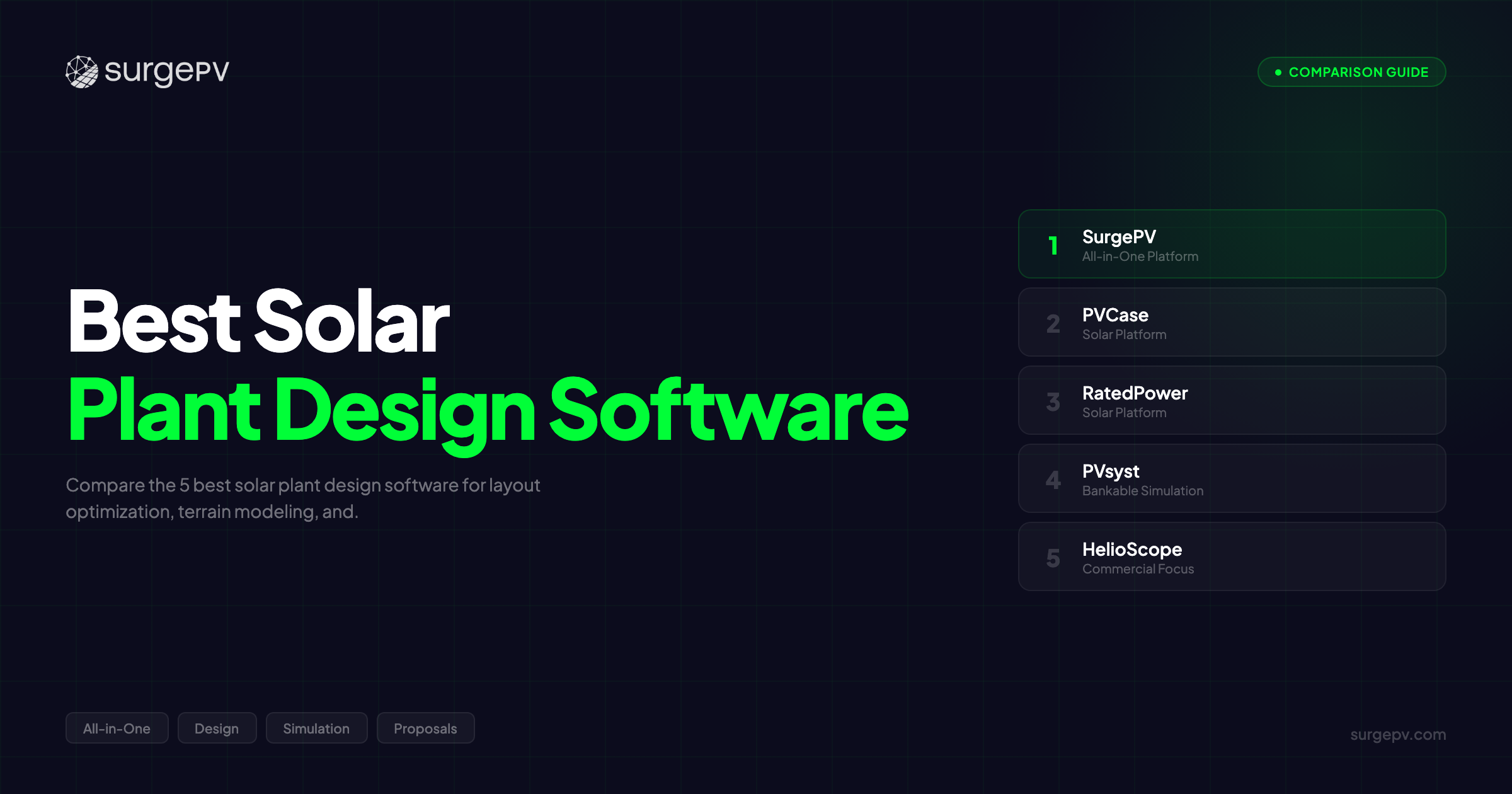
TL;DR: PVCase leads utility-scale terrain modeling through Civil 3D integration, but requires AutoCAD and separate tools for simulation and electrical. SurgePV delivers the most complete commercial-scale (100 kW-10 MW) workflow with tracker support, automated SLD generation, bankable P50/P75/P90, and proposals in one platform. RatedPower offers the fastest utility-scale feasibility iteration. PVsyst is the bankability gold standard but is NOT a design tool. HelioScope handles flat-terrain commercial ground-mount but lacks trackers and electrical features.
Here is what separates profitable solar plant developers from everyone else: the speed between “we have a site” and “here’s a bankable design with complete electrical documentation.” Most EPCs need 3-4 separate tools and 10-19 hours to get there. Some do it in one tool in under 5 hours.
Solar plant design has moved well beyond dropping modules on a flat surface. Today’s ground-mount projects demand terrain-aware layouts, tracker optimization with backtracking algorithms, detailed electrical infrastructure planning, and bankable P50/P75/P90 estimates — all before a single pile goes in the ground.
The wrong tool choice means switching between PVCase (layout), AutoCAD (electrical), PVsyst (simulation), and Excel (proposals) — burning 10+ hours and thousands of dollars per project. The best solar design software in 2026 handles layout optimization, tracker configuration, electrical engineering, and bankable simulation in streamlined workflows, whether cloud-based or CAD-integrated.
The right tool depends on your project scale: utility-scale (over 10 MW) demands PVCase or RatedPower’s terrain depth, while commercial-scale plants (100 kW-10 MW) benefit from SurgePV’s all-in-one design + electrical + proposals.
After delivering 1+ GW of solar projects at Heaven Green Energy — including commercial ground-mount, tracker-based plants, and carport installations — I tested every major plant design platform in real project conditions across 20+ solar design tools. Here is what I found.
In this guide, you’ll find:
- 5 solar plant design tools compared on layout optimization, terrain modeling, and tracker support
- Real workflow timing: how long a 5 MW ground-mount takes from site to bankable design in each tool
- The gap most plant designers miss — electrical design integration
- Which tool fits your project scale (100 kW to 50 MW+)
- Total cost of ownership including hidden AutoCAD and PVsyst add-ons
Quick Comparison Table
| Software | Best For | Tracker Support | Key Limitation | Starting Price |
|---|---|---|---|---|
| SurgePV | All-in-one plant design + electrical + proposals (100 kW-10 MW) | Single + dual-axis with backtracking | Not designed for over 10 MW terrain modeling depth | $1,899/yr (3 users) |
| PVCase | Utility-scale terrain modeling + CAD engineering (over 10 MW) | Advanced with terrain following | Requires AutoCAD ($2,000/yr), no proposals | ~$3,000+/yr (w/AutoCAD) |
| RatedPower | Rapid utility-scale feasibility studies | Single-axis optimization | No SLD, no proposals, enterprise pricing | Contact for pricing |
| PVsyst | Bankability validation (simulation only — NOT design) | Simulation only (no layout) | Not a design platform | ~$1,300 one-time |
| HelioScope | Commercial ground-mount on flat terrain | Limited | No SLD, limited trackers, Aurora acquisition uncertainty | ~$948/yr |
Did You Know?
According to IRENA, global solar PV capacity surpassed 1,400 GW in 2023, with ground-mount and tracker-based installations accounting for the majority of new utility and commercial-scale capacity. The plant design tools you choose directly impact how fast you capture a share of that growth — and whether your designs survive engineering review.
Best Solar Plant Design Software (Detailed Reviews)
SurgePV — All-in-One for Commercial-Scale Plants
Best For: Commercial EPCs (100 kW-10 MW) needing design + electrical + proposals in one platform
Pricing: $1,899/year (3 users); $1,499/user/year (For 3 Users plan)
Onboarding: 2-3 weeks
SurgePV is the only cloud-based platform that combines plant design, automated electrical engineering (SLD + wire sizing), bankable simulations (P50/P75/P90), and professional proposals in a single workflow. For commercial-scale plants (100 kW-10 MW), SurgePV eliminates the 3-4 tool stack — design tool + AutoCAD + PVsyst + proposal tool — that other approaches demand.
What most plant designers miss: the layout is only half the job. Every ground-mount project also needs single line diagrams, wire sizing, protection schemes, and a client-facing proposal. PVCase, RatedPower, and HelioScope all require you to leave their platform to complete those steps. SurgePV does not.
Key Plant Design Features
-
Tracker support — Single-axis trackers (15-25% production gain) and dual-axis trackers (25-35% production gain) with backtracking algorithm for shadow avoidance. On a 5 MW ground-mount, single-axis trackers add 750-1,250 MWh per year in production, translating to $30,000-75,000 in additional annual revenue depending on your PPA rate. PVCase and RatedPower also support trackers; Aurora and HelioScope fall short here.
-
Carport solar design — The ONLY platform with native carport support (single cantilever, dual cantilever, multi-column). No other plant design tool offers this. If your pipeline includes parking structures and carport projects, SurgePV is the only option that does not require a separate design workflow.
-
East-West racking — Low-tilt opposite orientations (5-15 degrees) delivering 20-40% more kW per roof area. High-density layouts for constrained commercial sites.
-
Automated SLD generation — Creates NEC Article 690/IEC-compliant single line diagrams in 5-10 minutes. Manual AutoCAD drafting takes 2-3 hours for the same output. At 30 ground-mount projects per year, you save 60-90 hours of manual electrical drafting — the equivalent of 1.5-2 full work weeks per designer. PVCase, RatedPower, HelioScope, and PVsyst all lack this feature.
-
Wire sizing and voltage drop analysis — Automated DC/AC wire sizing with voltage drop calculations (under 2% optimal, 3% max). No spreadsheet required.
-
P50/P75/P90 production estimates — 8760-hour shading analysis with +/-3% accuracy versus PVsyst. Bankable numbers from the same platform where you design.
-
Proposal generation — Professional web-based proposals with financial modeling (cash, loan, lease, PPA). Your plant design flows directly into client deliverables.
Pro Tip
Here’s what most plant designers don’t calculate: the true cost of the PVCase workflow is not just $990/year. Add AutoCAD ($2,000/year), PVsyst ($1,300 one-time), manual SLD drafting (3-5 hours per project), and proposal tools — your real cost is $4,300+/year per user plus 10-19 hours per project. SurgePV delivers the complete plant design workflow at $1,499/user/year in 3-5 hours. Book a demo to see the difference.
Pricing
| Plan | Price | Users |
|---|---|---|
| Individual | $1,899/year | 3 users |
| For 3 Users | $1,499/user/year | 3 users |
| For 5 Users | $1,299/user/year | 5 users |
| Enterprise | Custom | Multiple |
All features included on every plan. No hidden fees, no feature gating. See full pricing.
Cost comparison for a 3-user plant design team:
- SurgePV (3 users): $4,497/year — complete design + electrical + simulation + proposals
- PVCase + AutoCAD + PVsyst (3 users): $9,000+ (PVCase + AutoCAD) + $1,300 (PVsyst) = $10,300+ first year
- Annual savings: $5,800+ per year with SurgePV
Who SurgePV Is Best For
- Commercial-scale plant developers (100 kW-10 MW ground-mount)
- EPCs needing design + electrical + proposals in one workflow
- Teams designing tracker-based commercial plants (single-axis, dual-axis)
- Budget-conscious teams wanting to avoid the PVCase + AutoCAD + PVsyst stack
Limitations
- Less terrain modeling depth than PVCase + Civil 3D — not ideal for highly complex terrain or large utility sites
- Not designed for utility-scale projects above 10 MW (PVCase and RatedPower are stronger for 50 MW+)
- Newer platform with less brand recognition compared to PVCase in the utility-scale market
- PVsyst validation may still be needed for large project financing (over 5 MW)
Real-World Example
A 3-person commercial EPC team handling 2 MW ground-mount projects was using PVCase for layout, AutoCAD for SLDs, PVsyst for simulation, and a separate tool for proposals. Total workflow: 12-15 hours per project across 4 platforms. After switching to SurgePV, the same project — layout with single-axis trackers, automated SLD, P50/P75/P90 report, and client proposal — takes 3.5-4.5 hours in one platform. At 30 projects per year, that is 255-315 hours saved and over $5,800 in annual licensing costs eliminated.
Further Reading
For electrical integration details, see best solar electrical design software. For a broader platform comparison, see best solar design software (2026). For a deep dive on the utility-scale leader, read our full PVCase review.
You might be thinking: “PVCase gives deeper terrain modeling and more granular CAD control.” That is true. If your team designs 50 MW+ utility-scale plants on complex hillside terrain with in-house Civil 3D engineers, PVCase provides capabilities SurgePV does not match at that scale.
But here is what most plant designers miss: 80% of commercial ground-mount projects are under 10 MW, on relatively flat or gently sloping sites, where terrain modeling depth is not the bottleneck. The bottleneck is electrical documentation. PVCase cannot generate a single line diagram without AutoCAD. SurgePV does it in 5-10 minutes.
And the other objection: “Is SurgePV’s simulation accurate enough for plant financing?” SurgePV produces P50/P75/P90 estimates with +/-3% accuracy versus PVsyst. For commercial-scale projects where financing partners accept third-party validation, that accuracy level paired with a 98% BOM accuracy rate satisfies most commercial-scale financiers.
For utility-scale projects above 5 MW where banks require PVsyst-stamped reports specifically, you can design in SurgePV and validate with PVsyst — still saving the AutoCAD license and 3-5 hours of manual electrical work.
PVCase — CAD-Based Engineering Powerhouse for Utility-Scale
Best For: Utility-scale developers (over 10 MW) with in-house CAD teams
Pricing: ~$990/year per seat (PVCase) + ~$2,000/year (AutoCAD) = ~$3,000+/year per user
PVCase is the market leader for utility-scale solar plant engineering. It runs as an AutoCAD and Civil 3D plugin, offering the deepest layout optimization, terrain modeling, and ground-mount design capabilities available. If your team designs 50 MW solar farms on complex terrain and has in-house CAD engineers, PVCase provides engineering control no other tool matches.
What Works
- Terrain modeling (strongest in market) — Full topographic data integration via Civil 3D. Cut-and-fill calculations for site grading. Slope mapping and drainage analysis. Terrain-following tracker layouts. No other plant design tool matches this depth.
- Layout optimization — Automated layout generation with customizable parameters (GCR, setbacks, road access). Advanced row spacing optimization for inter-row shading minimization. Pile optimization with variable pile heights based on elevation data.
- Tracker support — Single-axis tracker layout with terrain following and backtracking. Row-to-row optimization for dense tracker installations.
- Cable routing — String design, inverter placement optimization, combiner box location optimization. Strong BOM generation from CAD drawings.
Where It Falls Short
- Requires AutoCAD ($2,000/year per seat) — PVCase is a plugin, not a standalone application. Budget the AutoCAD license on top.
- Desktop-only — No cloud collaboration. Your team must be on-site or via remote desktop to access projects.
- 6-8 week onboarding — CAD-based workflow requires significant training. Compare to 2-3 weeks for cloud-based tools.
- No bankable simulation — PVCase designs plants but cannot simulate production. You need PVsyst (~$1,300 one-time) separately.
- No SLD generation — Electrical documentation requires separate AutoCAD Electrical work, adding 3-5 hours per project.
- No proposal generation — Client-facing deliverables require a separate tool.
Total first-year cost for 3 users: ~$9,000 (PVCase + AutoCAD) + ~$1,300 (PVsyst) = $10,300+
Best for: Utility-scale developers (over 10 MW) with in-house CAD teams needing maximum terrain and engineering control. Not ideal for commercial-scale EPCs without CAD expertise. For a deeper analysis, read our full PVCase review.
RatedPower — Cloud-Based Speed for Utility-Scale Feasibility
Best For: Utility-scale project developers needing rapid design iteration
Pricing: Contact for pricing (enterprise model, estimated $5,000-20,000+/year)
RatedPower is a cloud-based solar plant design platform that automates utility-scale layout generation. It trades PVCase’s engineering depth for speed — producing preliminary plant designs in minutes rather than hours. If your team evaluates multiple sites for 20 MW+ feasibility studies, RatedPower’s iteration speed is difficult to match.
What Works
- Fastest layout iteration — Automated plant layout generation from site boundaries and constraints. Multiple design variants in minutes. Concept to preliminary design faster than any other tool.
- Cloud-based — No installation, team collaboration built in. Access from anywhere.
- Built-in energy yield — Production estimates, loss modeling, and basic financial analysis (LCOE, CAPEX) without needing PVsyst for preliminary assessments.
- Automated BOM and cost estimation — Quick CAPEX estimates for bid preparation.
- Single-axis tracker optimization — Automated tracker row placement for utility-scale layouts.
Where It Falls Short
- Utility-scale focus only — Limited for commercial-scale projects under 5 MW. Not designed for the 100 kW-5 MW range where most EPCs operate.
- No SLD generation — No electrical engineering features. Separate tools required for electrical documentation.
- Less terrain depth than PVCase — Topographic analysis is good but not at Civil 3D integration level.
- Pricing not publicly listed — Enterprise pricing model. Estimated $5,000-20,000+/year depending on project volume.
- No proposal generation — Basic report exports, but no client-facing proposal tools.
Best for: Utility-scale developers needing rapid feasibility studies and design iteration across multiple large sites. Not ideal for commercial-scale EPCs or teams needing integrated electrical documentation. Read our full RatedPower review.
Note
PVsyst is included in this comparison because it consistently appears in “best solar plant design software” searches. But PVsyst is NOT a plant design platform. It simulates energy production — it does NOT design where modules go, how trackers are laid out, or how electrical infrastructure connects. You need a separate design tool first, then validate with PVsyst.
PVsyst — Bankability Standard, Not a Design Platform
Best For: Financing validation and bankability reporting
Pricing: CHF 1,200 ($1,300 USD) one-time + ~$200/year maintenance
PVsyst is the global gold standard for solar simulation and bankability validation. Every major bank, financial institution, and investor accepts PVsyst reports for project financing. That authority is earned — PVsyst’s detailed loss modeling (25+ loss categories) and P50/P90/P99 probabilistic energy yield analysis are unmatched.
But PVsyst is NOT a plant design tool. This distinction matters for anyone searching “best solar plant design software.”
What PVsyst Does (Simulation Only)
- P50/P75/P90/P99 probabilistic energy yield — The bankability metrics financiers require. Industry gold standard.
- Detailed loss modeling — Soiling, temperature, mismatch, clipping, shading, degradation, and 20+ additional loss categories. Deepest loss analysis available.
- Hourly (8760) simulation — Hour-by-hour production modeling with IEC 61724-compliant outputs.
- 3D shading scene — Near-shading modeling for validation. Imports geometry from design tools.
What PVsyst Does NOT Do (No Design)
- No module layout tools — cannot place modules on a site
- No row spacing optimization — cannot calculate optimal GCR
- No terrain modeling or grading — cannot analyze slopes or drainage
- No tracker layout design — simulates tracker production but does not design placement
- No electrical design (no SLD, no wire sizing)
- No proposal generation
- Desktop-only — no cloud collaboration
4-6 week learning curve. PVsyst is a mature, deep tool, but the interface reflects decades of development, not modern UX.
Best for: Project financing validation. Pair PVsyst with a design tool — SurgePV for commercial-scale (100 kW-10 MW) or PVCase/RatedPower for utility-scale (over 10 MW) — for operational workflows plus PVsyst bankability certification.
Not ideal for: Daily design work, layout optimization, or any operational plant design task. PVsyst validates designs. It does not create them. Read our full PVsyst review.
HelioScope — Commercial Cloud Design, Missing Trackers and Electrical
Best For: Commercial ground-mount projects on flat terrain
Pricing: Starting $79/month ($948/year) per user (legacy pricing, transitioning to Aurora model)
HelioScope (now part of Aurora Solar) is a cloud-based design platform built for commercial-scale projects. Good module layout tools, bankable energy estimates, and easy team collaboration. But for plant design specifically, it falls short on the features ground-mount engineers need most: trackers, terrain modeling, and electrical documentation.
What Works
- Easy to learn — 2-3 week onboarding. Modern cloud interface without CAD complexity.
- Cloud-based collaboration — Browser-based, multi-user access. Team workflow management.
- Bankable reports — Energy yield estimates and shade analysis accepted by many commercial financiers.
- Ground-mount support — Module layout for flat or near-flat commercial sites (100 kW-10 MW).
Where It Falls Short for Plant Design
- Limited tracker support — PVCase, RatedPower, and SurgePV all provide stronger tracker layout capabilities. HelioScope’s tracker features lag behind.
- Limited terrain modeling — Designed primarily for flat sites. Complex slopes and grading analysis require other tools.
- No SLD generation — No wire sizing, no electrical engineering. Separate tools (AutoCAD, $2,000/year) required for electrical documentation.
- No proposal generation — Limited reporting. Moving to Aurora’s proposal engine.
- Aurora acquisition uncertainty — Feature roadmap and pricing are in transition. Verify current availability.
- Not suitable for utility-scale (over 10 MW) — Scale limitations restrict plant design capabilities.
Best for: Commercial EPCs designing simple ground-mount or rooftop projects on flat terrain who already have separate electrical engineering workflows.
Not ideal for: Plant designers needing tracker layouts, terrain modeling, or integrated electrical documentation. For a full analysis, read our HelioScope review.
Which Software Is Right for Your Project Scale?
| Your Situation | Recommended Software | Why It Fits |
|---|---|---|
| Commercial plant (100 kW-10 MW) | SurgePV | Design + trackers + automated SLD + P50/P75/P90 + proposals in one platform. No AutoCAD needed. |
| Utility-scale (over 10 MW) with CAD team | PVCase + PVsyst | Deepest terrain modeling, pile optimization, Civil 3D integration. Budget $3,000+/user/year. |
| Multiple site feasibility (over 20 MW) | RatedPower + PVsyst | Fastest concept-to-preliminary design. Multiple variants in minutes. |
| Bankability validation only | PVsyst (simulation, NOT design) | Industry gold standard for financing. Pair with a design tool. |
| Flat-terrain commercial ground-mount | SurgePV or HelioScope | Cloud-based, accessible. SurgePV adds electrical + proposals; HelioScope is simpler. |
When You May Not Need Dedicated Plant Design Software
Not every ground-mount project demands a specialized plant design platform. Consider simpler alternatives if:
- Simple rooftop-only projects — If your team only handles rooftop commercial installations without ground-mount, tracker, or carport work, general solar software covers your needs.
- Very small ground-mount (under 50 kW) — Small residential ground-mount systems can sometimes be designed in standard solar design tools without plant-specific layout optimization.
- Pure simulation needs — If you only need to validate someone else’s plant design with bankable numbers, PVsyst alone is sufficient.
- Early-stage feasibility only — If you only need rough site assessments before handing off to engineering firms, basic satellite-based layout tools may suffice temporarily.
However, for most commercial EPCs handling ground-mount projects above 100 kW, the time savings from proper plant design software pay for themselves within a few projects. At 5-15 hours saved per project versus manual workflows, the ROI is measured in weeks, not months.
Full Plant Design Feature Comparison
| Feature | SurgePV | PVCase | RatedPower | PVsyst | HelioScope |
|---|---|---|---|---|---|
| Layout optimization | Yes (commercial) | Advanced (CAD) | Automated (cloud) | No (simulation only) | Good (commercial) |
| Terrain modeling | Supported | Advanced (Civil 3D) | Yes | Basic (3D scene) | Limited |
| Single-axis trackers | Yes + backtracking | Advanced | Yes | Simulation only | Limited |
| Dual-axis trackers | Yes | Yes | Limited | Simulation only | No |
| Carport design | Yes (ONLY platform) | No | No | No | No |
| East-West racking | Yes (20-40% more kW) | Yes | Yes | Simulation only | Limited |
| SLD generation | Automated (5-10 min) | Via AutoCAD | No | No | No |
| Wire sizing | Automated | Via AutoCAD | Basic | No | No |
| P50/P75/P90 | Yes (+/-3% vs PVsyst) | Via PVsyst | Yes | Industry standard | Yes |
| Proposal generation | Yes (integrated) | No | Basic reports | No | Limited |
| Cloud-based | Yes | No (desktop CAD) | Yes | No (desktop) | Yes |
| Pricing/year | $1,899 (3 users) | ~$3,000+ (w/AutoCAD) | Contact sales | ~$1,300 one-time | ~$948 |
Further Reading
For a dedicated comparison of bankable simulation tools, see our guide to the best bankable solar simulation software. For electrical design integration, see best solar electrical design software.
Why Plant Design Software Matters for Ground-Mount Projects
The Multi-Tool Tax
Every commercial ground-mount project needs more than a layout. It needs electrical documentation for permitting, bankable production estimates for financing, and a proposal for the client. Most plant design tools handle one or two of these steps, leaving you to fill the gaps with AutoCAD ($2,000/year), PVsyst (~$1,300), spreadsheets, and proposal tools.
Here is what that looks like for a 5 MW ground-mount project:
- PVCase workflow: Layout (2-4 hrs in CAD) + electrical (3-5 hrs in AutoCAD) + simulation (2-4 hrs in PVsyst) + proposal (separate tool) = 10-19 hours across 3-4 tools
- RatedPower workflow: Layout (30-60 min) + electrical (not included, separate tool) + simulation (30-60 min built-in) + proposal (not included) = 2-4 hours for layout + simulation, but electrical and proposals still missing
- SurgePV workflow: Layout + tracker config (1-2 hrs) + electrical/SLD (30-45 min automated) + simulation (30-45 min built-in) + proposal (15-20 min) = 3-5 hours, complete deliverables, one platform
The time difference is significant. But the cost difference is what adds up: $10,300+ per year for PVCase + AutoCAD + PVsyst (3 users) versus $4,497 per year for SurgePV (3 users). That is $5,800+ in annual savings before counting the hours saved.
What Separates Plant Design from Rooftop Design
Plant design software addresses challenges rooftop tools do not handle:
- Row spacing and GCR optimization — Balancing Ground Coverage Ratio against inter-row shading losses to maximize energy production per hectare. A 1% improvement in GCR on a 10 MW plant can mean hundreds of additional MWh per year.
- Tracker configuration — According to IRENA, over 70% of new ground-mount projects globally use single-axis trackers. Single-axis adds 15-25% production; dual-axis adds 25-35%. Without proper backtracking algorithms, dense tracker layouts lose energy to self-shading.
- Terrain analysis — Real plant sites are not flat. Slope mapping, grading calculations, drainage planning, and variable pile heights all impact construction costs and layout feasibility.
- Electrical infrastructure — Plant-scale electrical design includes string inverter versus central inverter placement, combiner locations, DC/AC cable routing, and MV/HV infrastructure. SurgePV automates SLD generation in 5-10 minutes; PVCase requires AutoCAD; RatedPower and HelioScope have no electrical features.
- Bankability — P50/P75/P90 estimates are required for project financing above 5 MW. SurgePV provides +/-3% versus PVsyst accuracy. PVCase cannot produce bankable estimates without PVsyst.
Our Testing Methodology
We evaluated each platform by designing the same 5 MW ground-mount solar plant across all tools.
Test project: 5 MW ground-mount, single-axis tracker, 3-degree south-facing slope, commercial site with access road requirements and 15-meter property setbacks.
1. Layout optimization quality (25%)
Compared energy density (kW/hectare), GCR optimization, and inter-row shading losses for the same site boundaries and constraints.
2. Terrain and tracker handling (25%)
Evaluated terrain data integration, slope-aware layout generation, tracker row placement, and backtracking algorithm effectiveness.
3. Electrical design integration (20%)
Assessed whether electrical design (SLD, wire sizing, cable routing) is integrated or requires separate tools. Timed complete electrical documentation workflows.
4. Bankability and simulation (15%)
Compared P50/P75/P90 estimates, loss modeling depth, and report formats against financier requirements. Evaluated PVsyst compatibility.
5. Total workflow efficiency and cost (15%)
Measured total time from site import to complete deliverable package (design + electrical + simulation + report/proposal). Calculated true annual cost for a 3-person team handling 30 projects per year.
All testing conducted January-February 2026 with verified project parameters and real terrain data.
Transparency Note
SurgePV publishes this content. We are transparent about this relationship. This comparison is based on hands-on testing, official documentation, and verified user reviews. We acknowledge competitor strengths — PVCase’s terrain depth is unmatched, PVsyst’s bankability is the gold standard — and source all criticisms from public reviews and documentation. See our editorial standards.
Design Commercial Solar Plants Without Tool-Switching
Tracker layouts, automated SLD generation, bankable P50/P75/P90, and professional proposals — one platform.
Book a DemoNo commitment required · 20 minutes · Live project walkthrough
Bottom Line
Your project scale determines your tool.
For utility-scale projects (over 10 MW) with CAD teams: PVCase provides the deepest terrain modeling and layout optimization through Civil 3D integration. Budget $3,000+/year per user (PVCase + AutoCAD) plus PVsyst validation and 10-19 hours per project for the complete workflow.
For utility-scale rapid feasibility: RatedPower delivers the fastest concept-to-preliminary design iteration, ideal for developers evaluating multiple large sites. Budget for separate electrical engineering and detailed simulation validation.
For bankability validation at any scale: PVsyst remains the industry standard for project financing above 5 MW. It is NOT a design tool — pair it with SurgePV, PVCase, or RatedPower for operational design.
For commercial-scale plants (100 kW-10 MW): SurgePV offers the most complete single-platform workflow. Tracker support (single + dual-axis with backtracking), automated electrical engineering (SLD in 5-10 minutes), bankable P50/P75/P90 (+/-3% vs PVsyst), and integrated proposals — all at $1,299-1,899/user/year without AutoCAD. For the 80% of plant projects that are commercial-scale, SurgePV eliminates the multi-tool complexity that slows larger workflows.
For commercial ground-mount without electrical needs: HelioScope provides accessible cloud-based design, but tracker and terrain limitations restrict its plant design capabilities, and electrical engineering requires separate tools.
The question is not whether you need layout optimization — every plant project does. The question is whether you also need electrical documentation, bankable simulation, and proposals from the same platform, or whether you are willing to pay for and manage 3-4 separate tools.
At 30 projects per year, the difference between a 3-5 hour single-platform workflow and a 10-19 hour multi-tool workflow is 210-420 hours saved.
Book a demo and our team will walk you through a complete 5 MW plant design — layout, trackers, SLD, simulation, and proposal — in one session. Compare pricing — transparent rates, all features included, no AutoCAD required. Or explore all solar software reviews for additional comparisons.
Frequently Asked Questions
What is the best solar plant design software?
The best solar plant design software depends on your project scale. For utility-scale projects above 10 MW, PVCase offers the deepest terrain modeling and CAD-level engineering control through Civil 3D integration. For commercial-scale plants (100 kW-10 MW), SurgePV provides the most complete single-platform workflow with integrated tracker support, automated electrical engineering, bankable P50/P75/P90 estimates, and professional proposals. PVsyst is the bankability standard but is NOT a design platform. RatedPower excels at rapid utility-scale feasibility studies.
Do I need PVsyst for solar plant design?
PVsyst is important for projects requiring third-party bankability validation, typically utility-scale projects above 5 MW seeking financing from banks or institutional investors. PVsyst reports are the global gold standard. However, PVsyst is a simulation tool, not a design tool — you need a separate platform (SurgePV, PVCase, RatedPower) for layout design. SurgePV’s built-in P50/P75/P90 estimates with +/-3% accuracy versus PVsyst may satisfy many commercial-scale financiers without requiring a separate PVsyst license.
Can solar plant design software handle tracker layouts?
Yes, but capabilities vary significantly. PVCase offers the most advanced tracker layout with terrain-following capabilities for utility-scale. SurgePV supports single-axis trackers (15-25% production gain) and dual-axis trackers (25-35% gain) with backtracking algorithms for commercial-scale. RatedPower handles single-axis optimization for utility-scale. HelioScope has limited tracker support. For most commercial-scale tracker projects, SurgePV provides sufficient tracker layout capabilities with the added benefit of integrated electrical engineering.
How long does it take to design a solar plant?
Design time varies dramatically by tool. A 5 MW ground-mount plant takes approximately: 3-5 hours with SurgePV (design + electrical + simulation + proposal in one platform), 2-4 hours with RatedPower (layout + simulation only, no electrical or proposals), and 10-19 hours with the PVCase + AutoCAD + PVsyst stack (most thorough but slowest). The biggest time variable is electrical design: SurgePV automates SLD generation in 5-10 minutes, while the PVCase workflow requires 3-5 hours of manual AutoCAD electrical work per project.
What is the difference between solar plant design and solar simulation software?
Solar plant design software (PVCase, RatedPower, SurgePV) creates the physical layout — where modules go, how trackers are configured, how rows are spaced, where electrical infrastructure runs. Solar simulation software (PVsyst) calculates how much energy that layout will produce. PVsyst cannot design a plant; it validates an existing design. You need a design tool first (SurgePV, PVCase, RatedPower), then validate with PVsyst for bankability. SurgePV bridges both by building P50/P75/P90 simulation (+/-3% vs PVsyst) directly into the design platform.
How much does solar plant design software cost?
Solar plant design software ranges from $1,299/user/year (SurgePV, all-in-one) to $3,000+/year per user (PVCase + AutoCAD) to enterprise pricing (RatedPower, contact for quote). PVsyst costs ~$1,300 one-time for simulation validation. The key cost factor is total cost of ownership: PVCase at $990/year seems affordable, but adding AutoCAD ($2,000/year), PVsyst ($1,300), and proposal tools pushes real costs above $4,300/year per user. SurgePV includes design + electrical + simulation + proposals at $1,299-1,899/user/year with no add-ons.
Can SurgePV handle utility-scale solar plant design?
SurgePV is optimized for commercial-scale plants up to 10 MW, supporting ground-mount layouts, single-axis and dual-axis trackers with backtracking, carport structures (ONLY platform), and integrated electrical engineering. For utility-scale projects above 10 MW needing deep terrain modeling with Civil 3D integration, PVCase and RatedPower are stronger options. SurgePV’s value for plant design is the integrated workflow: design + electrical (automated SLD, wire sizing) + bankable simulation (P50/P75/P90) + proposals — eliminating 3-4 separate tools for the majority of EPC project volume.
What is the role of terrain modeling in solar plant design?
Terrain modeling analyzes site topography — slopes, elevation changes, drainage patterns — to generate layouts that account for variable pile heights, grading requirements, and tracker terrain-following. PVCase + Civil 3D offers the deepest terrain modeling capabilities. RatedPower provides cloud-based terrain analysis. For sites with significant slopes (over 5 degrees), advanced terrain modeling (PVCase) can save substantial construction costs by optimizing pile lengths and reducing grading. For relatively flat commercial sites, simpler terrain tools in SurgePV or HelioScope are sufficient. Use our sun angle calculator to evaluate tilt angle optimization for your site.
Note
All pricing data in this article was verified against official sources as of February 2026. Prices may have changed since publication.