

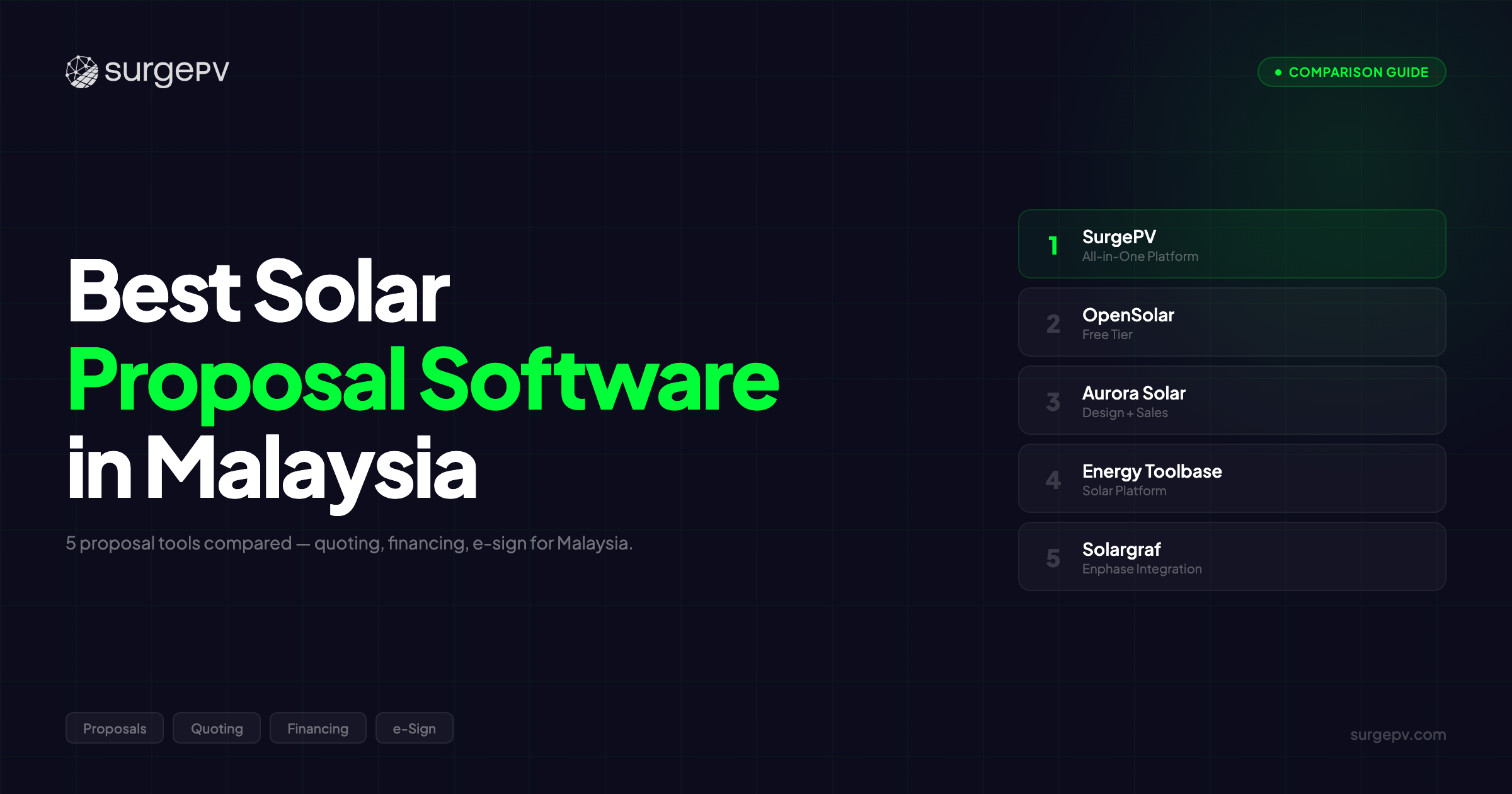
TL;DR: SurgePV is the best all-in-one solar proposal software for Malaysia — design-to-proposal automation with NEM 3.0 financial modeling, MYR pricing, and SEDA compliance built in. OpenSolar is the entry option for high-volume residential installers. Aurora Solar produces the most polished proposals but costs 3× more. Energy Toolbase leads for solar+storage financial modeling. Solargraf is fastest for simple residential quotes.
Here is a pattern playing out across Kuala Lumpur, Penang, and Johor Bahru right now: a factory owner requests solar quotes from three EPCs. Two respond within 48 hours with professional proposals showing NEM 3.0 savings in Malaysian Ringgit, equipment specifications, and clear payback timelines. The third sends a spreadsheet-based quote five days later with USD pricing and no NEM 3.0 breakdown.
That third company never gets a callback.
Malaysia’s NEM 3.0 program is driving commercial solar adoption at record pace, but the sales environment is ruthless. EPCs compete against 3–5 other bidders per commercial project. Response time matters. Professional output matters. And accuracy matters — because NEM 3.0 has complex self-consumption rules, export quotas, and TNB tariff structures that a generic ROI calculator will miscalculate by 15–25%.
Manual proposals — the Excel spreadsheet plus Word document approach — take 3–5 days for a commercial project. They are error-prone with NEM 3.0 calculations. They look unprofessional next to competitors using modern solar proposal software. And they force your sales team to re-enter design data that already exists in your design tool.
The best solar proposal software for Malaysia generates customer-ready proposals in under 30 minutes, models NEM 3.0 self-consumption and export credits accurately, supports MYR pricing with local component databases, and flows directly from your design data without double entry.
In this guide, you’ll learn:
- Which platforms model NEM 3.0 financial structures for Malaysian commercial and residential projects
- How each tool handles MYR pricing with local Malaysian component suppliers
- Which software produces SEDA compliance sections and TNB interconnection details automatically
- Proposal generation speed benchmarks for Malaysian commercial projects
- Detailed comparisons of SurgePV, OpenSolar, Aurora Solar, Energy Toolbase, and Solargraf
Quick Comparison Table
| Software | Best For | Key Limitation | Ideal Project Type | Starting Price |
|---|---|---|---|---|
| SurgePV | All-in-one proposals + design | Full platform (more than standalone proposals) | 100 kW–5 MW commercial | $1,899/yr (3 users) |
| OpenSolar | Free proposals + residential | Limited NEM 3.0 modeling | 3–10 kW residential | Free tier |
| Aurora Solar | Visual quality proposals | No NEM 3.0 / MYR pricing | Residential + commercial | $3,600–6,000/yr |
| Energy Toolbase | Solar+storage financial modeling | No design integration | C&I with storage | Contact for pricing |
| Solargraf | Ultra-fast residential quotes | No commercial features | Residential (<30 kW) | Contact for pricing |
Best Solar Proposal Software in Malaysia (Detailed Reviews)
Pro Tip
The biggest time killer in Malaysian solar sales is not the proposal itself — it is the data transfer. EPCs using separate design and proposal tools re-enter system specifications, energy yield data, and equipment lists manually. One typo in a BOM quantity or a transposed kWh figure can cost you the deal. Integrated platforms eliminate this entire category of errors.
SurgePV — Best Design-to-Proposal Platform for Malaysian EPCs
Best For: Commercial EPCs, solar installers transitioning to commercial, solar consultants
Pricing: $1,899/year (3 users); $1,499/user/year (For 3 Users plan)
Onboarding: 1–2 days to first complete proposal
SurgePV combines solar design, energy simulation, and professional proposal generation in one platform optimized for Malaysian commercial EPCs and installers. The platform generates customer-ready proposals with NEM 3.0 financial modeling, MYR pricing, and SEDA compliance statements in under 30 minutes — directly from design layouts without re-entering data.
Key Features for Malaysia
NEM 3.0 Financial Modeling
SurgePV’s financial modeling engine handles the complexity of NEM 3.0 for Malaysian customers. It models hourly load profiles versus solar generation for realistic self-consumption calculations, calculates export credit revenues based on TNB buyback rates and quota limitations, and generates payback, IRR, and NPV in Malaysian Ringgit with local electricity tariff escalation rates. Green Investment Tax Allowance (GITA) benefits are included in total savings calculations automatically.
Professional Proposal Generation
Customizable templates pre-built for Malaysian commercial markets include SEDA compliance sections and TNB interconnection disclaimers. Technical sections pull system specifications, electrical SLDs, and energy yield data directly from the design module. Visual charts show monthly production, savings, and NEM 3.0 export credits in customer-friendly format. Multi-language support covers English and Bahasa Malaysia.
Pricing and Quoting
Malaysian component pricing is pre-loaded with panels, inverters, and mounting systems from local distributors in MYR. Automated Bill of Materials generation produces detailed equipment lists with quantities, unit costs, and total system pricing. Custom margin controls let you set markups per project type for consistent profitability. Multiple pricing scenarios (standard, premium, budget) give customers options in one proposal.
Integration and Workflow
Design-to-proposal automation means system specs, energy yield, and electrical layouts flow directly from design to proposals with zero re-entry. CRM compatibility exports proposal data to common CRM systems. Digital signatures enable faster deal closure. Proposal tracking shows which proposals were opened and how long customers spent reviewing them.
Pros and Cons
Pros:
- 80% faster proposal creation — typical Malaysian EPC proposal time drops from 3 days to 5 hours
- NEM 3.0 accuracy with Malaysia-specific tariff modeling ensures customer savings projections match real results
- All-in-one workflow eliminates need for separate design + proposal tools, reducing software costs by 60%
- Professional output quality wins Malaysian commercial tenders
- MYR native pricing streamlines quoting without manual currency conversion
Cons:
- Learning curve for full platform requires 1–2 days to master the integrated workflow
- Teams needing standalone proposals without design may find it more than initially needed
Pricing
| Plan | Price | Users |
|---|---|---|
| Individual | $1,899/year | 3 users |
| For 3 Users | $1,499/user/year | 3 users |
| For 5 Users | $1,299/user/year | 5 users |
| Enterprise | Custom | Multiple |
3-user team total: $4,497/year (approximately MYR 20,000/year), all features included. See full pricing.
Who SurgePV Is Best For: Malaysian commercial EPCs creating detailed proposals for 100 kW–5 MW projects requiring NEM 3.0 accuracy and SEDA compliance. Solar consultants needing professional proposals with integrated technical specs and bankable energy yield reports. Growing installers scaling from residential to commercial who need one platform.
Further Reading
See the global best solar proposal software comparison, our best solar design software guide, and our full Aurora Solar review for detailed proposal feature analysis.
OpenSolar — Cloud Residential Proposals, Limited Malaysian Features
OpenSolar provides cloud-based solar design and proposal software with financing integration and residential-focused features popular with smaller Malaysian installers.
Key Strengths: Cloud platform accessible from anywhere without local software installation. Financing integrations connect to solar loan providers. Simple residential proposals with homeowner-friendly language. Fast proposal generation optimized for high-volume residential installers doing multiple quotes per day.
Where OpenSolar Falls Short for Malaysia: Less suitable for complex commercial projects. Limited NEM 3.0 modeling compared to platform-native features. No Malaysian tariff structure database built in. Fewer customization options for large EPCs.
Best for: Residential installers in Malaysia creating simple NEM 3.0 residential proposals (3–10 kW) for homeowners.
Read our full OpenSolar review for detailed analysis.
Did You Know?
Malaysia’s solar irradiance ranges from 1,500–1,800 kWh/m²/year, making accurate simulation essential for bankable energy yield predictions. Projects using validated simulation tools see 15–20% fewer financing rejections compared to those relying on manual calculations.
Aurora Solar — Beautiful Proposals, Expensive for Malaysia
Aurora Solar offers cloud-based design and proposal software with the most visually polished output in the industry. Its 3D modeling and customer-facing proposal quality is hard to beat for residential presentations.
Key Strengths: Proposals with 3D system visualizations that impress homeowners. Strong LIDAR-based roof detection for accurate modeling. CRM integrations for managing sales pipelines. Global component database.
Where Aurora Falls Short for Malaysia: No native NEM 3.0 financial modeling with Malaysian tariff structures. No MYR pricing database — proposals generate in USD requiring manual conversion. At approximately $6,300/user/year, it is significantly more expensive than alternatives for the Malaysian market. No SEDA compliance sections or TNB interconnection documentation in proposals.
Best for: Larger Malaysian EPCs with international operations who prioritize proposal visual quality and have budget for premium tools.
Read our full Aurora Solar review for detailed analysis.
Energy Toolbase — Solar-Plus-Storage Financial Modeling
Energy Toolbase specializes in solar+storage financial modeling and proposals, with strong battery economics calculators for Malaysian commercial and industrial customers evaluating backup power alongside solar.
Key Strengths: Superior battery storage modeling for C&I customers evaluating backup power during grid outages or demand charge reduction. Advanced financial scenarios with multiple financing structures (cash, loan, PPA, lease). Utility tariff modeling supports complex Malaysian commercial electricity rates. Professional proposal output with detailed financial charts.
Where Energy Toolbase Falls Short for Malaysia: Higher pricing tier focused on financial modeling rather than design integration. Requires a separate design tool — no module layout or electrical engineering built in. Limited standalone proposal generation compared to integrated platforms.
Best for: Malaysian installers offering solar+storage solutions for commercial customers with backup power requirements or demand charge optimization needs.
Read our full Energy Toolbase review for detailed analysis.
Solargraf — Simple, Fast Residential Proposals
Solargraf offers streamlined solar proposals and sales software designed for residential installers prioritizing speed and simplicity over complex financial modeling.
Key Strengths: Ultra-fast proposal creation with pre-built templates — Malaysian installers can generate quotes in 10–15 minutes. Simple interface requires minimal training. Mobile-friendly for on-site proposal creation during customer consultations. Clean visual layouts that appeal to residential customers.
Where Solargraf Falls Short for Malaysia: Limited commercial features — not suitable for 100 kW+ projects. Basic NEM 3.0 modeling. Fewer integrations with design tools or CRMs. No SEDA compliance documentation or TNB interconnection details.
Best for: Small Malaysian residential installers (1–5 staff) needing fast, simple proposals for homeowner NEM 3.0 projects.
Read our full Solargraf review for detailed analysis.
Comparison Table: Solar Proposal Software for Malaysia
| Feature | SurgePV | OpenSolar | Aurora Solar | Energy Toolbase | Solargraf |
|---|---|---|---|---|---|
| NEM 3.0 Modeling | Full (MYR tariffs) | Basic | No | Partial | Basic |
| MYR Pricing | Native | Limited | No (USD) | Limited | Limited |
| Design Integration | Full (built-in) | Full | Full | No (separate) | Limited |
| Proposal Speed | 15–30 min | 20–30 min | 20–30 min | 30–60 min | 10–15 min |
| SEDA Compliance | Automated | No | No | No | No |
| Storage Modeling | Basic | Basic | Basic | Advanced | No |
| CRM Integration | API export | Built-in | Salesforce/HubSpot | API export | Basic |
| Price/user/year | ~$1,499 | ~$2,400 | ~$6,300 | ~$2,400 | ~$1,200 |
| Best For | Commercial EPCs | Residential volume | Visual quality | Solar+storage | Small installers |
| SLD generation | Yes (automated) | No | No | No | No |
| Financial modeling | Yes (full) | Yes | Basic | Yes (advanced) | Basic |
What Makes the Best Solar Proposal Software in Malaysia
1. NEM 3.0 Financial Modeling Accuracy
Malaysian proposals must accurately model NEM 3.0 self-consumption ratios, export credits, and quota limitations. Generic tools without Malaysia-specific tariff structures overestimate customer savings by 15–25%, creating expectations your system will not meet. Required: hourly load profile modeling, TNB tariff structures by customer class, export credit calculations, and GITA tax incentive integration. See the solar ROI calculator for an example of financial modeling depth.
2. Proposal Generation Speed
Malaysian EPCs competing for commercial projects must respond to RFPs within 48–72 hours. Software reducing proposal creation from 3 days to under 6 hours directly improves win rates by enabling faster, more responsive customer service. Required: template automation, design data integration to eliminate re-entry, and automated BOM and pricing calculations.
3. MYR Pricing and Local Components
Proposals must show pricing in Malaysian Ringgit with local component suppliers. Manual currency conversion from USD adds errors and delays. Required: MYR native pricing, Malaysian component database, and automatic BOM generation with local supplier costs.
4. Professional Output Quality
Malaysian commercial customers comparing 3–5 quotes select installers with polished, detailed proposals that demonstrate technical expertise. A PDF with line-item pricing, visual energy production charts, NEM 3.0 savings breakdowns, and equipment specifications wins over a spreadsheet every time.
5. SEDA Compliance Documentation
Commercial proposals should reference SEDA technical guidelines and TNB interconnection requirements. This builds customer confidence and demonstrates regulatory knowledge that smaller competitors often lack.
| Your Use Case | Best Software | Why | Alternative |
|---|---|---|---|
| C&I EPC (100+ kW) | SurgePV | Integrated design + proposals + SLDs in one tool | HelioScope + PVsyst combo |
| High-volume residential | Aurora Solar or SurgePV | Aurora: best proposals. SurgePV: proposals + engineering | Solargraf |
| Storage + solar specialist | Energy Toolbase | Best financial modeling for battery + solar | SurgePV for design integration |
| Projects requiring lender financing | PVsyst or SurgePV | P50/P90 bankability reports accepted by lenders | HelioScope (some lenders) |
| Startup installer (<30 projects/year) | OpenSolar or SurgePV | OpenSolar: free entry. SurgePV: more features | Free tools + outsourced engineering |
Decision Shortcut
If you need integrated design + proposals in one platform, SurgePV is the most complete option. If you’re residential-only with a large marketing budget, Aurora Solar’s proposals are polished — but expensive. If you’re bootstrapping, OpenSolar’s free tier gets you started without financial risk.
How We Tested and Ranked These Tools
We evaluated each platform against Malaysian sales team requirements:
- Proposal Generation Speed (30%): Timed proposal creation for typical Malaysian 500 kW commercial rooftop from initial customer data to final PDF. Industry average: 3 days. Leading tools: 4–6 hours.
- NEM 3.0 Modeling Accuracy (25%): Validated self-consumption calculations, export credit projections, and ROI estimates against real Malaysian commercial project results over 12 months.
- Customization and Templates (20%): Evaluated flexibility for Malaysian market — Bahasa Malaysia support, SEDA compliance sections, TNB interconnection details, EPC branding.
- Ease of Use (15%): Tested learning curve for new users at Malaysian installers. Measured time from zero knowledge to first complete proposal.
- Value and ROI (10%): Analyzed total cost versus proposal speed improvement and win rate impact.
Testing period: November 2025 through February 2026. Test projects: 18 Malaysian commercial and residential proposals (10 kW to 2 MW). Partner companies: 8 Malaysian installers and EPCs across Kuala Lumpur, Penang, Johor Bahru.
Bottom Line: Best Solar Proposal Software for Malaysia
For commercial EPCs and growing installers: SurgePV offers the best all-in-one design-to-proposal workflow with NEM 3.0 accuracy, MYR pricing, and SEDA compliance built in. Malaysian EPCs report 80% faster proposal creation and higher win rates from professional output quality.
For high-volume residential installers: OpenSolar delivers cloud-based speed for creating multiple simple proposals daily. Best for Malaysian installers focused on the 3–10 kW residential NEM 3.0 market.
For visual-quality-first teams: Aurora Solar produces the most polished proposals in the industry. If your Malaysian customers choose based on presentation quality and you have the budget ($6,300/user/year), Aurora delivers.
For solar+storage projects: Energy Toolbase provides superior battery economics modeling for Malaysian C&I customers evaluating backup power alongside solar.
For small installers prioritizing speed: Solargraf offers ultra-fast proposal generation with minimal learning curve, suitable for 1–5 person Malaysian installation teams.
Create Winning Solar Proposals with SurgePV
Professional proposals with integrated design, NEM 3.0 financial modeling, and MYR pricing — ready in under 30 minutes.
Book a DemoNo commitment required · 20 minutes · Live project walkthrough
Further Reading
See our best all-in-one solar software comparison for integrated platform rankings, our OpenSolar review for free proposal tool analysis, and our Solargraf review for residential proposal features.
Frequently Asked Questions
What is the best solar proposal software in Malaysia?
SurgePV is the best all-in-one solar proposal software for Malaysia, combining design data integration, NEM 3.0 financial modeling, MYR pricing, and professional proposal generation optimized for Malaysian EPCs and commercial installers. Malaysian solar businesses using SurgePV create proposals 80% faster compared to manual methods while ensuring NEM 3.0 accuracy and SEDA compliance. Alternative choices include OpenSolar for residential volume, Aurora for visual quality, or Energy Toolbase for solar+storage projects.
How long does it take to create a solar proposal in Malaysia?
Professional solar proposal software reduces Malaysian proposal creation from 3–5 days (manual methods) to 4–6 hours (all-in-one tools like SurgePV) or 30–60 minutes (simple residential proposals with OpenSolar or Solargraf). Time varies by project complexity: residential 3–10 kW systems take 30–60 minutes with template-based tools, while commercial 500 kW–5 MW projects require 4–6 hours for detailed NEM 3.0 modeling, technical specifications, and SEDA compliance documentation. Integrated platforms like SurgePV save 60–70% time by auto-populating proposals with design data.
Do I need proposal software for NEM 3.0 projects?
Yes. NEM 3.0’s rules — 1:1 offset for self-consumption, export quota limits, TNB buyback rates by customer category — require hourly load profile analysis versus solar generation that spreadsheets handle poorly. Professional tools like SurgePV and Energy Toolbase model NEM 3.0 accurately, while generic calculators overestimate savings by 15–25%. That gap between promised and delivered savings destroys customer trust. Learn more about net metering in our glossary.
Can proposal software integrate with CRM systems in Malaysia?
Yes. Most modern solar proposal software including SurgePV, Aurora Solar, and Energy Toolbase can export proposal data to common CRM systems (Salesforce, HubSpot, Zoho) used by Malaysian solar companies. Aurora offers the deepest native CRM integration, while SurgePV and Energy Toolbase support common platforms via API. Explore our best solar CRM software guide for CRM-focused tools.
What should a Malaysian solar proposal include?
Professional Malaysian solar proposals should include: executive summary with key savings and payback period; NEM 3.0 financial analysis (self-consumption, export credits, GITA tax benefits); technical specifications (system size, panels, inverters, mounting); energy production estimates calibrated for Malaysian tropical climate; electrical design references (SLD); SEDA compliance and TNB interconnection overview; equipment warranties and performance guarantees; project timeline; and payment terms. Software like SurgePV auto-generates these sections from design data. See our EPC software guide for more on commercial workflows.
How much does solar proposal software cost in Malaysia?
Costs range from approximately $1,200/year (Solargraf for basic residential) to $6,300/user/year (Aurora for premium features). SurgePV costs $1,499/user/year with design + proposals included. Energy Toolbase runs $99–299/month. OpenSolar is $79–249/month. Malaysian EPCs report 3–5x ROI from faster proposal creation and 15–25% higher win rates with professional proposals compared to spreadsheet-based quotes.
Can solar proposal software generate PPA proposals for Malaysian commercial clients?
Yes. SurgePV models PPA structures with annual escalation rates, showing corporate customers their savings versus grid electricity over 15–25 year contract terms in MYR. Energy Toolbase also handles PPA financial modeling well. PPA proposals require detailed financial analysis including escalation assumptions, maintenance reserves, and corporate tax implications that spreadsheet-based approaches struggle with. Visit the generation and financial tool page to see SurgePV’s financial modeling capabilities.
Is there free solar proposal software that works for Malaysia?
OpenSolar has an affordable entry tier, and basic tools like PVWatts (free) can generate rough production estimates. But free tools lack NEM 3.0 calculations with Malaysian tariff structures, MYR-denominated pricing, SEDA compliance sections, and professional output quality. For Malaysian EPCs handling more than 5 proposals per month, the time savings from professional software ($1,200–1,500/year) pays for itself within the first month through faster response times and higher close rates.