
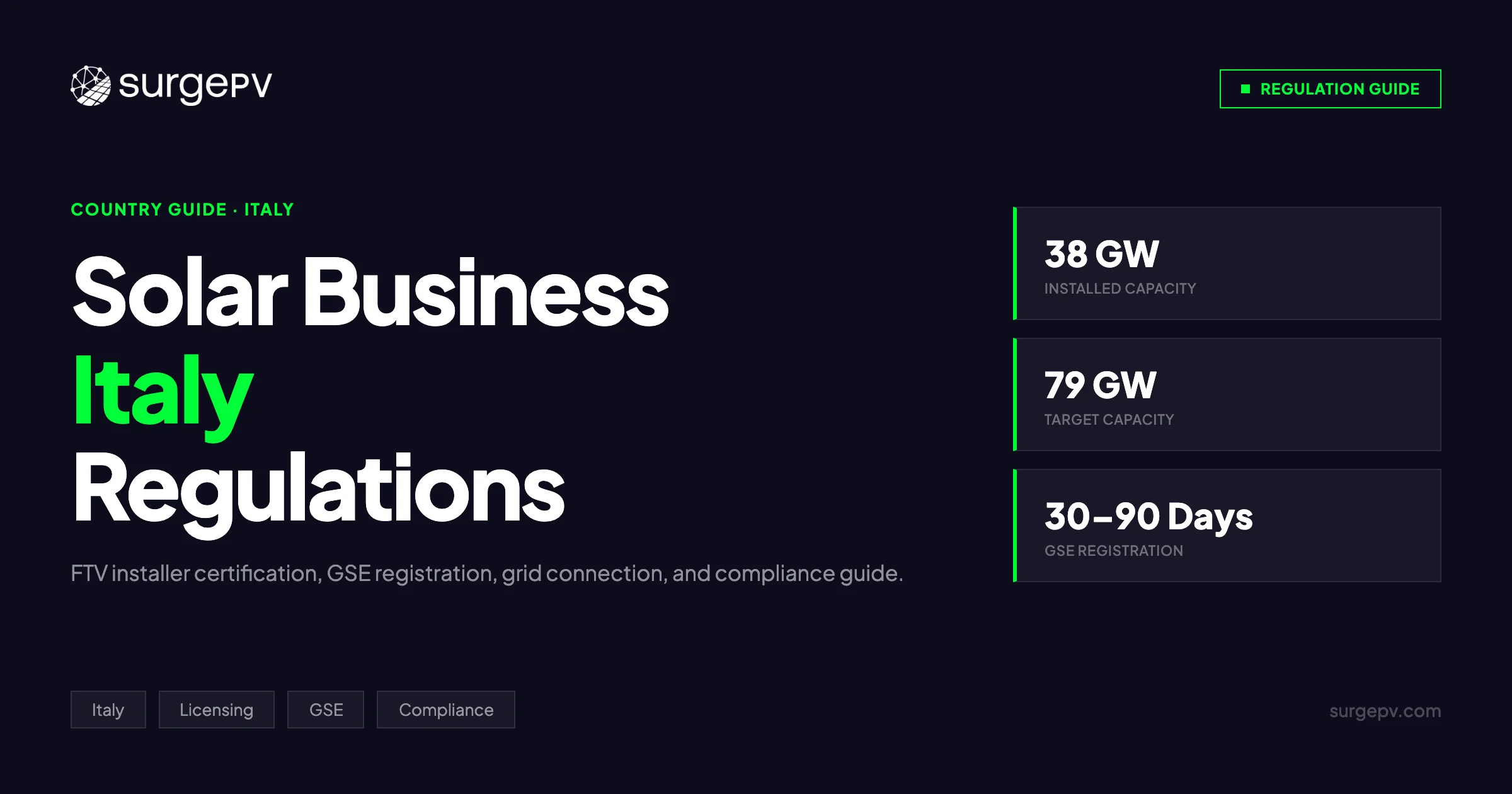
Italy’s solar sector has expanded at extraordinary speed over the past four years — from roughly 22 GW of installed photovoltaic capacity in 2021 to an estimated 38 GW by end of 2025, with the government targeting 79 GW by 2030 under the updated PNIEC (Piano Nazionale Integrato per l’Energia e il Clima). For solar businesses operating in this market, that growth narrative is compelling. But behind every megawatt installed sits a dense web of licensing requirements, permit categories, grid connection protocols, GSE registration rules, and technical standards that can stop a project cold if mismanaged.
This guide is written for solar installation companies, EPC contractors, and financial backers operating in Italy who need a clear, current view of the regulatory environment as it stands in 2026. It covers everything from the FTV installer certification you need before you touch a panel to the CEI 0-16 standard your medium-voltage connection must meet, from VAT treatment of solar services to the regional variations that make Sicilian projects behave very differently from Lombard ones.
Key Takeaway
Italy’s solar regulatory framework is split across national legislation (primarily D.Lgs. 28/2011, D.M. 37/2008, and the PNIEC), sector-specific bodies (GSE, ARERA, ENEA, TERNA), and 20 regional administrations — each with its own permitting culture. Navigating all three layers simultaneously is the single biggest operational challenge for solar businesses in Italy in 2026.
TL;DR — Italy Solar Business Regulations 2026
Before diving into the detail, here is the fast-read version:
- Installer certification: FTV certification (D.Lgs. 28/2011) is mandatory for all solar installers; D.M. 37/2008 electrical qualification required for systems above 20 kWp on the medium-voltage grid.
- Company qualification: SOA certification (OS30 or OG11 category) required for public contracts exceeding €150,000.
- Building permits: CILA for most rooftop systems up to 50 kWp; SCIA for larger or heritage-adjacent systems; permesso di costruire for ground-mount above 1 MWp or in protected zones.
- Grid connection: Must follow TERNA’s “Regole Tecniche” for HV/MV and CEI 0-21 for LV; process managed through distributors (e-distribuzione, Areti, A2A Reti Elettriche etc.).
- GSE registration: Required to access Scambio sul Posto, Ritiro Dedicato, and any incentive programme; typical timeline 30–90 days.
- Technical standards: CEI 0-21 for LV connections, CEI 0-16 for MV connections, CEI 82-25 for PV systems (superseded by CEI EN 62446, but CEI 82-25 references still appear in contracts).
- VAT: Solar installation services are subject to 10% VAT (reduced rate); panels and components are 22% unless installed as part of a habitation upgrade under specific conditions.
- Incentives: Detrazione Fiscale 50% for residential; Transizione 5.0 tax credit for commercial; Agrisolare for agrivoltaic; no active Conto Energia feed-in tariff for new installations.
Latest Updates: Italy Solar Business Regulations 2026
The Italian regulatory environment shifted substantially between 2024 and early 2026. These are the most significant changes solar businesses must be aware of:
PNIEC revision (December 2024): Italy’s updated National Energy Plan raised the 2030 renewables target and explicitly prioritised rooftop and agrivoltaic solar over large ground-mounted systems. This has practical consequences: permitting fast-tracks introduced under the DL Semplificazioni (Law 108/2021) were extended and slightly broadened in scope, reducing the universe of projects that require a full Environmental Impact Assessment (VIA).
Transizione 5.0 (operative from Q1 2025): The Transizione 5.0 tax credit programme replaced portions of Industria 4.0 for energy-efficiency linked investments. Solar installations connected to digitally monitored production processes now qualify for credits of 35–45% of eligible cost. This is significant for C&I solar businesses because it creates a new financing conversation with manufacturing clients.
Agrisolare evolution: The second tranche of Agrisolare funding (€1.5 billion under PNRR Missione 2) closed applications in late 2024. A third tranche was announced in February 2026 with updated eligible crop categories and a new requirement for bifacial panels on all new applications. Installers who did not update their product catalogue before applying have seen applications rejected.
GSE portal update: GSE relaunched its online portal (portale gestione pratiche) in October 2024 with new document upload requirements. All new applications must now include a machine-readable XML declaration of system parameters alongside the traditional PDF technical dossier. Installers using legacy documentation templates have experienced processing delays of 60–90 additional days.
CEI 0-21 Ed. 4 (2024): A revised edition of CEI 0-21 took effect in January 2025, updating anti-islanding protection requirements and introducing new reactive power capability thresholds for inverters above 6 kW. All inverter models used in new installations must carry updated CEI 0-21 Ed. 4 type-approval certificates.
Regional permitting reforms: Lombardia, Emilia-Romagna, and Puglia all issued regional ordinances between mid-2024 and early 2026 streamlining rooftop solar permitting. In Puglia specifically, a 2025 regional law (L.R. 22/2025) introduced a digital “sportello unico” (one-stop-shop) for solar permits below 1 MWp, reducing average approval times from 14 months to approximately 5 months for qualifying projects.
Pro Tip
Bookmark the GSE’s “Normativa e Documenti” section and sign up for ARERA’s regulatory newsletter. Both update frequently and the changes are rarely publicised through trade media before they take effect. Use good solar design software that stays current with Italian technical standards so your documentation packages are always compliant from day one.
Installer Certification Requirements: FTV and D.M. 37/2008
FTV Certification (Fotovoltaico)
The foundational credential for any solar installer operating in Italy is the FTV certification introduced by D.Lgs. 28/2011 (which transposed EU Directive 2009/28/CE on renewables). Without this certification, an installer cannot legally carry out solar PV installation work, and — critically — GSE will not accept a system registration submitted by an uncertified company.
FTV certification is obtained through accredited training bodies (enti di formazione accreditati) recognised by MASE (Ministero dell’Ambiente e della Sicurezza Energetica). The training programme covers:
- Photovoltaic system design principles
- Electrical installation safety (both AC and DC circuits)
- Structural loading and mounting system requirements
- Grid connection procedures and documentation
- Safety regulations (D.Lgs. 81/2008 — workplace safety)
The standard course runs approximately 80 hours for new entrants, with shorter refresher programmes (typically 20–40 hours) available for qualified electricians with relevant prior experience. Each certified installer receives a unique registration number that must appear on all GSE submissions, building permit applications, and client contracts.
Key practical points:
- FTV certification is individual — it belongs to the named installer, not the company. A business with ten employees must ensure that at least the lead installer on each project holds the certification.
- The certification is nationally recognised across all Italian regions, but some regions have added supplementary regional competency registers (albi regionali) — Toscana and Valle d’Aosta being the most notable examples.
- Re-certification is required every five years. Installers who miss the renewal window lose their registration number and cannot submit GSE applications until they complete a refresher course and re-register.
- The EU Blue Card framework means that certified installers from other EU member states can apply for Italian FTV equivalence through MASE’s recognition process, which typically takes 3–6 months.
D.M. 37/2008: Electrical Qualification
D.M. 37/2008 (formerly Law 46/1990) governs the installation of electrical systems in buildings. For solar PV specifically, it establishes that anyone installing systems that connect to the low-voltage or medium-voltage grid must hold a relevant electrical qualification — either as a qualified electrician (abilitato) or as a company with a qualified technical director (responsabile tecnico).
For solar businesses, D.M. 37/2008 matters in two concrete ways:
-
Declaration of Conformity (Dichiarazione di Conformità, or DdC): On completion of every installation, the installing company must issue a DdC confirming that the electrical system meets all applicable standards. This document is required by the local DSO to energise the system and by GSE for incentive registration. A company without the appropriate D.M. 37/2008 qualification cannot legally issue a DdC.
-
System above 20 kWp connecting to MV grid: For larger commercial systems, D.M. 37/2008 qualifications for HV/MV electrical work (categoria OE — opere elettriche) are required. Many small residential installers lack this qualification, which is why subcontracting arrangements with MV-qualified electrical firms are common on commercial projects.
Company Registration: SOA Certification for Larger Projects
SOA (Organismo di Attestazione) certification is Italy’s system for qualifying construction companies to bid on public works contracts. For solar businesses, it becomes relevant when:
- Bidding on public sector solar projects (schools, hospitals, municipalities, government buildings)
- Participating in regional or national renewable energy tenders
- Acting as main contractor on projects funded through EU instruments (PNRR, structural funds)
The relevant SOA categories for solar are:
| Category | Description | Applies to |
|---|---|---|
| OS30 | Impianti fotovoltaici | PV-specific systems and components |
| OG11 | Impianti tecnologici | Broader electromechanical systems |
| OS19 | Sistemi di telecomunicazione | Where SCADA/monitoring is a significant contract element |
SOA certification is tiered by contract value (classifica I through VIII, ranging from up to €258,000 to above €15.4 million). The classification determines the maximum public contract value a company can bid on as prime contractor. Companies are assessed on their financial statements, reference projects, technical staff, and equipment.
Practical implications for solar businesses:
- A residential installer without SOA certification is effectively locked out of the public sector solar market.
- Obtaining SOA certification typically takes 3–5 months and requires at least three years of operating history with auditable accounts.
- SOA certificates must be renewed every three years (with an interim verification at 18 months).
- For PNRR-funded projects specifically, contracting authorities have been stricter about verifying SOA categories because EU audit requirements demand documented supplier qualification.
Key Takeaway
If your solar business intends to pursue public contracts in Italy — including PNRR-funded school solarisation programmes or municipal energy community projects — budget 3–5 months and approximately €5,000–€15,000 for the SOA certification process before you start tendering. Missing this qualification at the bid stage disqualifies your company regardless of technical merit.
Building Permit Types: CILA, SCIA, and Permesso di Costruire
Italy’s building permit regime for solar has been substantially simplified since 2020, but it remains tiered by system size, building type, and location. Getting the permit category wrong is one of the most common causes of project delays — and in the worst cases, of retrospective enforcement action that forces panel removal.
CILA (Comunicazione di Inizio Lavori Asseverata)
CILA is the lightest-touch permit category — essentially a notification to the local Comune (municipality) that work is starting, countersigned (asseverata) by a qualified architect, engineer, or geometra who certifies that the work conforms to regulations.
CILA applies to solar installations when:
- The system is installed on an existing rooftop (not new-build)
- System capacity is up to 50 kWp for residential and small commercial
- The building is not in a historically protected zone (zona vincolata) under D.Lgs. 42/2004 (Codice dei Beni Culturali)
- The installation does not alter the building’s external volume or facade characteristics beyond the panels themselves
Under the DL Semplificazioni (converted to Law 108/2021) and subsequent clarifications, many solar rooftop systems that previously required SCIA were reclassified as CILA-eligible, significantly reducing the administrative burden. The CILA is submitted online through the Comune’s SUAP (Sportello Unico per le Attività Produttive) or SUE (Sportello Unico per l’Edilizia) portal. Work can begin on the same day the CILA is submitted — no waiting period is required.
Important caveat: CILA does not exempt you from compliance with the Codice dei Beni Culturali. In historic centres or areas with landscape protection constraints (vincoli paesaggistici), even a CILA-eligible system may require a separate nulla osta from the Soprintendenza (heritage authority). Failing to obtain this authorisation is a criminal offence under Italian law and leads to mandatory restoration of the building to its original state.
SCIA (Segnalazione Certificata di Inizio Attività)
SCIA is one level above CILA. It is also self-certified by a qualified professional, but the documentation package is more comprehensive and the Comune has the right to inspect and suspend work within 30 days of submission (60 days for particularly sensitive categories).
SCIA is typically required for:
- Systems between 50 kWp and 1 MWp on existing buildings
- Any solar installation on a building in a heritage-sensitive zone where CILA is insufficient
- Roof-integrated (BIPV) systems that alter the building’s external appearance
- Installations requiring structural assessment reports (relazione strutturale) because the roof loading changes significantly
The SCIA package must include a technical project report, structural calculations (if relevant), CEI 0-21 or 0-16 compliant electrical schematic, a planimetric drawing showing panel layout, and the professional’s certified declaration (asseverazione).
Permesso di Costruire
The full building permit — permesso di costruire — is required for:
- Ground-mounted solar systems above 1 MWp (in most regions; thresholds vary)
- Any solar installation in areas subject to hydrogeological constraints (vincolo idrogeologico)
- Systems in national parks or Natura 2000 protected areas
- Projects requiring Environmental Impact Assessment (VIA) at regional or national level
- All agrivoltaic installations above 200 kWp (though some regional fast-tracks apply)
The permesso di costruire requires explicit approval from the Comune before work can start. Processing times range from 60 days (for straightforward applications) to 18+ months for projects requiring VIA or involving multiple authorities. For utility-scale solar, it is common to engage a specialist permitting consultant (consulente autorizzativo) who manages relationships with the 5–8 authorities that may need to issue their own sectoral clearances (nulla osta).
Autorizzazione Unica: For projects above 1 MWp, the Autorizzazione Unica (AU) process managed by the regional government coordinates all sectoral approvals in a single procedure. The AU was introduced specifically to streamline large renewable energy projects, but timelines remain variable — from 180 days in Emilia-Romagna to over 36 months in Sardegna for contested ground-mount proposals.
Pro Tip
Always commission a preliminary vincoli check before agreeing project timelines with a client. A simple CILA project can become an 18-month permesso di costruire exercise if the building sits within a 150-metre buffer zone from a heritage-listed site — a constraint that does not show up unless you query the Catasto and regional GIS layers specifically. Modern solar design software with Italian cadastral data integration can surface these constraints at the feasibility stage rather than after contracts are signed.
Grid Connection Process: ENEA, TERNA, and Distributors
Italy’s grid connection process involves multiple actors depending on system size, and the sequence matters: submitting documents in the wrong order or to the wrong entity can reset your timeline.
Low-Voltage Connections (up to 100 kW)
For small residential and commercial systems connecting to the low-voltage (230V / 400V) grid:
-
Pre-connection inquiry (Preventivo di connessione): The system owner (or installer as their agent) submits a connection request to the local DSO (Distribution System Operator). The main DSOs in Italy are e-distribuzione (Enel group, covering ~85% of the national territory), Areti (Rome), A2A Reti Elettriche (Lombardia/Brescia), INRETE Distribuzione Energia (Emilia-Romagna), and various municipal operators. The DSO has 30 days (residential) or 45 days (commercial) to respond with a connection offer (preventivo).
-
Acceptance and payment: The customer accepts the offer and pays the connection fee quoted by the DSO. For systems under 11.08 kW (single-phase) or 33.24 kW (three-phase), the connection fee is standardised by ARERA and typically ranges from €200–€800. Larger systems are quoted individually.
-
Technical work: The installer carries out the installation. At completion, the installer issues the Dichiarazione di Conformità (DdC) under D.M. 37/2008 and prepares the CEI 0-21 Ed. 4 compliance declaration.
-
Connection activation: The DSO visits the site to inspect the metering point and activate bidirectional metering. This visit can take 10–40 business days from when all documents are submitted.
-
GSE registration: Only after the DSO connection is active can the installer complete the GSE portal submission for Scambio sul Posto or Ritiro Dedicato.
Medium-Voltage Connections (100 kW to 10 MW)
For commercial and light industrial systems connecting to the MV (6 kV–36 kV) grid, the process follows the same general sequence but with significantly more technical documentation:
- CEI 0-16 compliant protection relay scheme and settings
- System studies (load flow, fault level, harmonic analysis) if the DSO requires them
- Potential Autorizzazione Unica for systems above 1 MWp (as noted in the permits section)
- Connection agreement (contratto di connessione) rather than a simple offer letter
MV connection timelines run 3–12 months from application to energisation, with significant variation between DSOs. e-distribuzione’s national process is generally faster; smaller municipal operators can be considerably slower.
High-Voltage Connections (above 10 MW)
Projects connecting to the high-voltage (≥132 kV) transmission network fall under TERNA’s jurisdiction. TERNA publishes its own “Regole Tecniche di Connessione” and manages the HAC (Hauristic Assessment of Connections) process. At this scale, the connection study alone can take 12–18 months and result in significant grid reinforcement costs that the project developer must fund. For most solar businesses in Italy, HV connections are relevant only for utility-scale projects (50 MWp+) developed by specialist IPPs.
Key Takeaway
The single most common cause of Italian solar project delays is a mismatch between the building permit timeline and the DSO connection timeline. Both need to start early, in parallel — but the DSO will not accept a connection application without at least a preliminary building permit number in most regions. Map both critical paths from day one using your solar proposal software so clients understand that a “6-month project” can become 14 months if either path is mismanaged.
GSE Registration and Eligibility
GSE (Gestore dei Servizi Energetici) is the state-owned entity that manages Italy’s renewable energy incentive programmes and the administrative relationship between solar producers and the grid. Every solar PV system in Italy that wants to access any incentive scheme — or even just participate in Scambio sul Posto — must be registered with GSE.
What Requires GSE Registration
- Scambio sul Posto (SSP): Italy’s net-metering programme for systems up to 500 kWp. The GSE calculates the virtual compensation between energy fed in and energy drawn from the grid and issues a quarterly settlement. All systems below 500 kWp that want net-metering must register.
- Ritiro Dedicato (RD): The feed-in purchase scheme for larger systems. GSE purchases surplus energy at a regulated price set by ARERA. Mandatory for systems above 500 kWp; optional for smaller systems as an alternative to SSP.
- Transizione 5.0: While the tax credit itself is administered through the Agenzia delle Entrate, GSE acts as the certifying body that validates that a solar installation meets the energy saving threshold required to unlock the credit. Without a GSE certification, the tax credit cannot be claimed.
- Agrisolare: GSE manages the incentive grants for agrivoltaic systems on agricultural land. Applications, technical audits, and disbursements all go through GSE.
GSE Registration Process (Step by Step)
- System completion and DdC: Obtain the Dichiarazione di Conformità from the installing electrician.
- DSO connection confirmation: Obtain the DICO (Dichiarazione di Connessione) or equivalent confirmation letter from the DSO confirming the meter is bidirectional and the system is energised.
- Portal registration: Log into the GSE portale gestione pratiche. Create a plant (impianto) record with: address and cadastral data, system size and technology type, inverter model and CEI certification number, panel manufacturer and model, mounting type, FTV certification number of the responsible installer, DdC reference number, DICO reference number.
- XML upload (new requirement from October 2024): Upload the machine-readable XML technical data file alongside the PDF dossier. The XML schema is published by GSE on their website.
- GSE review: GSE has 30 days (SSP/RD) or 60 days (incentive schemes) to approve, request corrections, or reject. Common rejection reasons: mismatched cadastral reference, inverter model not appearing in GSE’s approved list, incorrect FTV certification number, XML/PDF data inconsistencies.
- Convention signing: If approved, GSE issues a convention (convezione) which both parties sign electronically. The convention defines the commercial terms of the incentive or SSP arrangement.
Timeline reality check: While the statutory timeline is 30–60 days, processing backlogs at GSE have meant actual timelines of 60–150 days for new applications. Systems in regions with high application volumes (Puglia, Sicilia, Lazio) experience the longest waits. This means that clients counting on GSE income from month 1 of operation need to build a 3–5 month income gap into their financial modelling — something that becomes immediately visible when you use a generation and financial modelling tool that sequences commissioning against incentive receipt.
Pro Tip
Prepare the GSE documentation package in parallel with the installation, not after it. The XML file and technical dossier can be drafted and QC’d while the physical installation is underway. Submitting on the day of energisation rather than 4–6 weeks later meaningfully reduces the time to first GSE settlement. Use solar software that generates compliant documentation templates to eliminate manual transcription errors that trigger rejection requests.
CEI 0-21 and CEI 0-16 Compliance
Italy does not use EN standards directly for grid connection of renewable energy sources — it uses CEI (Comitato Elettrotecnico Italiano) standards that adapt and extend the European framework. For solar businesses, the two critical standards are CEI 0-21 (LV connections) and CEI 0-16 (MV connections).
CEI 0-21 Ed. 4 (January 2025)
CEI 0-21 governs the technical requirements for connecting active users (including solar PV generators) to the low-voltage distribution network. Edition 4, which became mandatory for all new installations from January 2025, introduced several changes that directly affect hardware selection and system design:
Anti-islanding: Inverters must implement the frequency shift anti-islanding method (or an equivalent approved method) with detection times not exceeding 300ms. The protection relay must trip on: under-voltage (below 0.85 pu for 400ms), over-voltage (above 1.10 pu for 400ms or 1.15 pu for 100ms), under-frequency (below 47.5 Hz for 100ms), over-frequency (above 51.5 Hz for 100ms).
Reactive power capability: Inverters above 6 kW must be capable of providing reactive power support to the grid (power factor range 0.9 leading to 0.9 lagging). The DSO may activate this function remotely after connection.
Voltage ride-through (VRT): Systems above 11.08 kW must support low-voltage ride-through (LVRT), remaining connected during voltage dips down to 0.2 pu for up to 625ms. This requirement is new in Edition 4 and not all inverter models that were CEI 0-21 Ed. 3 certified automatically carry Edition 4 approval.
Practical implication: Before specifying an inverter for a new Italian project, check that the model has a current CEI 0-21 Ed. 4 type-approval certificate. The CEI approved equipment list (lista delle apparecchiature approvate) is updated quarterly. Using an inverter with only Ed. 3 certification on a post-January 2025 installation will result in the DSO refusing to activate the connection.
CEI 0-16 (MV Connections)
CEI 0-16 is the equivalent standard for medium-voltage connections. For solar businesses it means:
- A dedicated MV protection relay (relay di interfaccia) is mandatory, separate from the inverter’s internal protection.
- The relay settings are agreed with the DSO during the connection study phase and specified in the contratto di connessione.
- Annual or biennial testing of the protection relay must be performed and documented; the testing report is required at GSE submission and subsequently as part of O&M compliance.
- Harmonic current injection must comply with CEI EN 61000-3-12 and any additional limits specified by the local DSO.
CEI 82-25 and CEI EN 62446
CEI 82-25 (Guide for realization of photovoltaic systems) was the foundational Italian PV design standard for many years. It has been largely superseded by CEI EN 62446 (IEC 62446), which covers commissioning tests, documentation, and inspection requirements for PV systems. However, CEI 82-25 references still appear in older contracts, insurance policies, and some regional building codes. Knowing both standards — and being able to confirm which one a client’s contract references — is part of professional practice for Italian solar installers.
VAT Regime for Solar Installers
VAT treatment of solar installation in Italy is complex because it depends on the nature of the work, the type of client, and the characteristics of the building. Getting it wrong creates cash-flow exposure and, in audits, potential penalties.
Installation Services: 10% VAT
Solar PV installation services are classified as “manutenzione straordinaria” (extraordinary maintenance) or “ristrutturazione edilizia” (building renovation) for residential properties. Both categories attract the 10% reduced VAT rate rather than the standard 22%.
For commercial and industrial clients, the situation is more nuanced. If the solar system is being installed as part of a broader factory or building renovation, the installation service can still qualify for 10% VAT. A stand-alone commercial installation without a broader building works context is more likely to be assessed at 22%.
Components and Equipment: 22% VAT
Solar panels, inverters, mounting structures, cables, and other components are generally subject to 22% VAT when purchased by the installing company. The 10% rate applies only to services (labour), not to goods — unless the goods are “incorporated” into the installation work and the goods cost represents less than 50% of total contract value (in which case the entire contract may be invoiced at the service rate of 10%). This 50% threshold is a critical calculation point in contract structuring.
Reverse Charge (Inversione Contabile)
For B2B transactions within the construction sector, Italy applies reverse charge (inversione contabile) under Art. 17(6) DPR 633/72. This means that when a solar installer subcontracts installation work to another construction-sector company, the subcontractor invoices without VAT and the main contractor self-assesses VAT. This avoids cash-flow problems in supply chains but requires careful contract structuring and accurate sector code (codice ATECO) classification.
VAT and Incentives
Claiming the Detrazione Fiscale 50% tax deduction (see solar incentives Italy) requires that the invoice be paid via bonifico bancario parlante (a bank transfer with specific reference codes). Cash payments are disallowed. For the Transizione 5.0 credit, invoices must explicitly reference the enabling legislation (Art. 38 DL 19/2024) — an omission that causes the credit to be denied on audit.
Subcontracting Rules
Solar installation projects in Italy frequently involve subcontracting — specialist mounting subcontractors, MV electrical subcontractors, monitoring system integrators — and the rules governing these relationships have compliance implications.
Public Contracts
For projects procured under the Codice dei Contratti Pubblici (D.Lgs. 36/2023), subcontracting is permitted up to 50% of the total contract value. Each subcontractor must:
- Hold relevant SOA certification for their portion of the work (if the subcontracted value exceeds relevant thresholds)
- Be declared to the contracting authority in advance of work starting
- Be paid directly by the contracting authority in most cases (direct payment obligation)
- Pass the ANAC (Autorità Nazionale Anticorruzione) white-list check if operating in sectors subject to anti-mafia and anti-corruption controls
Private Contracts
For private sector solar projects, subcontracting rules are less prescriptive but still matter:
- VAT reverse charge: As noted above, construction sector reverse charge applies between main contractor and subcontractor if both operate under construction ATECO codes.
- DURC (Documento Unico di Regolarità Contributiva): Every subcontractor must have a valid DURC — the document confirming they are current with social security (INPS) and accident insurance (INAIL) contributions. The main contractor is responsible for verifying DURC validity before allowing subcontractor work to start. A subcontractor with an invalid DURC exposes the main contractor to joint liability for the subcontractor’s social security debts.
- Responsabilità solidale: Under Italian law (Art. 29 D.Lgs. 276/2003), the main contractor is jointly and severally liable for unpaid wages of a subcontractor’s workers on the project. This liability extends for two years after project completion.
Insurance Requirements
Italian law mandates specific insurance coverage for solar installation businesses. Gaps in coverage — particularly around professional liability — regularly surface during loss events and can leave businesses with uninsured exposure.
Mandatory Coverages
RC Professionale (Professional Liability): Not universally mandatory by law for all solar installers, but required by most client contracts and by GSE for incentive scheme access. Covers claims arising from design errors, specification mistakes, and advice given during project development. Cover limits typically required: €500,000–€2,000,000 per event.
RC Impresa / RC Terzi (Third-Party Liability): Mandatory for all businesses employing workers. Covers bodily injury and property damage caused to third parties during installation work. Minimum legal cover: €500,000 per event for most activities; higher limits are standard in commercial contracts.
INAIL (National Institute for Insurance against Accidents at Work): All employees engaged in solar installation (classified as construction work under ATECO 43.21 or 43.29) must be registered with INAIL and premiums paid. The INAIL rate for roof-working and electrical installation activities typically runs 3–6% of gross payroll. Non-registration is a criminal offence and triggers significant back-premium assessments on inspection.
CAR (Contractor’s All Risks) for larger projects: For commercial and utility-scale projects, CAR insurance is typically required under the EPC contract. It covers physical damage to the works during construction, third-party liability during the construction period, and sometimes delayed start-up (if commissioning delays trigger penalties under the offtake agreement).
Post-Completion Warranties
Under Italian law (Codice Civile Art. 1667–1669), contractors are liable for visible defects for two years after delivery and for latent structural defects for ten years. Solar installers routinely provide:
- 2-year workmanship warranty (matching the legal minimum)
- 10-year or 25-year panel performance warranties (passed through from manufacturers)
- Inverter warranties (typically 5–10 years, extendable)
Errors in warranty documentation — such as failing to register the system with the panel manufacturer’s warranty programme at commissioning — are a common O&M compliance gap that surfaces only when a claim is made, often years after the installer has moved on.
Manage Italian Solar Compliance from a Single Platform
SurgePV’s solar design software integrates Italian technical standards, GSE documentation templates, and regional permit requirements so your project files are always audit-ready.
Book a DemoNo commitment required · 20 minutes · Live project walkthrough
Regional Variations: How Italian Regions Differ on Solar Regulation
Italy’s constitutional structure gives regions significant authority over land use, environmental protection, and energy permitting. This creates a patchwork of regional rules that can dramatically change the economics and timelines of a solar project depending on where it sits.
The North: Lombardia, Veneto, Piemonte, Emilia-Romagna
Northern regions generally have more efficient bureaucratic processes but tighter land use restrictions, particularly around agricultural land conversion. Lombardia introduced a 2024 regional law that significantly tightened restrictions on ground-mounted solar on Class I and II agricultural land (the most productive categories), pushing developers toward rooftop and agrivoltaic configurations. Emilia-Romagna, by contrast, has been more permissive toward ground-mount in industrial buffer zones and has invested in digitalising its permit portals, leading to faster processing.
VAT note for Trentino-Alto Adige: This autonomous province has some locally administered funding programmes for solar that interact with national VAT rules in specific ways. Always verify with a local commercialista (tax accountant) before structuring contracts here.
The Centre: Lazio, Toscana, Marche, Umbria
Lazio is dominated by Areti’s grid network around Rome, which has different DSO processes and response times from e-distribuzione. Heritage constraints are particularly intense in and around Rome, where a large proportion of buildings fall within protected zones. Toscana has maintained a supplementary regional competency register for installers and has been known to require additional documentation not mandated under national rules.
The South: Puglia, Campania, Sicilia, Sardegna, Calabria
The south presents both the greatest solar opportunity (the highest irradiation levels in Europe) and the most challenging regulatory environment:
Puglia has Italy’s largest installed base of solar and also one of its worst grid curtailment problems. The Terna grid reinforcement programme for the Puglia region is underway (Hypergrid project, expected completion 2027–2028), but in the meantime, new connections in some grid zones (zone di saturazione) face curtailment obligations of 15–35% of potential generation. This must be modelled into financial projections — see Italy solar incentives and automation for more on how leading operators handle this.
Sicilia has additional regional planning layers including the Piano Paesaggistico Regionale (PPR), which designates large swaths of the island as landscape-protected areas where even rooftop solar above certain visibility thresholds requires nulla osta from the regional heritage authority. Processing times for these clearances are notoriously long.
Sardegna passed controversial regional legislation in 2024 that imposed a temporary moratorium on new ground-mounted solar installations above 1 MWp pending a revision of its PPR. This moratorium was partially lifted in late 2025 following legal challenges and EU pressure, but uncertainty remains around which areas will be designated as “suitable zones” (zone idonee) under the national DM Aree Idonee implementation.
Calabria and Campania are characterised by slower permit processing and higher informal friction costs. Projects in these regions benefit most from engaging local permitting specialists with established relationships with regional planning offices.
Autonomous Provinces: Trento and Bolzano
These provinces have their own building codes and energy regulations that differ meaningfully from the national framework. The Provincia Autonoma di Bolzano (South Tyrol) has implemented its own strict visual impact assessment for solar in the Dolomite landscape areas and requires specific panel colours and finishes in some zones.
Key Takeaway
Never treat Italy as a single regulatory market. The difference between a 90-day permit in Emilia-Romagna and an 18-month permit in Sicilia represents hundreds of thousands of euros in carrying costs and opportunity cost for a commercial project. Regional due diligence — ideally with local legal counsel — should be built into every project feasibility study. Review the Superbonus impact on regional installer capacity for additional context on regional market dynamics.
How to Stay Current with Italian Solar Regulatory Changes
Italy’s solar regulations change frequently — through emergency decree laws (decreti legge), ARERA regulatory decisions, GSE circulars, CEI standard updates, and regional legislation. A change in any one of these can alter your project economics or compliance requirements with little notice. Here is a practical system for staying current:
Official Sources to Monitor
Gazzetta Ufficiale della Repubblica Italiana (gazzettaufficiale.it): All national legislation and regulatory decrees are published here. Set up alerts for keywords including “fotovoltaico,” “rinnovabili,” “connessione rete,” and “incentivi energia.”
ARERA website (arera.it): ARERA publishes all regulatory decisions (delibere) affecting grid tariffs, DSO obligations, and net-metering rules. The delibere section should be checked at least monthly. ARERA also publishes a free email newsletter (newsletter ARERA) with updates.
GSE normativa e documenti (gse.it): GSE updates its technical guides, application forms, and XML schemas on this page. Subscribe to the GSE newsletter and check the page whenever you are preparing a new application — forms and requirements change without notice.
CEI (ceiweb.it): CEI publishes standard updates and errata. Purchasing a CEI normativa subscription (Abbonamento CEI) gives access to the full current text of all relevant standards. For smaller businesses, the relevant standard PDFs (CEI 0-21, CEI 0-16, CEI EN 62446) can be purchased individually.
MASE (mase.gov.it): For certification requirements, FTV course providers, and PNIEC updates.
Industry Associations
ANIE Rinnovabili: The Italian renewable energy association publishes regulatory briefings and convenes working groups with GSE and ARERA. Membership is valuable for staying ahead of planned regulatory changes.
Confartigianato Energia: For smaller solar installation businesses, Confartigianato provides regulatory guidance, training updates, and advocacy on permitting simplification.
Italia Solare: A rapidly growing association specifically for solar sector businesses in Italy, with good regulatory monitoring resources and regional chapters.
Professional Networks and Events
The Key Energy fair (held annually in Rimini in November, co-located with Ecomondo) is Italy’s premier renewable energy event and typically features regulatory update sessions from GSE, ARERA, and MASE officials. The SolarExpo component of this event is specifically oriented toward solar industry professionals.
Using a purpose-built solar proposal software platform that publishes regulatory updates relevant to Italian solar businesses can also materially reduce the research burden on individual compliance officers.
How Software Helps Italian Solar Businesses Stay Compliant
The regulatory complexity described in this guide creates a significant administrative burden for Italian solar businesses. Companies that systematically use software tools to manage compliance outperform those that rely on manual processes, both in error rates and project velocity.
Documentation Accuracy
The most common causes of GSE rejection — mismatched cadastral references, incorrect inverter model codes, inconsistent data between XML and PDF submissions — are all addressable through solar design software that populates documentation from a single source of truth. When the system design database feeds both the technical drawings and the GSE submission XML, data inconsistencies are structurally eliminated rather than managed through manual review.
Financial Modelling for Regulatory Scenarios
Italian solar projects are financially sensitive to incentive access timing. A 90-day GSE processing delay has a different NPV impact than a 30-day delay; a Puglia curtailment obligation of 20% produces a fundamentally different project IRR than the panel manufacturer’s production estimate suggests. Professional solar financial modelling tools that incorporate Italian-specific variables — GSE settlement timing, curtailment risk by grid zone, VAT cash-flow timing, DSO connection fee ranges — give solar businesses and their investors an accurate view of project economics rather than an optimistic one.
The generation and financial modelling tool built for Italian solar projects should at minimum capture: monthly generation by orientation and tilt (using TMY data calibrated to Italian irradiation maps), GSE settlement timing, DSO connection costs, incentive programme parameters (Detrazione Fiscale, Transizione 5.0, Agrisolare), VAT cash-flows by invoice type, and O&M cost curves appropriate for Italian market rates.
Proposal Professionalism
Italian commercial and industrial clients — particularly those considering Transizione 5.0 applications — expect a level of analytical rigour in solar proposals that goes beyond a simple payback calculation. A proposal that shows the client their energy consumption profile against modelled solar generation, quantifies the Transizione 5.0 credit they qualify for, maps the GSE registration timeline against their investment decision window, and presents three financing scenarios (cash, lease, PPA) positions the installer as a credible business partner rather than a commodity vendor.
Solar design software that generates Italian-market-specific proposals — with the correct incentive calculations, regional irradiation data, and compliance checklist — gives smaller installers the analytical presentation capability previously available only to large EPCs.
For a detailed look at how leading Italian solar operators use software to track incentive changes and automate compliance workflows, see solar incentives Italy automation. For the financial fundamentals of Italian solar — costs, payback periods, and regional ROI benchmarks — the solar panel ROI Italy guide provides the detailed modelling framework.
Pro Tip
Build a compliance checklist into your project management workflow with a gate at each phase: pre-contract (vincoli check, permit category determination, FTV certification verification), pre-installation (CILA/SCIA submission confirmed, DSO connection offer accepted, CEI 0-21 Ed. 4 inverter confirmed), post-installation (DdC issued, GSE XML package prepared, DURC of all subcontractors verified), and post-GSE approval (convention signed, metering confirmed, Transizione 5.0 GSE certification initiated if applicable). Missing any gate can stall revenue recognition for months.
FAQ
What licenses do solar installers need in Italy?
Solar installers in Italy must hold the FTV (Fotovoltaico) certification issued under the D.Lgs. 28/2011 framework, which requires completing a certified training course recognised by MASE. For systems above 20 kWp connecting to the medium-voltage grid, additional electrical qualifications under D.M. 37/2008 are required. Companies bidding on public contracts above €150,000 must also hold SOA certification in the OS30 or OG11 category. FTV certification is individual (attached to the named installer, not the company) and must be renewed every five years.
What is the GSE registration process for solar in Italy?
GSE registration is required to access all Italian solar incentive schemes and the Scambio sul Posto net-metering programme. Installers submit a technical dossier through the GSE online portal including a CEI 0-21 or 0-16 compliant system design, DICO connection confirmation from the local DSO, proof of FTV certification, and — since October 2024 — a machine-readable XML file alongside the PDF. GSE has 30 days to respond on SSP/RD applications and 60 days for incentive scheme applications, though actual processing times have averaged 60–150 days in high-volume regions. Once approved, GSE issues a convention that must be signed electronically before incentive payments begin.
What building permits are required for solar installations in Italy?
The permit category depends on system size and building type. Most rooftop systems up to 50 kWp on non-heritage buildings require only a CILA — a professional-certified notification submitted the day work starts, with no waiting period. Systems between 50 kWp and 1 MWp, or those near heritage-listed buildings, typically require SCIA, for which the municipality has 30 days to suspend work if it finds an issue. Ground-mounted systems above 1 MWp, or any installation in a protected natural or landscape area, require a full permesso di costruire — potentially combined with the Autorizzazione Unica regional procedure — with timelines of 6 months to 3+ years.
What is CEI 0-21 and why does it matter for Italian solar installers?
CEI 0-21 (Edition 4, mandatory from January 2025) is the Italian standard governing the connection of solar PV and other active generators to the low-voltage distribution network. It mandates specific anti-islanding protection relay settings, voltage and frequency ride-through requirements, and reactive power capability for inverters above 6 kW. All inverter models used on new Italian LV-connected installations must hold a current CEI 0-21 Ed. 4 type-approval certificate. Using an inverter certified only under Edition 3 on a post-January 2025 installation will result in the DSO refusing to activate the grid connection, blocking GSE registration and any incentive income.
How does VAT work for solar installation businesses in Italy?
Solar installation services are generally subject to 10% reduced VAT when performed on residential properties as “manutenzione straordinaria” or “ristrutturazione.” Components (panels, inverters, cables) are taxed at 22% VAT when purchased by the installer. Where the goods element represents less than 50% of the total contract value, the entire contract may potentially be invoiced at 10% — but this requires careful structuring and documentation. B2B subcontracting within the construction sector triggers reverse charge (inversione contabile), meaning the subcontractor invoices without VAT and the main contractor self-assesses. Always verify the applicable VAT treatment with a qualified commercialista before issuing invoices on any commercial solar project.
What are the grid curtailment risks for solar projects in Puglia and how should they be modelled?
Puglia has Italy’s highest concentration of renewable energy installations and significant grid congestion, particularly in the Foggia and Bari provinces. New grid connections in saturated zones may be granted subject to curtailment obligations — typically 15–35% of potential generation — which reduce actual annual yield and therefore project revenue. TERNA publishes updated grid congestion maps (mappe di congestione) which show curtailment-risk zones. These curtailment obligations must be incorporated into financial models from the outset: a project modelled at 100% generation yield that actually delivers 75% will substantially miss its projected IRR and may breach debt service covenants if project financed.