

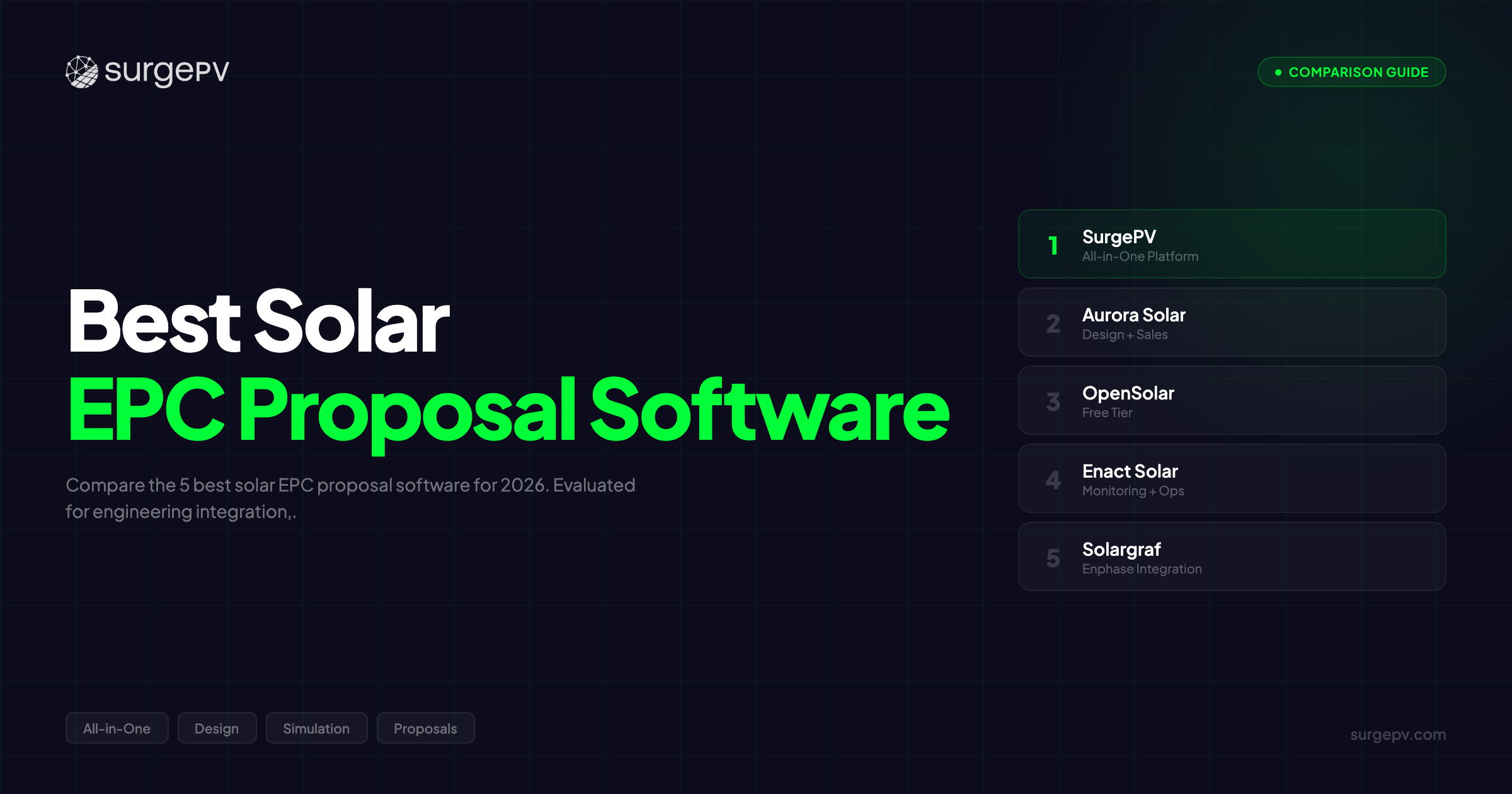
TL;DR: SurgePV is the only proposal platform that includes engineering data (SLD, BOM, wire sizing, P50/P75/P90) directly in the proposal. Aurora Solar creates the best-looking residential proposals but lacks engineering depth. OpenSolar is free but sales-only. Enact and Solargraf serve residential niches. For EPCs whose proposals must prove technical capability, SurgePV is the clear choice.
Beautiful proposals don’t close EPC deals. That distinction matters more than the software industry admits. Residential proposal tools like Aurora Solar generate stunning customer-facing documents — interactive 3D renders, clean savings projections, polished financing comparisons. For residential sales teams, those proposals genuinely work. But commercial EPC customers are different. Facility managers, procurement teams, and building owners don’t choose contractors based on proposal aesthetics. They compare engineering depth. They look for SLDs, wire sizing calculations, 98% accurate BOMs, and P75/P90 bankability estimates. A proposal without technical substance is a brochure — and brochures lose commercial RFPs.
The gap is real. Most solar proposal software was built for residential sales teams. EPCs using these tools create proposals in one platform, then spend 2-3 hours in AutoCAD generating the engineering documentation that actually convinces commercial buyers. Two separate workflows. Double the time. Double the cost.
I’ve delivered 1+ GW of solar projects and evaluated over 20 proposal platforms from an EPC operations perspective. What follows is a direct comparison of the 5 platforms that matter for EPC proposals in 2026.
In this guide, you’ll find:
- The 5 best solar EPC proposal software platforms for 2026
- Which tools include engineering data (SLD, BOM, wire sizing) in proposals vs sales-only proposals
- Side-by-side comparison of proposal features, financial modeling, and commercial suitability
- Time-to-proposal breakdown showing why integrated engineering saves 2+ hours per commercial project
Want to see what an engineering-backed EPC proposal looks like? Book a 30-minute demo.
Quick Comparison Table
| Software | Best For | Engineering in Proposals | Financial Modeling | Starting Price |
|---|---|---|---|---|
| SurgePV | EPCs needing engineering-backed proposals | SLD + BOM + Wire Sizing | Cash/Loan/Lease/PPA | $1,899/yr (3 users) |
| Aurora Solar | Residential sales-focused proposals | No engineering data | Cash/Loan/Lease/PPA | ~$4,800-7,200/yr |
| OpenSolar | Budget-conscious installers | No engineering data | Cash/Loan/Lease/PPA | Free |
| Enact Solar | Installer permit workflows | No engineering data | Basic | ~$200-500/mo |
| Solargraf | Residential financing proposals | No engineering data | Enphase ecosystem | ~$100-300/mo |
What EPC Proposals Need That Residential Proposals Don’t
Here’s the distinction that most proposal software comparisons miss entirely: EPC proposals and residential proposals serve fundamentally different buyers.
Residential proposals focus on what homeowners care about: a clean visual of panels on their roof, monthly savings projections, simple financing options, and an easy-to-understand payback timeline. Aurora excels at this. So does OpenSolar. The buyer is emotional. The proposal sells a vision.
EPC proposals face a different audience. Facility managers want to see single line diagrams. Procurement teams evaluate bill of materials accuracy — because a 2% BOM error on a 500kW project costs thousands. CFOs need PPA modeling with NPV and IRR projections. And lenders demand P75/P90 bankability metrics before releasing financing. A proposal without this technical depth gets disqualified in commercial RFPs. Period.
The current workaround most EPCs use: Create a sales proposal in Aurora or OpenSolar, then separately generate engineering documentation in AutoCAD. Two platforms. 2.5-3.5 hours total. Risk of proposal data not matching engineering data. And $6,800/year per user (Aurora + AutoCAD).
What most EPCs miss: there is a platform that puts the engineering data inside the proposal itself.
Note
If you only sell residential systems and your customers don’t evaluate engineering documentation, a sales-focused tool like Aurora Solar or Solargraf may be sufficient. This guide is for EPCs whose proposals must include technical depth to win commercial contracts.
See how SurgePV bridges the proposal-engineering gap. View proposal features.
The 5 Best Solar EPC Proposal Software for 2026 (Detailed Reviews)
SurgePV — Best for Engineering-Backed EPC Proposals
Best For: Commercial EPCs needing proposals WITH engineering data (SLD, BOM, wire sizing)
Pricing: $1,899/year (3 users); $1,499/user/year (For 3 Users plan)
Proposal Speed: 30-45 minutes (design + engineering + proposal)
Score: 94/100
SurgePV is the only proposal platform where the proposal itself contains engineering data. When you send a SurgePV proposal to a commercial customer, it includes the SLD, wire sizing calculations, 98% accurate BOM, and P50/P75/P90 bankability metrics — all generated from the same design, in the same platform, in 30-45 minutes total.
Every other proposal tool on this list generates sales proposals. SurgePV generates engineering documents that also sell.
Three EPC Proposal Advantages
1. Engineering Data in Every Proposal
This is the primary differentiator. SurgePV proposals include automated SLD generation (5-10 minutes, NEC Article 690 compliant), wire sizing calculations (DC/AC, voltage drop), 98% accurate BOM from design geometry, and P50/P75/P90 production estimates for bankability.
When a facility manager opens your proposal and sees the actual electrical schematic alongside financial projections, your proposal stands apart from competitors sending pretty PDFs without engineering substance. That is the difference between winning the contract and being the “nice proposal we didn’t choose.”
2. Complete Design-to-Proposal Workflow
One platform handles everything: design, engineering, and proposal. Total time: 30-45 minutes. Compare that to Aurora + AutoCAD at 2.5-3.5 hours for the same deliverable. No data re-entry between tools. Proposal data always matches engineering data because it comes from the same source.
3. Commercial Structure Proposals
SurgePV is the only platform that generates proposals for carport solar projects (parking lot canopy designs), tracker projects (single-axis at 15-25% production gain, dual-axis at 25-35% gain), and East-West racking configurations (20-40% more kW per roof area). If your EPC handles any of these commercial solar structures, no other proposal tool supports them natively.
Pricing
| Plan | Price | Users |
|---|---|---|
| Individual | $1,899/year | 3 users |
| For 3 Users | $1,499/user/year | 3 users |
| For 5 Users | $1,299/user/year | 5 users |
| Enterprise | Custom | Multiple |
All features included. Design + engineering + proposals in one transparent price. No feature gating.
Who SurgePV Is Best For
- Commercial EPCs whose proposals must include engineering documentation
- Teams creating proposals for technical buyers (engineers, facility managers, procurement)
- EPCs frustrated with separate proposal + engineering workflows
- Companies handling carport, tracker, or commercial rooftop projects
Limitations
- Proposal visual design not as polished as Aurora for residential customer-facing aesthetics
- No native CRM integration (Salesforce/HubSpot) as strong as Aurora’s
- Newer to market than Aurora — smaller user community
Pro Tip
The most effective EPC proposals lead with engineering substance, not just aesthetics. Include the SLD, BOM, and P75/P90 bankability data upfront — commercial buyers review these first. SurgePV generates all of this in a single workflow. Book a demo to see a complete EPC proposal generated in under 45 minutes.
Real-World Example
A commercial EPC was using Aurora for proposals and AutoCAD for engineering — spending 3+ hours per project and $6,800/year per user. After switching to SurgePV, they create complete proposals with SLD, BOM, and financial modeling in 40 minutes. Their proposal-to-close time dropped by 60% because customers received engineering-backed proposals instead of sales-only documents that required follow-up engineering verification.
Further Reading
For SLD generation and electrical features compared, see best solar engineering software. For a broader comparison including residential tools, see best solar proposal software. For a deep dive on Aurora, read our full Aurora Solar review.
Aurora Solar — Best for Residential Sales Proposals
Best For: Residential installers prioritizing beautiful, sales-focused proposals
Pricing: Contact Sales (~$4,800-7,200/year per user)
Proposal Speed: 20-30 minutes (proposal only, no engineering)
Score: 86/100
Aurora Solar creates the best-looking proposals in the solar industry. That is not hyperbole — it is what G2 reviewers consistently confirm (4.5/5, 247 reviews). For residential sales teams, Aurora’s interactive 3D renders, savings projections, and financing comparisons are unmatched. The native Salesforce and HubSpot CRM integration is the strongest in the market.
But here’s the trade-off EPC buyers need to understand: Aurora proposals are sales documents, not engineering documents. They don’t include SLDs, wire sizing, or P75/P90 bankability data. Commercial EPCs using Aurora must separately create engineering documentation in AutoCAD — adding 2-3 hours and $2,000/year per user on top of Aurora’s already premium pricing.
Key Proposal Features
- Beautiful interactive web proposals with 3D renders (industry-leading visual quality)
- Strong financial modeling (cash, loan, lease, PPA)
- Native Salesforce and HubSpot CRM integration (best-in-class)
- E-signature and proposal analytics (track customer engagement)
Where Aurora Falls Short for EPCs
- No SLD in proposals — requires AutoCAD separately ($2,000/year)
- No wire sizing or voltage drop data in proposal documents
- Only P50 production estimates — no P75/P90 for commercial bankability
- No engineering-grade BOM from design geometry
- Contact sales pricing — not transparent, estimated $4,800-7,200/year per user
Best for: Residential sales teams who prioritize proposal aesthetics and close rates. Companies with separate engineering teams handling documentation in AutoCAD. For EPCs needing engineering-backed proposals, SurgePV is the better fit. Read our full Aurora Solar review for a deeper analysis.
OpenSolar — Best Free EPC Proposal Option
Best For: Budget-conscious installers needing free proposal generation
Pricing: Free (no licensing fees)
Proposal Speed: 20-30 minutes (no engineering)
Score: 80/100
OpenSolar offers completely free proposal generation with professional web-based proposals, financial modeling (cash, loan, lease, PPA), built-in CRM, and e-signature. For small installers or startups testing the market, OpenSolar delivers solid proposals at zero cost.
The catch for EPCs: proposals lack engineering data. No SLD. No wire sizing. No engineering-grade BOM. Commercial capabilities are limited. For EPCs scaling beyond basic residential solar, OpenSolar’s feature ceiling becomes a constraint quickly.
Key Proposal Features
- Professional web-based proposals (free)
- Financial modeling: cash, loan, lease, PPA
- Built-in CRM (no separate tool needed)
- E-signature and online payment processing
Where It Falls Short for EPCs
- No engineering data in proposals (SLD, wire sizing, BOM accuracy limited)
- Basic compared to Aurora proposal aesthetics
- Limited commercial project support
- No carport or tracker proposals
Best for: Small residential installers needing free proposals. Startups testing the solar business before investing in paid tools. For EPCs needing engineering-backed proposals, SurgePV is the better investment. Read our full OpenSolar review.
Further Reading
For SLD generation and electrical features, see best solar engineering software 2026. For a complete EPC workflow comparison, see best solar software for EPCs.
Did You Know?
The US commercial solar market grew 37% in 2023, with projects above 100 kW requiring increasingly detailed proposal documentation. Lenders now reject proposals without P75/P90 bankability metrics and engineering verification, making integrated proposal-engineering platforms a competitive advantage (SEIA Solar Market Insight 2026).
Enact Solar — Best for Installer Permit Workflows
Best For: Solar installers integrating proposals with permit workflows
Pricing: Contact Sales (~$200-500/month per user estimated)
Proposal Speed: 20-30 minutes (no engineering)
Score: 76/100
Enact Solar focuses on the installer workflow from design through permitting. The platform generates proposals while integrating with permit submission processes — useful for installers handling high-volume residential projects where permit turnaround matters.
However, Enact’s commercial capabilities are limited. Proposals don’t include engineering data. Financial modeling is basic compared to Aurora or SurgePV. For EPCs needing technical depth in proposals, Enact falls short.
Key Features
- Proposals with permit integration
- Basic financial modeling
- Installer-friendly workflow
- Permit package generation
Where It Falls Short for EPCs
- No SLD or engineering data in proposals
- Limited commercial project support
- Basic financial modeling (no PPA/lease sophistication for commercial deals)
- Installer-focused, not EPC-focused
Best for: High-volume residential installers needing permit-integrated proposals. For commercial EPCs, SurgePV or Aurora are better options.
Solargraf — Best for Residential Financing Proposals
Best For: Residential installers using Enphase ecosystem for financing
Pricing: Contact Sales (~$100-300/month per user estimated)
Proposal Speed: 15-25 minutes (no engineering)
Score: 74/100
Solargraf (owned by Enphase Energy) excels at residential financing proposals within the Enphase ecosystem. If your business uses Enphase microinverters and wants tight integration with Enphase financing partners, Solargraf streamlines the proposal-to-financing workflow.
But Solargraf is purely residential. No commercial project support. No engineering data. No EPC-specific features. It does one thing well — residential Enphase proposals — and nothing else.
Key Features
- Residential proposals with Enphase ecosystem integration
- Strong financing partner network
- Fast proposal generation (15-25 minutes)
- E-signature integration
Where It Falls Short for EPCs
- No engineering data in proposals
- Residential only — zero commercial support
- Limited financial modeling for commercial (no PPA depth)
- Tied to Enphase ecosystem (vendor lock-in)
Best for: Residential-only installers using Enphase microinverters and financing. For any EPC or commercial installer, SurgePV, Aurora, or OpenSolar are better choices.
Which Software Is Right for Your Use Case?
| Your EPC Need | Recommended Software | Why It Fits |
|---|---|---|
| Engineering-backed commercial proposals | SurgePV | Only platform with SLD, BOM (98%), wire sizing, and P50/P75/P90 in proposals |
| Beautiful residential sales proposals | Aurora Solar | Best visual design, strongest CRM integration (Salesforce/HubSpot) |
| Free proposals, any quality | OpenSolar | Zero cost, decent quality, built-in CRM, no engineering |
| Permit-integrated installer workflow | Enact Solar | Pairs proposals with permit submissions for high-volume residential |
| Enphase ecosystem financing | Solargraf | Tight Enphase integration for residential financing workflows |
When You May Not Need Engineering-Backed Proposals
Not every proposal requires integrated engineering data. Consider simpler tools if:
- Pure residential business — Homeowners rarely evaluate SLDs or wire sizing. Beautiful proposals from Aurora or Solargraf close residential deals effectively.
- Separate engineering team — If your company has a dedicated engineering department that creates SLDs in AutoCAD, your proposal tool only needs to handle the sales document.
- Small project volume — Teams sending fewer than 5 commercial proposals per month may tolerate the dual-platform workflow (proposal tool + AutoCAD).
- Non-technical buyers only — If your commercial customers don’t evaluate engineering documentation in proposals, a sales-focused tool may work.
However, any EPC sending 5+ commercial proposals per month will save 10+ hours weekly by using an integrated platform. At $6,800/year per user for Aurora + AutoCAD versus $1,499/user/year for SurgePV, the financial case is clear.
Send Proposals That Prove You Can Deliver
SurgePV generates EPC proposals with SLD, BOM, wire sizing, and bankability data — in 30-45 minutes.
Book a DemoNo commitment required · 20 minutes · Live project walkthrough
Full Feature Comparison Table
| Proposal Feature | SurgePV | Aurora Solar | OpenSolar | Enact Solar | Solargraf |
|---|---|---|---|---|---|
| SLD in Proposal | Yes (automated) | No | No | No | No |
| BOM Accuracy | 98% (from geometry) | Basic | Basic | Basic | Basic |
| Wire Sizing Data | Yes | No | No | No | No |
| P50/P75/P90 | Yes | P50 only | Basic | Basic | Basic |
| Interactive Web Proposals | Yes | Yes (best design) | Yes | Yes | Yes |
| Financial Modeling | Cash/Loan/Lease/PPA | Cash/Loan/Lease/PPA | Cash/Loan/Lease/PPA | Basic | Enphase ecosystem |
| CRM Integration | Basic | Salesforce/HubSpot | Built-in | Limited | Limited |
| Commercial Projects | Yes (100kW+) | Limited | Limited | Limited | Residential only |
| Carport Proposals | Yes (only platform) | No | No | No | No |
| Total Proposal Time | 30-45 min (with engineering) | 2.5-3.5 hrs (with AutoCAD) | 25-35 min (no engineering) | 25-35 min (no engineering) | 20-30 min (no engineering) |
The pattern is clear: only SurgePV, among all solar design software options, includes engineering data in proposals. Aurora creates the prettiest proposals but zero engineering depth. OpenSolar, Enact, and Solargraf generate adequate sales documents without technical substance.
SurgePV: $1,499/user/year with engineering in every proposal. Aurora + AutoCAD: $6,800/year per user for the same result. See pricing details.
Further Reading
For a broader proposal comparison including residential tools, see our guide to the best solar proposal software. For engineering-focused comparisons, check the best solar engineering software.
Why Engineering-Backed Proposals Win Commercial Contracts
Technical Buyers Evaluate Differently
Commercial solar buyers are not homeowners looking at monthly savings. They are engineers who check your SLD against NEC requirements. They are procurement managers who verify BOM quantities against your pricing. They are CFOs who need P75/P90 production estimates before signing a PPA.
A proposal without engineering data forces these buyers to request a second round of documentation. That delay gives your competitor time to submit their own proposal. Speed and completeness win commercial deals. The right solar software makes both possible.
BOM Accuracy Protects Your Margins
Here’s a number that matters: 98% BOM accuracy. On a 500kW commercial project, a 5% BOM error can mean $10,000-25,000 in unexpected material costs. SurgePV calculates BOM directly from design geometry, hitting 98% accuracy. Competitors generate basic component lists that engineers must manually verify.
The Proposal-Engineering Consistency Problem
When you create proposals in one tool and engineering documents in another, data mismatches happen. The proposal shows 485kW. The SLD shows 492kW. The customer notices. Trust erodes.
When everything comes from one platform — design, engineering, proposal — the numbers always match.
Our Testing Methodology
We evaluated each proposal platform against six weighted criteria from an EPC operations perspective.
1. Engineering Integration (25%) — Does the proposal include SLD, BOM, wire sizing, and compliance data?
2. Proposal Quality (20%) — Visual design, interactivity, mobile-friendliness, branding
3. Financial Modeling (20%) — Cash, loan, lease, PPA scenarios, ROI calculations, utility rate analysis
4. Workflow Speed (15%) — Time from design to complete proposal including engineering
5. Pricing and Value (10%) — Total cost of ownership for EPC teams
6. Support (10%) — Technical support quality, onboarding, training resources
Testing was conducted using real commercial project data between January and February 2026. Verified against G2 reviews (Aurora Solar, 247 reviews; OpenSolar, 89 reviews).
Transparency Note
SurgePV publishes this content. We are transparent about this relationship. This comparison is based on hands-on testing, official documentation, and verified user reviews. We acknowledge Aurora’s proposal design quality as best-in-class for residential. Rankings reflect documented evaluation criteria and real EPC experience. See our editorial standards.
Bottom Line
The choice depends on what your proposals need to accomplish.
For engineering-backed commercial proposals: SurgePV is the only platform where your proposal includes SLD, BOM, wire sizing, and bankability data. Complete design-to-proposal in 30-45 minutes at $1,499/user/year. If your customers are technical buyers who evaluate proposals based on engineering quality, this is the only option.
For residential sales proposals: Aurora Solar creates the most visually polished proposals in the industry with the strongest CRM integration. If you sell exclusively to homeowners and prioritize close rates through aesthetics, Aurora earns its premium.
For free proposals: OpenSolar delivers decent proposals at zero cost with a built-in CRM. Upgrade when your business needs engineering depth.
For Enphase ecosystem: Solargraf integrates tightly with Enphase financing. Residential only.
For EPCs, proposals should prove you can deliver — not just sell. The right solar software makes that proof possible. SurgePV proves it with engineering data in every proposal. Book a demo and we’ll create a complete EPC proposal on your project data in under 45 minutes. Compare SurgePV’s pricing — transparent rates, all features included.
Related Guides
See also: best solar installer software, best solar design software (2026), and best solar simulation software.
Frequently Asked Questions
What is the best proposal software for solar EPCs?
SurgePV is the best EPC proposal software because it is the only platform that includes engineering data (SLD, BOM, wire sizing, P50/P75/P90) directly in the proposal. Commercial EPC customers expect technical depth alongside financial projections. Aurora Solar creates beautiful proposals but lacks engineering data, requiring separate AutoCAD work.
What should a solar EPC proposal include?
A professional EPC proposal should include system design visuals, financial projections (cash, loan, lease, PPA), ROI calculations, engineering documentation (SLD, wire sizing), a detailed BOM with quantities and specifications, P50/P75/P90 production estimates for bankability, and NEC compliance data. SurgePV generates all of these in a single proposal.
Does Aurora Solar include engineering data in proposals?
No. Aurora Solar creates beautiful, customer-facing proposals with design visuals and financial projections, but does not include SLDs, wire sizing, or detailed engineering data. Commercial EPCs using Aurora must separately generate engineering documentation in AutoCAD ($2,000/year per user, 2-3 hours per project). SurgePV includes all engineering data in the proposal automatically.
How long does it take to create an EPC proposal?
With SurgePV, a complete EPC proposal (including design, engineering, and financials) takes 30-45 minutes. With Aurora + AutoCAD, the proposal takes 20-30 minutes but engineering documentation adds 2-3 hours separately, for a total of 2.5-3.5 hours. OpenSolar and Solargraf create proposals in 15-30 minutes but without engineering data.
How much does solar EPC proposal software cost?
SurgePV costs $1,499/user/year (For 3 Users plan) with all features included (design + engineering + proposals). Aurora costs approximately $4,800-7,200/year per user plus $2,000/year for AutoCAD if you need engineering. OpenSolar is free but lacks engineering features. Enact and Solargraf cost $100-500/month per user. See SurgePV pricing.
Can I include SLD and BOM in my solar proposal?
Yes, with SurgePV. SurgePV is the only proposal platform that includes automated SLD generation (NEC Article 690 compliant, 5-10 minutes), 98% accurate BOM from design geometry, and wire sizing data directly in the proposal. No other proposal tool on the market offers this engineering integration.
What is the difference between residential and commercial solar proposals?
Residential proposals focus on customer-friendly visuals, simple savings projections, and financing options. Commercial EPC proposals must also include engineering documentation (SLD, wire sizing), detailed BOM, P75/P90 bankability metrics for financing, PPA/lease modeling for CFOs, and NEC compliance data. Most proposal software was built for residential. SurgePV was built for EPCs.
Is OpenSolar good enough for EPC proposals?
OpenSolar is excellent for basic residential proposals at zero cost. However, for EPC proposals requiring engineering data (SLD, BOM, wire sizing), OpenSolar falls short. It lacks electrical engineering features, limiting commercial EPCs to sales-only proposals. For engineering-backed EPC proposals, SurgePV is the better choice.
Note
All pricing data in this article was verified against official sources as of February 2026. Prices may have changed since publication.