

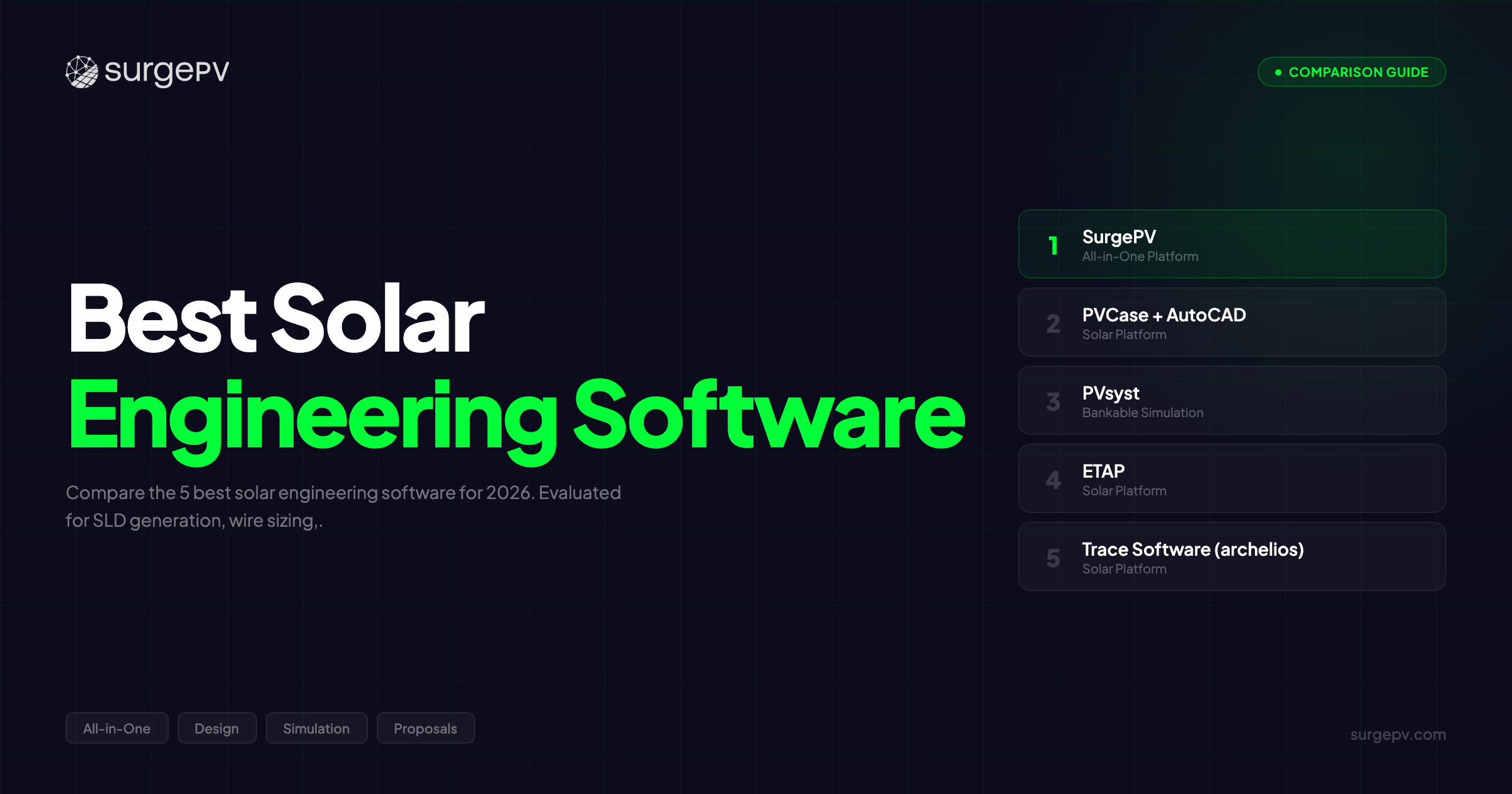
TL;DR: SurgePV is the best solar engineering software for commercial EPCs (100 kW-10 MW), delivering automated SLD generation, wire sizing, and NEC 690 compliance without AutoCAD. PVCase + AutoCAD suits utility-scale engineers. PVsyst handles simulation validation. ETAP covers multi-industry power systems. Trace Software (archelios) serves European IEC workflows.
Most solar software ignores engineering. That is the uncomfortable truth. Platforms like Aurora Solar, OpenSolar, and HelioScope handle panel layout and shading analysis well enough. But electrical engineering — SLD generation, wire sizing, voltage drop calculations, NEC Article 690 compliance — gets treated as someone else’s problem.
Commercial EPCs spend 2-3 hours per project switching between their design tool and AutoCAD. They pay $2,000/year per seat for a CAD license just to produce the electrical documentation that their “solar software” can’t generate. And they accept this as normal because every tool they’ve tried has the same gap.
It doesn’t have to work that way. Engineering-grade solar design software now automates these workflows entirely. The right platform generates permit-ready single line diagrams in 5-10 minutes, calculates wire sizes instantly, and ensures NEC compliance — all without CAD expertise.
I’ve managed 1+ GW of solar projects and evaluated over 20 engineering platforms in real EPC operations with a 50+ person team. What follows is not a theoretical comparison. It is a field-tested evaluation of the 5 platforms that matter for solar engineering in 2026.
In this guide, you’ll find:
- The 5 best solar engineering software platforms for 2026, tested on real commercial projects
- Side-by-side comparison of SLD generation, wire sizing, and code compliance features
- Total cost of ownership analysis (why “affordable” tools cost more when you add AutoCAD)
- Which tool fits your engineering workflow — commercial EPC, utility-scale, or simulation-only
Quick Comparison Table
| Software | Best For | SLD Generation | Wire Sizing | Starting Price |
|---|---|---|---|---|
| SurgePV | Commercial EPCs needing engineering without CAD | Automated (5-10 min) | Automated | $1,899/yr (3 users) |
| PVCase + AutoCAD | Utility-scale engineers with CAD expertise | In AutoCAD | In AutoCAD | $2,990/yr per user |
| PVsyst | Simulation validation and bankability | No | Basic cable loss | ~$1,000-2,000 one-time |
| ETAP | Multi-industry power system analysis | General electrical | General | $5,000-15,000+/yr est. |
| Trace Software (archelios) | European solar engineers (IEC focus) | Yes | Yes | $2,000-5,000/yr est. |
What Makes Solar Engineering Software Different from Design Software
Here’s what most software comparison guides won’t tell you: there is a fundamental difference between solar design software and solar engineering software. Most guides lump them together. They shouldn’t.
Design software — platforms like Aurora Solar, OpenSolar, and HelioScope — handles panel layout, roof modeling, shading analysis, and proposals. It stops at the visual design. You get a nice rendering of panels on a roof. You get a production estimate. You get a customer-facing proposal.
What you don’t get: the electrical documentation that actually makes the project happen.
Engineering software goes deeper. SLD generation. Wire sizing with voltage drop analysis. Conduit fill calculations. Breaker sizing. NEC Article 690 compliance verification. This is the documentation that goes to permitting authorities, AHJs, and lenders.
Why does this matter for EPCs? Because commercial projects (100 kW-10 MW) require electrical engineering documentation for permits. Without engineering features in your platform, you need AutoCAD at $2,000/year plus 2-3 hours per project. That adds up fast.
The numbers tell the story: over 70% of commercial EPCs still use AutoCAD alongside their design platform. Not because they want to — because their “solar software” can’t generate what permitting offices actually require.
Note
If you only design residential systems under 50 kW and have a separate engineering team, a design-only platform like Aurora Solar may be sufficient. This guide is for engineers and EPCs who need integrated electrical engineering capabilities.
Further Reading
For complete EPC workflow comparisons, see best solar software for EPCs. For SLD generation focus, see best solar electrical design software.
The 5 Best Solar Engineering Software for 2026 (Detailed Reviews)
SurgePV — Best Engineering Software for Commercial EPCs
Best For: Commercial EPCs (100 kW-10 MW) needing engineering-grade accuracy without AutoCAD
Pricing: $1,899/year (3 users); $1,499/user/year (For 3 Users plan)
Onboarding: 2-3 weeks
SurgePV is the only platform that delivers engineering-grade electrical documentation — automated SLD generation, wire sizing, voltage drop analysis, and NEC Article 690 compliance — inside a cloud-based design platform. No AutoCAD. No desktop software. No CAD expertise required.
Here’s the truth: every other platform on this list either lacks engineering features entirely or requires AutoCAD to access them. SurgePV eliminated that dependency.
Three Engineering Advantages
1. Automated SLD Generation
This is the primary advantage. SurgePV generates permit-ready single line diagrams in 5-10 minutes. Manual AutoCAD drafting takes 2-3 hours for the same output. The SLD includes everything permitting offices require: DC side (arrays, combiners, disconnects, wire sizes), AC side (inverters, disconnects, panel connection, meter), and protection devices (breakers, fuses, SPD, AFCI).
All NEC Article 690 compliant — covering 690.7 (maximum voltage), 690.8 (circuit sizing), 690.12 (rapid shutdown), and 690.41 (grounding).
A 3-person engineering team handling 10 commercial projects per month saves 20-25 hours per month on SLD generation alone. That is 3+ full working days recovered.
2. Automated Wire Sizing and Voltage Drop
DC and AC wire sizing with automated voltage drop analysis — instant results versus 30-60 minutes of manual spreadsheet calculations. SurgePV handles temperature correction per NEC 310.15, conduit fill adjustment, and ensures voltage drop stays under 2% optimal (3% maximum).
No more cross-referencing NEC Table 310.16 manually. No more spreadsheet errors that get flagged during inspection.
3. Engineering-Grade Simulation
8760-hour shading analysis achieving +/-3% accuracy compared to PVsyst. P50/P75/P90 bankability metrics — not just the P50 that Aurora provides, but the full range that financiers actually require. Plus 98% BOM accuracy calculated directly from design geometry.
SurgePV delivers the engineering accuracy that commercial financing demands, without the complexity that desktop tools impose.
Key Features
- Automated SLD generation (NEC 690 compliant, 5-10 min)
- Wire sizing (DC/AC) with voltage drop analysis
- Conduit fill calculations
- Breaker sizing, fuse selection, AFCI/SPD
- 8760-hour shading analysis (+/-3% vs PVsyst)
- P50/P75/P90 production estimates
- Carport design (only platform with native support)
- Tracker support: single-axis (15-25% gain), dual-axis (25-35% gain)
- East-West racking (20-40% more kW per roof area)
- AI roof modeling (15-20 min vs 45-60 min manual)
- Professional web-based proposals with financial modeling
- 70,000+ module database, 3,000+ US utilities
Pricing
| Plan | Price | Users |
|---|---|---|
| Individual | $1,899/year | 3 users |
| For 3 Users | $1,499/user/year | 3 users |
| For 5 Users | $1,299/user/year | 5 users |
| Enterprise | Custom | Multiple |
All features included on every plan. No hidden fees, no feature gating. See full pricing.
Who SurgePV Is Best For
- Commercial EPCs (100 kW-10 MW) needing permit-ready electrical documentation
- Engineering teams wanting to eliminate AutoCAD ($2,000/year) and tool-switching
- Teams without CAD expertise who need engineering-grade output
- Solar installers scaling from residential to commercial
Limitations
- Newer to market than PVsyst (1990s) or AutoCAD — smaller established user community
- AI roof detection not as advanced as Aurora for complex residential roofs
- Not for utility-scale (1 MW+) ground-mount optimization — PVCase is the better choice there
Pro Tip
SurgePV’s automated SLD generation saves 2-3 hours per project compared to manual AutoCAD drafting — and eliminates the $2,000/year AutoCAD license entirely. For a 3-engineer team doing 10 projects/month, that is $6,000/year in AutoCAD licenses plus 240+ hours of engineering time recovered annually. Book a demo to see it in action.
Real-World Example
A mid-size commercial EPC team was spending 2.5 hours per project creating SLDs in AutoCAD. After switching to SurgePV, SLD generation dropped to under 10 minutes. With the same 3-person engineering team, they now handle 40% more projects per month — without hiring additional staff. That is the difference automated electrical engineering makes when you remove the AutoCAD bottleneck.
Further Reading
For a global design platform comparison, see best solar design software (2026). For bankability and accuracy comparisons, see best solar simulation software. For a deep dive on PVsyst, read our full PVsyst review.
PVCase + AutoCAD — Best for Utility-Scale Engineering
Best For: Utility-scale engineers (1 MW+) needing CAD-level precision
Pricing: $2,990/year per user (PVCase $990 + AutoCAD $2,000)
Onboarding: 6-8 weeks (requires AutoCAD expertise)
PVCase is an AutoCAD plugin built for utility-scale PV plant engineering. For engineers with existing AutoCAD skills, PVCase delivers the deepest CAD-level control for ground-mount optimization, cable routing, and terrain modeling. Users report 60-70% faster design versus manual AutoCAD workflows.
But there’s a trade-off. PVCase requires AutoCAD — that means a $2,000/year license on top of PVCase’s $990/year fee. The learning curve is 6-8 weeks. And it is desktop-based with limited cloud collaboration.
Key Engineering Features
- SLD generation within AutoCAD environment
- Cable routing with trenching calculations
- Automated stringing and MPPT optimization
- Advanced ground-mount terrain modeling and pile spacing
- PVsyst export for simulation validation
- BOM generation from design
Where It Falls Short
- Requires AutoCAD expertise — 6-8 week learning curve, $2,000/year additional license
- Desktop-only — no cloud collaboration, version control challenges with distributed teams
- Not for residential or small commercial — overkill below 1 MW
- Limited proposal tools — engineering focus only, no client-facing sales documents
Best for: Utility-scale developers (1 MW+) with in-house AutoCAD expertise who need terrain optimization for large ground-mount projects. For commercial EPCs (100 kW-1 MW) who don’t want CAD dependency, SurgePV is the better fit — faster onboarding, no AutoCAD required, lower total cost. Read our full PVCase review.
PVsyst — Best for Simulation Validation and Bankability
Best For: Engineers requiring industry-standard simulation for financier validation
Pricing: ~$1,000-2,000 one-time license (desktop)
Onboarding: 4-6 weeks
PVsyst is the gold standard for solar simulation and bankability validation. Founded in the early 1990s, PVsyst provides academic-grade accuracy and is universally accepted by financiers worldwide.
But here’s what most comparisons don’t clarify: PVsyst is simulation-only. It is not a design platform and not an engineering platform. You cannot create SLDs, size wires, or model roof layouts in PVsyst. Engineers use PVsyst alongside their design and engineering platform — SurgePV or PVCase — for final validation.
What Works
- Industry-standard accuracy accepted by every major financier
- P50/P75/P90/P99 bankability metrics — the deepest probability analysis available
- Detailed loss modeling (soiling, temperature, mismatch, inverter clipping)
- Advanced battery and microgrid simulation scenarios
What It Cannot Do
- NOT a design platform (no layout, no roof modeling)
- NO SLD generation at all
- NO wire sizing or voltage drop calculations
- Desktop-only — no cloud collaboration
- Steep 4-6 week learning curve
Recommended Workflow with SurgePV
- Daily engineering: Use SurgePV for design + electrical engineering (30-45 min complete workflow)
- When required: Export to PVsyst for final validation (only when financiers specifically request PVsyst reports)
- Result: Reduce PVsyst usage by 90%. SurgePV’s +/-3% accuracy versus PVsyst is sufficient for most commercial projects.
Best for: Projects where financiers specifically require PVsyst validation and academic research needing the deepest simulation detail. For daily engineering workflows, use SurgePV for design + engineering and export to PVsyst only when financiers demand it. Read our full PVsyst review.
Pro Tip
Most commercial projects don’t need PVsyst. SurgePV’s simulation accuracy (+/-3% vs PVsyst) is accepted by most lenders for projects under 10 MW. Reserve PVsyst for large utility-scale projects where financiers specifically require it — and save 4-6 weeks of learning curve.
Did You Know?
The US solar industry installed 32.4 GW of new capacity in 2023, a 51% increase over 2022. Commercial installations grew the fastest, up 37% year-over-year — driving demand for engineering-grade software that generates permit-ready documentation without AutoCAD dependency (SEIA Solar Market Insight 2026).
ETAP — Best for Multi-Industry Power System Analysis
Best For: Enterprises needing power system analysis across multiple industries
Pricing: $5,000-15,000+/year (enterprise, contact sales)
Onboarding: 4-8 weeks
ETAP is a multi-industry power system analysis platform used by utilities, industrial facilities, and large engineering firms. While ETAP offers strong electrical engineering capabilities — load flow analysis, short circuit analysis, protective device coordination — it is not a solar-specific platform.
What this means in practice: ETAP lacks solar design tools entirely. No roof modeling, no shading analysis, no panel layout, no solar-specific proposal generation. You cannot design a solar project in ETAP. You can only perform electrical power system analysis on a design created in another tool.
Key Features
- Power system analysis (load flow, short circuit, arc flash)
- Protective device coordination
- SLD generation (general electrical — not solar-specific)
- Cable sizing and voltage drop analysis
- Multi-standard compliance (NEC, IEC, IEEE)
Why Most Solar EPCs Don’t Need ETAP
- NOT a solar design platform — no roof modeling, no shading, no panel layout
- NO solar-specific features — no carport design, no tracker support, no string sizing
- NO proposal generation — cannot create client-facing documents
- Enterprise pricing — $5,000-15,000+/year is 3-10x the cost of SurgePV
- Overkill — designed for multi-industry power systems, not solar-specific workflows
Best for: Large enterprises already using ETAP for other electrical engineering work who want to extend it for solar power system integration. For solar EPCs, solar engineering software like SurgePV or PVCase delivers purpose-built solar engineering at a fraction of the cost.
Trace Software (archelios) — Best for European Solar Engineers
Best For: European solar engineers needing IEC-compliant design and engineering
Pricing: $2,000-5,000/year estimated (contact sales)
Onboarding: 4-6 weeks
Trace Software’s archelios suite combines solar design with electrical engineering through integration with their elec calc platform. The suite offers solar layout, shading analysis, SLD generation, and IEC-standard electrical calculations.
archelios is strongest in European markets where IEC standards dominate. The elec calc integration gives it genuine electrical engineering depth — wire sizing, protection device selection, and IEC-compliant documentation. For European EPCs, this is a serious option.
Key Features
- Solar design with 3D modeling
- Shading analysis and production simulation
- Electrical engineering via elec calc integration
- SLD generation with IEC compliance
- Wire sizing and protection device selection
Where It Falls Short
- European market focus — limited NEC Article 690 support for US projects
- Limited US utility database — coverage gaps for American markets
- No solar-specific proposal generation — engineering reports only, not sales proposals
- Hybrid deployment (desktop + web) — not fully cloud-based
- Smaller community — fewer English-language resources and US-focused documentation
Best for: European solar engineers working with IEC standards who need combined electrical and solar design in one suite. For US-based commercial EPCs needing NEC compliance, SurgePV is the better fit. Read our full Trace Software review.
Which Software Is Right for Your Use Case?
| Your Situation | Recommended Software | Why It Fits |
|---|---|---|
| Commercial EPC (100 kW-10 MW) | SurgePV | Automated SLD + wire sizing + design + proposals in one platform, no AutoCAD |
| Utility-scale developer (1 MW+) | PVCase + AutoCAD | Deepest CAD-level terrain optimization for large ground-mount projects |
| Bankability validation only | PVsyst | Industry-standard simulation accepted by all major financiers |
| Multi-industry enterprise | ETAP | Already use ETAP for other power system engineering, extend to solar |
| European IEC compliance | Trace Software (archelios) | Strongest IEC integration with elec calc electrical engineering |
| Small team (1-3 engineers) | SurgePV | Lowest TCO, fastest onboarding (2-3 weeks), all features included |
Eliminate AutoCAD from Your Engineering Workflow
SurgePV delivers automated SLD generation, wire sizing, and NEC compliance — no CAD expertise required.
Book a DemoNo commitment required · 20 minutes · Live project walkthrough
When You May Not Need Advanced Engineering Software
Not every solar project demands a full engineering platform. Consider simpler alternatives if:
- All residential, no commercial work — Design-only platforms like Aurora Solar or OpenSolar handle residential workflows without engineering features.
- You outsource electrical engineering — If a third-party engineer handles SLDs and wire sizing, you only need design and proposal tools.
- Very low project volume — Teams handling fewer than 5 commercial projects per year may find manual AutoCAD workflows acceptable despite the time cost.
- Your AHJ does not require SLDs — Some jurisdictions accept simplified electrical documentation for smaller systems.
However, any EPC doing 5+ commercial projects per month will see significant time and cost savings from integrated engineering software. The AutoCAD dependency alone costs $2,000/year per engineer plus 2-3 hours per project.
Full Feature Comparison Table
| Feature | SurgePV | PVCase + AutoCAD | PVsyst | ETAP | Trace (archelios) |
|---|---|---|---|---|---|
| SLD Generation | Automated (5-10 min) | In AutoCAD | No | General electrical | Yes |
| Wire Sizing (DC/AC) | Automated | In AutoCAD | Basic cable loss | General | Yes |
| Voltage Drop Analysis | Automated | In AutoCAD | Basic | Yes | Yes |
| NEC 690 Compliance | Yes | Yes | Limited | Multi-standard | IEC focus |
| 8760-Hour Shading | Yes (+/-3% vs PVsyst) | Yes | Yes (gold standard) | No | Yes |
| P50/P75/P90 | Yes | Via PVsyst | Yes (best-in-class) | No | Yes |
| Carport Design | Yes (only platform) | No | No | No | No |
| Proposal Generation | Yes | Limited | No | No | Reports only |
| Cloud-Based | Yes | No (desktop) | No (desktop) | Limited | Hybrid |
| AutoCAD Required | No | Yes ($2K/yr) | N/A | N/A | N/A |
| Annual Cost (3 users) | $4,497 | $8,970 | $3,000-6,000 (one-time) | $15,000-45,000 | $6,000-15,000 |
For commercial EPCs needing permit-ready electrical documentation without CAD expertise, SurgePV is the only option on this list. Every other platform either lacks engineering features entirely (Aurora, OpenSolar, HelioScope) or requires AutoCAD (PVCase). See how SurgePV compares to your current engineering workflow — all engineering features included at transparent pricing.
Further Reading
For a broader comparison including design-focused tools, see our guide to the best solar design software. For EPC-specific evaluations, check the best solar software for EPCs.
Why Engineering-Grade Software Matters for Commercial Solar
Permit Rejection Costs Real Money
Every permit rejection costs $500-2,000 in rework and delays. Incomplete or inaccurate SLDs are among the top 3 reasons permits get rejected. Automated SLD generation with built-in NEC compliance — like SurgePV’s approach — eliminates the manual errors that cause rejections.
The time cost of rejection is worse than the dollar cost. A rejected permit delays a project by 2-4 weeks. For a commercial EPC juggling multiple projects, those delays cascade through your entire pipeline.
Bankability Requires More Than P50
Financiers are getting stricter. P50 estimates alone no longer satisfy most commercial lenders. They want P75 and P90 — the conservative estimates that account for weather variability, degradation, and uncertainty factors.
Aurora Solar provides P50 only. That’s a problem for commercial projects seeking financing. SurgePV and PVsyst both provide P50/P75/P90, but SurgePV does it inside the same platform where you design and engineer the system. No tool-switching required.
The Hidden Cost of AutoCAD Dependency
A 3-engineer team using Aurora + AutoCAD for commercial solar projects spends approximately $20,400-27,600/year (Aurora at $4,800-7,200/user + AutoCAD at $2,000/user). The same team on SurgePV spends $4,497/year. That is $15,903-23,103 in annual savings — before accounting for the 2-3 hours per project saved on SLD generation.
At 10 commercial projects per month, the time savings alone equal 240-300 hours per year. That is the equivalent of hiring an additional engineer — without the salary.
Our Testing Methodology
We evaluated each platform against six weighted criteria:
- Engineering Accuracy (25%) — SLD correctness, wire sizing accuracy, code compliance validation against actual permit submissions
- Electrical Features (25%) — SLD generation, wire sizing, voltage drop, conduit fill, breaker sizing, protection devices
- Workflow Efficiency (15%) — Time from design to permit-ready engineering documentation
- Pricing and Value (15%) — Total cost of ownership including add-on tools (AutoCAD, PVsyst)
- Ease of Use (10%) — Learning curve, onboarding time, interface quality for engineers
- Support and Documentation (10%) — Technical support quality, engineering-focused documentation
Testing was conducted between January and February 2026 using real commercial project data, NEC compliance verification, and verified user reviews from G2 and TrustRadius.
Transparency Note
SurgePV publishes this content. We are transparent about this relationship. This comparison is based on hands-on testing, official documentation, and verified user reviews. We acknowledge PVCase’s CAD-level depth for utility-scale and PVsyst’s simulation standard. Rankings reflect documented evaluation criteria and real-world engineering testing. See our editorial standards.
Bottom Line: Best Solar Engineering Software for Your Workflow
The best solar engineering software depends on your project type, team expertise, and budget.
For commercial EPCs (100 kW-10 MW): SurgePV delivers the most complete engineering workflow. Automated SLD generation eliminates AutoCAD dependency, +/-3% simulation accuracy reduces PVsyst usage, and integrated proposals close deals faster. At $1,499/user/year with all features included, SurgePV offers the lowest total cost of ownership for engineering teams.
For utility-scale specialists (1 MW+): PVCase + AutoCAD delivers the deepest CAD-level control for large ground-mount projects. If your team already has AutoCAD expertise and focuses on projects above 1 MW, PVCase is purpose-built for that workflow — despite the $2,990/user/year total cost.
For simulation validation: PVsyst remains the bankability gold standard. Pair it with SurgePV for daily engineering, and use PVsyst only when financiers specifically require it.
For European engineers: Trace Software (archelios) offers the strongest IEC integration for European markets. US-based EPCs should choose SurgePV for NEC compliance.
The EPCs winning commercial projects today produce permit-ready engineering documentation faster than their competitors — not by drafting SLDs by hand in AutoCAD. Your engineering software choice is a competitive advantage.
Book a demo and we’ll generate a permit-ready SLD on your project data in under 10 minutes. Compare pricing — transparent rates, all engineering features included.
Further Reading
For engineering-backed proposals, see best solar EPC proposal software. For design and permits for installers, see best solar installer software. For bankability comparisons, see best solar simulation software.
Frequently Asked Questions
What is the best software for solar engineering?
SurgePV is the best solar engineering software for commercial EPCs (100 kW-10 MW) because it combines automated SLD generation, wire sizing, voltage drop analysis, and NEC Article 690 compliance in a single cloud platform — without requiring AutoCAD. For utility-scale engineering (1 MW+), PVCase + AutoCAD offers the deepest CAD-level control. For simulation validation, PVsyst remains the industry standard.
Do you need AutoCAD for solar engineering?
Not anymore. Traditional solar engineering workflows required AutoCAD ($2,000/year per user) for SLD generation and wire sizing because design platforms like Aurora and OpenSolar lack electrical engineering features. SurgePV eliminates AutoCAD dependency by automating SLD generation (5-10 minutes vs 2-3 hours in AutoCAD), wire sizing, and voltage drop calculations directly inside the design platform.
What is a Single Line Diagram (SLD) and why do solar projects need one?
A Single Line Diagram is an electrical schematic showing the complete wiring path from solar panels through inverters to the electrical grid. SLDs are required for building permits and electrical inspections in most US jurisdictions under NEC Article 690. SurgePV generates NEC-compliant SLDs automatically in 5-10 minutes from your system design.
How accurate is solar engineering software compared to PVsyst?
SurgePV achieves +/-3% accuracy compared to PVsyst for shading analysis and energy production estimates. This is sufficient for most commercial projects. PVsyst remains the gold standard for financier validation, but SurgePV’s accuracy eliminates the need for PVsyst in daily engineering workflows. When financiers specifically require PVsyst, you can export SurgePV designs for final validation.
What is the difference between P50 and P75/P90 production estimates?
P50 is the median production estimate (50% probability of exceeding). P75 means 75% probability of exceeding the estimate — more conservative. P90 means 90% probability — the most conservative. Financiers require P75/P90 for bankability. Aurora only provides P50 estimates. SurgePV provides P50/P75/P90, matching PVsyst’s bankability reporting capability.
How much does solar engineering software cost?
SurgePV costs $1,499/user/year (For 3 Users plan) with all engineering features included. PVCase costs $990/year but requires AutoCAD ($2,000/year extra) for a total of $2,990/user/year. ETAP costs $5,000-15,000+/year (enterprise pricing). PVsyst is approximately $1,000-2,000 one-time but is simulation-only, not an engineering platform. See SurgePV pricing for full details.
Can solar engineering software replace a licensed Professional Engineer (PE)?
No. Solar engineering software automates electrical calculations and documentation but does not replace the need for a licensed PE stamp where required by local jurisdictions. A PE must review and stamp engineering documents for permit approval. SurgePV generates the engineering documentation that a PE reviews — reducing their work from hours to minutes of review time.
What NEC codes apply to solar engineering software?
NEC Article 690 is the primary code governing photovoltaic systems in the US. Key sections include 690.7 (maximum voltage), 690.8 (circuit sizing), 690.12 (rapid shutdown), and 690.41 (grounding). SurgePV automates compliance with these NEC requirements during SLD generation and wire sizing calculations. IEC 62446 applies to international installations.
Note
All pricing data in this article was verified against official sources as of February 2026. Prices may have changed since publication.