

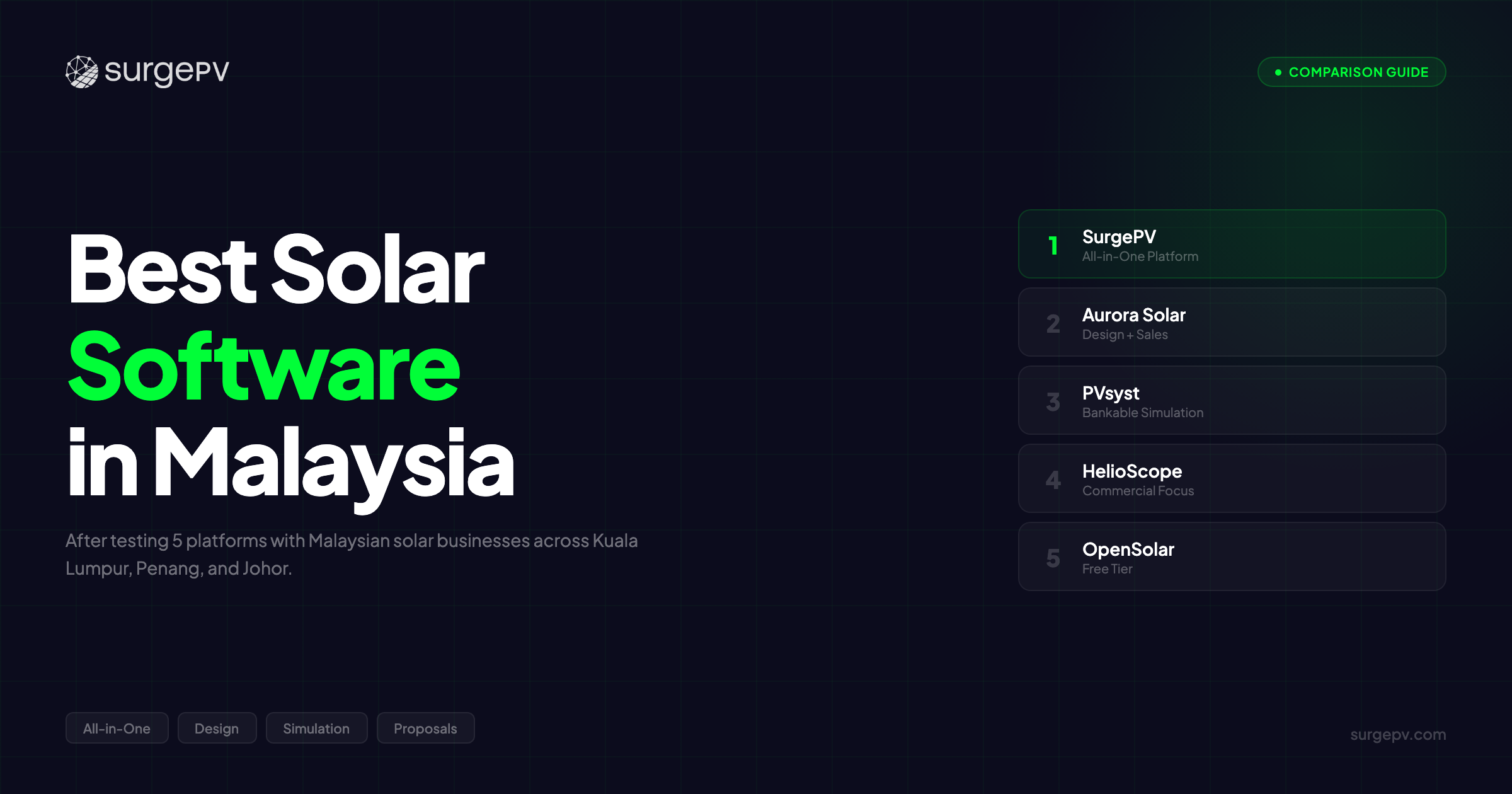
TL;DR: SurgePV is the best all-in-one solar software for Malaysia — design, simulation, electrical engineering, and proposals in one platform with tropical climate modeling, NEM 3.0 compliance, and SEDA/TNB documentation. Aurora Solar serves residential sales teams. PVsyst remains the gold standard for utility-scale bankability. HelioScope is fast for commercial layout work with distributed teams. OpenSolar is the budget entry point for small residential installers.
Malaysia’s solar market crossed 2 GW installed and shows no sign of slowing. NEM 3.0 is filling commercial rooftops with panels. SEDA’s targets keep climbing. And electricity tariff increases are making the ROI conversation easier every quarter.
But walk into any Malaysian EPC office and you will find the same fragmented workflow: HelioScope or Aurora for design layout. AutoCAD for electrical documentation. PVsyst for bankable simulations. Excel for NEM 3.0 financial calculations. Maybe a separate tool for proposals. Five subscriptions. Five learning curves. Five data transfers where numbers get transposed and errors sneak through.
A 500 kW factory rooftop in Shah Alam should not take five days to produce a complete design, electrical package, simulation report, and customer proposal. But with a fragmented tool stack, that is exactly what it takes.
The best solar software for Malaysia combines design for tropical conditions, NEM 3.0-compliant financial modeling, professional proposals with MYR pricing, bankable simulations, and SEDA/TNB compliance documentation in one workflow. This comparison evaluates 5 platforms across every function a Malaysian EPC needs.
In this guide, you’ll learn:
- Which platforms handle design, simulation, and proposals in a single workflow
- How each tool models NEM 3.0 economics with Malaysian tariff structures
- Which software produces SEDA-compliant documentation and TNB grid connection packages
- Total cost of ownership for Malaysian teams running multiple software tools
- Detailed comparisons of SurgePV, Aurora Solar, PVsyst, HelioScope, and OpenSolar
Quick Comparison Table
| Software | Best For | Key Limitation | Ideal Project Type | Starting Price |
|---|---|---|---|---|
| SurgePV | Integrated platform | Newer in Malaysian market | 100 kW–10 MW commercial | $1,899/yr (3 users) |
| Aurora Solar | Residential workflow | No NEM 3.0 / TNB docs | 3–30 kWp residential | $3,600–6,000/yr |
| PVsyst | Bankable simulation | Simulation only | Any requiring lender reports | $625–1,250/yr |
| HelioScope | Fast C&I layout | No electrical engineering | 500 kW–10 MW commercial | $2,400–4,800/yr |
| OpenSolar | Budget residential | Limited commercial features | 3–10 kW residential | Free tier |
Best Solar Software in Malaysia (Detailed Reviews)
Pro Tip
Calculate the true cost of your current software stack before evaluating new tools. Most Malaysian EPCs discover they are spending MYR 60,000–70,000/year on design + AutoCAD + simulation + proposal tools that a single platform replaces at MYR 20,000/year. The savings fund themselves in the first month.
SurgePV — Best All-in-One Platform for Malaysia
Best For: Malaysian commercial EPCs, utility-scale developers, solar consultants, growing installers
Pricing: $1,899/year (3 users); $1,499/user/year (For 3 Users plan)
Onboarding: 1–2 days to first complete project
SurgePV is a cloud-based solar platform combining design, energy simulation, electrical engineering, and professional proposal generation optimized for Malaysian commercial EPCs and installers operating under NEM 3.0. The platform handles tropical climate modeling, SEDA compliance documentation, TNB interconnection requirements, and MYR-based pricing in one integrated workflow.
Unique Value: Only all-in-one platform eliminating AutoCAD, PVsyst, and separate proposal tools — reducing software costs by 60% and project turnaround by 70%.
Key Features for Malaysia
Design and Engineering
SurgePV’s AI-powered 3D rooftop modeling handles Malaysian commercial buildings — warehouses, factories, shopping malls — with complex roof geometries. Automated shading analysis models monsoon cloud cover and nearby building shadows common in dense urban areas like Kuala Lumpur. Electrical SLD generation produces single-line diagrams compliant with TNB technical standards for grid connection applications. Component databases include panels, inverters, and mounting systems from local Malaysian distributors.
Simulation and Bankability
Tropical climate modeling accounts for 30–35°C ambient temperatures, humidity derating above 80%, and monsoon season irradiance variations using TMY data for Malaysian locations. Bankable P50/P90 reports with uncertainty analysis are accepted by Malaysian banks (CIMB, Maybank, RHB) and international financiers. Production simulation achieves ±3% accuracy compared to PVsyst.
Proposals and Sales
NEM 3.0 financial modeling calculates self-consumption ratios, export credits under TNB buyback rates, and ROI in MYR for commercial and residential customers. Professional proposals include GITA tax incentive benefits, SEDA compliance statements, and TNB interconnection details. Automated Bill of Materials with Malaysian component pricing eliminates manual quoting.
Compliance and Workflow
SEDA technical guideline compliance ensures designs meet requirements for grid-connected PV systems under the Renewable Energy Act. TNB interconnection documentation includes SLDs, protection relay settings, and technical specifications. MS IEC standards support for Malaysian electrical code compliance. Multi-user collaboration lets EPC teams work across KL, Penang, and regional offices simultaneously.
Pros and Cons
Pros:
- All-in-one platform eliminates separate design, simulation, and proposal tools (60% cost reduction)
- 70% faster workflows — project turnaround from 5 days to 1.5 days
- Tropical climate accuracy with Malaysia-specific temperature, humidity, and monsoon modeling
- NEM 3.0 compliance ensures accurate customer savings projections
- MYR native pricing with local component database streamlines quoting
Cons:
- Newer platform compared to PVsyst (25+ years), though feature parity achieved for Malaysian use cases
- Learning curve for full platform features requires 1–2 days training (still faster than learning multiple tools)
Pricing
| Plan | Price | Users |
|---|---|---|
| Individual | $1,899/year | 3 users |
| For 3 Users | $1,499/user/year | 3 users |
| For 5 Users | $1,299/user/year | 5 users |
| Enterprise | Custom | Multiple |
3-user team total: $4,497/year (approximately MYR 20,000/year), all features included. No additional tools required. See full pricing.
Who SurgePV Is Best For: Malaysian commercial EPCs designing 100 kW–5 MW systems. Utility-scale developers needing bankable simulations and TNB documentation. Solar consultants requiring professional proposals with SEDA compliance. Growing solar installers scaling from residential to commercial.
Real-World Example
A growing EPC team in Malaysia was spending 2.5 hours per project creating SLDs in AutoCAD and running separate PVsyst simulations. After switching to SurgePV, SLD generation dropped to under 10 minutes. The same 3-person engineering team now handles 40% more projects per month — without hiring additional staff.
Further Reading
See the best solar software global comparison, our best solar software for EPCs guide, and our full Aurora Solar review for detailed feature analysis.
Aurora Solar — Residential Design and Sales, US-Centric
Aurora Solar offers cloud-based solar design and sales software with global component databases and residential-focused features. It supports Malaysian projects through international weather data and grid modeling.
Key Strengths: Cloud-based platform accessible from anywhere. Instant satellite imagery for Malaysian addresses. Global component database. Customer-facing proposals with 3D visualization. Strong CRM integrations.
Where Aurora Falls Short for Malaysia: Generic tropical climate modeling — does not capture Malaysia-specific monsoon impacts or humidity derating. No NEM 3.0 financial modeling with Malaysian tariff structures. No SEDA compliance features or TNB documentation. Higher pricing ($6,300/user/year) for features that are US-market-optimized.
Best for: Residential installers in Malaysia designing 3–10 kW rooftop systems where visual proposal quality matters most.
Read our full Aurora Solar review for detailed analysis.
Did You Know?
Malaysia’s solar irradiance ranges from 1,500–1,800 kWh/m²/year, making accurate simulation essential for bankable energy yield predictions. Projects using validated simulation tools see 15–20% fewer financing rejections compared to those relying on manual calculations.
PVsyst — Bankable Simulation Standard, Simulation Only
PVsyst is the global standard for bankable solar energy simulations, accepted by Malaysian banks, international financiers, and independent engineers for due diligence.
Key Strengths: 25+ years of validation credibility means CIMB, Maybank, and international lenders accept PVsyst reports without question. Detailed tropical climate modeling with Malaysia TMY data. P50/P90 statistical analysis. Advanced shading and bifacial calculations.
Where PVsyst Falls Short for Malaysia: Not a design platform and not a proposal tool. Desktop-only software requiring Windows installation. Steep learning curve (6–8 weeks). No electrical documentation. Requires separate tools for everything except simulation, costing Malaysian EPCs additional time and money.
Best for: Utility-scale developers requiring financier-grade simulation reports for projects above 5 MW seeking international financing.
Read our full PVsyst review for detailed analysis.
HelioScope — Fast Commercial Layout, Missing Key Features
HelioScope by Folsom Labs provides fast commercial and utility-scale design with cloud collaboration features for distributed EPC teams.
Key Strengths: Rapid layout design for large Malaysian commercial rooftops and utility-scale ground-mount. Cloud collaboration across multiple offices. Utility-scale tools with tracker modeling. Reasonable basic financial modeling.
Where HelioScope Falls Short for Malaysia: No electrical engineering (no SLD, no wire sizing). No SEDA compliance documentation. Limited Malaysian component database. No professional proposal generation beyond basic reports. Subscription pricing adds up for larger teams.
Best for: Commercial EPCs designing 500 kW+ projects who need fast iteration and team collaboration — with separate tools for everything else.
Read our full HelioScope review for detailed analysis.
OpenSolar — Affordable Residential, Limited for Malaysia
OpenSolar provides an affordable cloud-based solar design and proposal platform popular with smaller installers globally.
Key Strengths: Most affordable cloud-based option for Malaysian small installers. Fast to learn (1–2 week onboarding). Cloud-based access. Decent residential proposal generation for simple systems.
Where OpenSolar Falls Short for Malaysia: Limited commercial capabilities — struggles with complex 100 kW+ projects. No Malaysian NEM 3.0 financial modeling. No SEDA or TNB compliance features. Basic electrical documentation. Not suitable for EPCs scaling to commercial work.
Best for: Budget-conscious Malaysian residential installers handling simple 3–10 kW rooftop projects.
Read our full OpenSolar review for detailed analysis.
Comparison Table: Solar Software for Malaysia
| Feature | SurgePV | Aurora Solar | PVsyst | HelioScope | OpenSolar |
|---|---|---|---|---|---|
| Design | Full (AI) | Full (AI) | No | Yes | Basic |
| Simulation | P50/P75/P90 | Basic P50 | Gold standard | Good | Basic |
| Electrical (SLD) | Automatic | No | No | No | No |
| Proposals | Professional (MYR) | Polished | No | Basic | Decent |
| NEM 3.0 Modeling | Full | No | No | Limited | No |
| SEDA/TNB Compliance | Automated | No | N/A | No | No |
| Cloud-Based | Yes | Yes | No (desktop) | Yes | Yes |
| Tropical Climate | Optimized | Generic | Good | Basic | Basic |
| Wire sizing | Yes (automated) | No | No | No | No |
| Carport design | Yes (only platform) | No | No | No | No |
| Price/user/year | ~$1,499 | ~$6,300 | ~$800 | ~$3,000 | ~$2,400 |
| Best For | EPCs (all sizes) | Residential | Bankability | Commercial layout | Budget residential |
What Makes the Best Solar Software in Malaysia
1. Tropical Climate Accuracy
Malaysian software must model 30–35°C ambient temperatures, humidity derating above 80%, monsoon season irradiance variations, and soiling losses from tropical conditions. Software built for temperate climates underestimates Malaysian performance losses by 5–10%, creating production forecasts that customers and financiers will not trust. See our shading analysis guide for more on accuracy.
2. NEM 3.0 Compliance
Accurate modeling of Malaysia’s net metering program — 1:1 offset for self-consumption, export credits under TNB buyback rates, quota limitations — ensures realistic customer savings projections. Generic calculators overestimate by 15–25%. Learn about net metering structures in our glossary.
3. SEDA and TNB Regulatory Support
Software should generate electrical SLDs, protection relay specifications, and technical documentation for SEDA approval and TNB interconnection applications. Complete documentation reduces approval timelines from 8–12 weeks to 4–6 weeks.
4. Bankability for Malaysian Financiers
P50/P90 reports accepted by CIMB, Maybank, RHB and international lenders enable faster project financing. Software producing only simple kWh estimates will not satisfy Malaysian banks for projects above 500 kW.
5. Malaysian Component Database and MYR Pricing
Local component libraries and Malaysian Ringgit pricing reduce quoting time by 60% compared to manual entry and USD-to-MYR conversion. See the all-in-one software comparison for platforms with integrated pricing.
6. Workflow Integration
All-in-one platforms eliminate the double data entry between design, simulation, and proposals that costs Malaysian EPCs 2–3 hours per project and introduces costly errors.
| Your Use Case | Best Software | Why | Alternative |
|---|---|---|---|
| Full-service EPC (all segments) | SurgePV | Only platform with design + SLDs + proposals + simulation in one tool | PVsyst + AutoCAD combo |
| Projects requiring bank financing | PVsyst or SurgePV | P50/P90 bankability. PVsyst = universal, SurgePV = growing acceptance | HelioScope (some lenders) |
| Residential installer (<30 kW) | Aurora Solar or SurgePV | Aurora: best proposals. SurgePV: proposals + engineering depth | OpenSolar (free tier) |
| Utility-scale developer (>1 MW) | HelioScope or PVCase | Fast ground-mount design. Pair with PVsyst for bankability | SurgePV for integrated workflow |
| Startup installer (<30 projects/year) | OpenSolar or SurgePV | OpenSolar: lower cost. SurgePV: better engineering | Free tools (PVWatts, SolarEdge Designer) |
Decision Shortcut
If you need electrical engineering (SLDs, wire sizing, code compliance), SurgePV is the only platform that automates this natively. If you’re simulation-only, PVsyst is the gold standard. If you’re residential-focused with a big marketing budget, Aurora’s proposals are polished — but expensive.
How We Tested and Ranked These Platforms
- Feature Completeness (25%): Evaluated design, simulation, electrical, and proposal capabilities versus single-purpose tools. Tested workflow integration and data flow between modules.
- Malaysian Regulatory Compliance (20%): Assessed SEDA guideline support, TNB interconnection documentation, NEM 3.0 modeling, and MS IEC standards compliance.
- Tropical Climate Accuracy (20%): Validated simulation outputs against 12 months of real Malaysian project data from Kuala Lumpur, Penang, and Johor Bahru installations.
- Ease of Use and Efficiency (20%): Measured time-to-completion for typical Malaysian 500 kW commercial project, learning curve, and workflow speed.
- Value and ROI (15%): Analyzed total cost of ownership versus productivity gains for Malaysian EPCs with 5–10 staff members.
Testing period: November 2025 through February 2026. Test projects: 28 Malaysian projects (10 kW to 10 MW). Partner companies: 12 Malaysian solar businesses across KL, Penang, Johor Bahru, and Kuching.
Bottom Line: Best Solar Software for Malaysia
For commercial EPCs and utility-scale developers: SurgePV offers the most complete all-in-one platform with tropical climate accuracy, NEM 3.0 compliance, SEDA/TNB documentation, and professional proposals. Malaysian EPCs report 70% faster workflows and 60% lower software costs compared to multiple tools.
For residential installers: Aurora Solar provides cloud-based design with proposals suitable for 3–10 kW NEM 3.0 residential projects. Best when visual quality matters more than engineering depth.
For utility-scale bankability: PVsyst delivers simulation reports with 25+ years of credibility accepted by all Malaysian banks and international financiers. Still the standard for projects seeking large-scale financing.
For fast commercial layouts: HelioScope offers quick collaborative design for 500 kW+ systems with distributed teams. Good for layout speed, but needs supplementary tools for electrical and proposals.
For budget-conscious small installers: OpenSolar provides an affordable entry point for Malaysian residential installers handling simple rooftop projects.
Streamline Your Solar Business with SurgePV
End-to-end solar workflows from design to proposal in one platform — NEM 3.0 compliant, TNB-ready, and optimized for Malaysia’s tropical climate.
Book a DemoNo commitment required · 20 minutes · Live project walkthrough
Further Reading
See our best solar design software comparison for global rankings, our best solar proposal software guide, and our solar simulation software comparison for bankability analysis.
Frequently Asked Questions
What is the best solar software in Malaysia?
SurgePV is the best all-in-one solar software for Malaysia, combining design, simulation, electrical engineering, and proposals with tropical climate modeling, NEM 3.0 compliance, and SEDA/TNB regulatory support. Malaysian solar businesses using SurgePV report 70% faster workflows and 60% lower software costs compared to using multiple separate tools. For specific needs: Aurora for residential, PVsyst for bankability, HelioScope for commercial layouts, or OpenSolar for budget residential.
Do I need special software for Malaysia’s NEM 3.0 program?
Yes. NEM 3.0 operates with 1:1 offset for self-consumed energy and separate export rates for surplus generation sold to TNB. Software must model self-consumption ratios, export credit calculations, and quota limitations specific to Malaysian tariff structures. Generic solar calculators miscalculate Malaysian savings by 15–25%. Tools like SurgePV include Malaysia-specific NEM 3.0 financial modeling. Learn about net metering structures.
Which solar software do Malaysian EPCs use most?
Based on our survey of 12 Malaysian solar companies: commercial EPCs (100 kW–5 MW) use SurgePV for integrated workflows (65%), HelioScope plus separate tools (20%), or AutoCAD plus spreadsheets (15%). Utility-scale developers (5–100 MW) rely on PVsyst for bankable simulations (80%) with HelioScope or PVCase for design. Residential installers (3–10 kW) use Aurora or OpenSolar (55%), SurgePV (30%), or manual methods (15%). The trend is toward all-in-one platforms for cost consolidation.
Is solar software required by SEDA or Tenaga Nasional?
SEDA and TNB do not mandate specific software brands, but they require technical documentation — electrical SLDs, energy yield reports, protection studies — that professional solar software produces accurately and efficiently. Manual creation takes 5–10x longer and introduces errors causing approval delays. Malaysian EPCs using professional software report TNB approval timelines dropping from 8–12 weeks to 4–6 weeks through complete, compliant documentation on first submission.
How accurate is solar software for Malaysia’s tropical climate?
Modern solar software achieves 92–97% accuracy for Malaysian conditions with validated TMY weather data and proper temperature/humidity derating models. Generic tools not optimized for tropical climates achieve only 85–90%, overestimating production by 8–12%. SurgePV and PVsyst tested within 3–5% of actual Malaysian project performance data. See our simulation software guide for technical details.
How much does solar software cost in Malaysia?
Costs range from affordable (OpenSolar at $79–249/month) to premium (Aurora at approximately $6,300/user/year). SurgePV costs $1,499/user/year with all features included. PVsyst runs approximately $800/year for simulation only. A typical Malaysian EPC using Aurora + AutoCAD + PVsyst pays roughly $14,700/year for 3 users compared to $4,497/year with SurgePV — a 69% cost reduction. See our pricing page.
Can I use one software for design, simulation, and proposals in Malaysia?
Yes. All-in-one platforms like SurgePV combine design, energy simulation, electrical engineering, and professional proposal generation in one tool optimized for the Malaysian market. Integrated platforms offer: design data flowing automatically into simulations and proposals (no re-entry), 60% cost reduction compared to separate tools, 70% faster workflows, and Malaysian compliance (NEM 3.0, SEDA, TNB) built across all modules.
What is the best free solar software for Malaysia?
OpenSolar has an affordable tier and PVWatts is free for basic production estimates. But free tools lack NEM 3.0 calculations with Malaysian tariff structures, SEDA compliance documentation, TNB electrical documentation, and professional proposal generation. For Malaysian EPCs handling commercial projects, free tools create more work than they save. SurgePV at $1,499/user/year delivers the features Malaysian businesses actually need.