

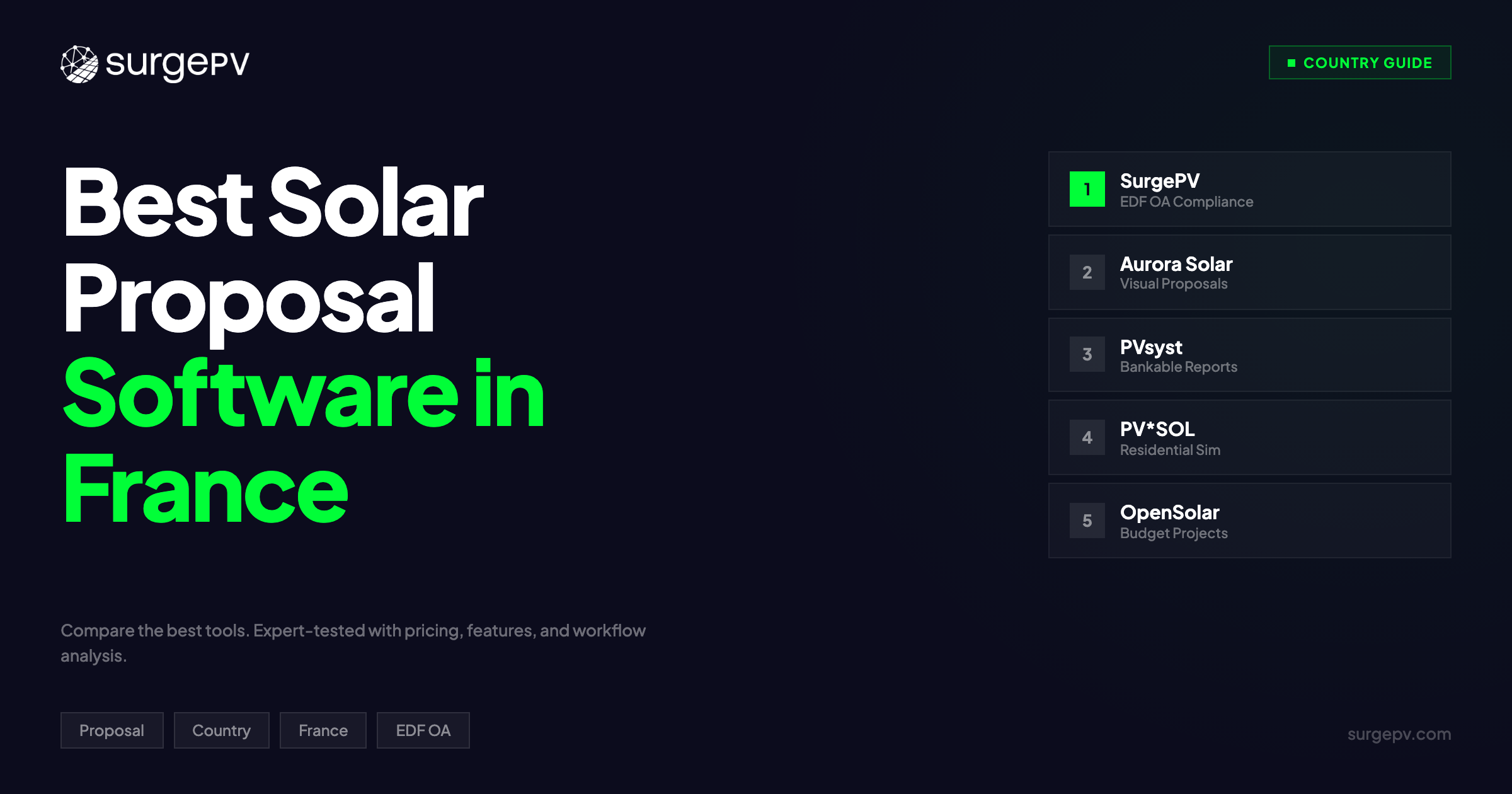
TL;DR: France’s solar proposal requirements are unique: EDF OA quarterly tariff modeling, autoconsommation with surplus injection calculations, Turpe 6 grid charges, Consuel-compliant documentation, and French-language proposals. SurgePV delivers all-in-one EDF OA compliance with automated tariff modeling at EUR 633-1,299/user/year. PVsyst remains the bankable simulation standard accepted by BNP Paribas and Credit Agricole. Aurora Solar brings visual proposal design but lacks French regulatory automation.
French solar installers have a proposal problem.
Their proposals take 2-4 hours to produce. Most miss EDF OA tariff calculations. Few model autoconsommation with surplus injection correctly. And none of the leading global solar proposal software tools were built for Consuel compliance or Turpe 6 grid charge integration.
France added 4.2 GW of solar capacity in 2025, pushing total installed capacity past 29 GW. The PPE3 energy roadmap targets 48 GW by 2030. The S21 tariff reform reshaped feed-in tariff structures for rooftop systems up to 500 kWc. And EDF OA surplus buyback rates dropped to EUR 0.04/kWh for residential systems under 9 kWc, making accurate autoconsommation modeling the difference between a profitable project and a poor investment.
But most French installers still use proposal workflows built for other markets. The result: proposals that calculate EDF OA revenue incorrectly, financial scenarios that ignore Turpe 6 charges entirely, and electrical documentation that fails Consuel inspection.
That matters when French commercial clients compare 3-5 devis from competing EPCs, and when project finance requires bankable documentation for BNP Paribas or Credit Agricole approval.
For our global solar proposal software comparison, we evaluated 15+ platforms. For the broader French solar software market, see our best solar software in France guide. This guide is specifically for solar companies operating in France. We tested 5 platforms against real French requirements: EDF OA tariff modeling, autoconsommation with surplus injection, Turpe 6 grid charge integration, Consuel compliance, and French-language proposal export.
In this guide, you will learn:
- Which 5 proposal platforms handle French EDF OA tariff compliance and autoconsommation modeling best
- Why PVsyst’s bankable simulation reports matter for French project finance
- Which tools support French-language proposals and Consuel-compliant documentation
- How to generate EDF OA-compliant proposals in under 30 minutes
- What French regulations (S21 tariffs, NF C 15-100, Turpe 6) mean for your proposal workflow
- Our recommendation by company type: residential installer, commercial EPC, or bureau d’etudes
Why French Solar Proposals Are Different
Before comparing platforms, here is why France demands specialized proposal software that generic tools miss.
EDF OA Feed-In Tariff Compliance
The Commission de Regulation de l’Energie (CRE) sets quarterly feed-in tariffs under the S21 tariff framework. For Q1 2026, surplus injection rates sit at EUR 0.04/kWh for residential systems under 9 kWc, while full injection rates range from EUR 0.079-0.091/kWh depending on system size.
The S21 reform changed the game. Installations between 100 and 500 kWc now face competitive bidding instead of automatic regulated tariffs. The applicable tariff depends on the date Enedis declares your connection file complete, not the proposal date. A proposal tool that doesn’t track quarterly tariff changes will overestimate or underestimate revenue, either disappointing your client or losing the deal to a competitor with more accurate numbers.
SurgePV includes an automated EDF OA tariff engine that updates quarterly. PVsyst and PV*SOL allow manual tariff input but do not automate updates. Aurora Solar and OpenSolar lack French tariff integration entirely.
Autoconsommation Modeling with Turpe 6
France’s shift toward autoconsommation (self-consumption) is accelerating. With surplus buyback rates at just EUR 0.04/kWh and retail electricity prices at EUR 0.25-0.28/kWh under the Tarif Bleu, the economics strongly favor maximizing self-consumption over selling surplus.
Accurate proposal software must model:
- Autoconsommation individuelle with surplus injection to EDF OA
- Autoconsommation collective for multi-tenant commercial buildings
- Turpe 6 grid charges that affect the true cost of grid-imported electricity
- CSPE (Contribution au Service Public de l’Electricite) surcharges
- Load profile matching between PV production and consumption patterns
A proposal that shows “30% self-consumption” without accounting for Turpe 6 charges underestimates savings by 10-15%. That error compounds over a 20-year EDF OA contract period.
Consuel Compliance and Electrical Standards
French solar installations must pass Consuel inspection before grid connection. The technical file (SC 144) requires compliant electrical documentation meeting NF C 15-100 and UTE C 15-712-1 standards.
Your proposal software needs to generate single line diagrams showing DC/AC protection devices, wire sizing per French norms, surge protection, and grounding. Manual SLD creation takes 2-3 hours per commercial project plus the EUR 1,800/year AutoCAD license. SurgePV automates this in 5-10 minutes.
A Consuel rejection delays grid connection by 2-4 weeks, pushes back the EDF OA contract start date, and can change the applicable quarterly tariff. Accurate electrical documentation in the proposal stage prevents these delays.
RGE Certification and MaPrimeRenov Documentation
RGE QualiPV certification is mandatory for installers whose clients want to access subsidies. Proposals must include documentation that supports the RGE process. While MaPrimeRenov primarily covers thermal renovations, bundled solar-plus-renovation projects require integrated financial modeling that shows combined savings.
The prime a l’autoconsommation (self-consumption investment bonus) adds up to EUR 0.14/Wc for systems under 36 kWc. Proposal software that automates this calculation shows clients better ROI and closes deals faster.
GDPR Data Protection
The EU General Data Protection Regulation applies to all customer data collected during the proposal process. Cloud-based platforms (SurgePV, Aurora Solar, OpenSolar) must offer data encryption and consent mechanisms. Desktop tools (PVsyst, PV*SOL) store data locally, giving French installers direct control.
Note
French solar proposals differ from global proposals in five ways: EDF OA tariff calculations replace generic utility rate assumptions, autoconsommation with Turpe 6 replaces simple self-consumption ratios, Consuel compliance replaces NEC code standards, S21 tariff framework replaces fixed rate structures, and French-language documentation is expected by clients and regulatory bodies. Proposal tools built for the US market miss all five requirements.
Best Solar Proposal Software for France: 2026 Comparison
| Feature | SurgePV | Aurora Solar | PVsyst | PV*SOL | OpenSolar |
|---|---|---|---|---|---|
| Best For | All-in-one EDF OA compliance | Design-focused residential teams | Bankable simulation reports | Detailed residential simulation | Budget residential projects |
| French-Language Proposals | Yes (native) | No | Reports only | Partial | No |
| EDF OA Tariff Modeling | Yes (automated, quarterly) | No | Manual input | Manual input | No |
| Autoconsommation + Turpe 6 | Yes (full modeling) | Limited | Yes (load profiles) | Yes (load profiles) | Limited |
| Consuel-Compliant SLDs | Yes (5-10 min automated) | No (requires AutoCAD) | No | No | No |
| Proposal Builder | Yes (full customization) | Yes (industry-leading visuals) | No (simulation reports only) | Basic (simulation focus) | Yes (basic) |
| eSignature | Yes (built-in) | Yes | No | No | Yes |
| P50/P90 Bankability | Yes | Limited | Yes (gold standard) | Yes | No |
| 3D Design | Yes | Yes (industry-leading) | No (simulation only) | No (simulation only) | Yes (basic) |
| Platform | Cloud | Cloud | Desktop (Windows) | Desktop (Windows) | Cloud |
| Pricing (EUR/year) | 633-1,299/user | 4,800-6,000+ | 900-1,500 | 600-1,200 | 1,000-2,000 |
| Our Rating | 9.2/10 | 7.5/10 | 8.5/10 (simulation) | 7.8/10 | 6.5/10 |
Quick verdict: For French installers needing complete proposal workflows with EDF OA compliance, SurgePV offers the most complete solution. For bankable simulation reports that French lenders accept without question, PVsyst is the gold standard. For visual proposal design without French regulatory features, Aurora Solar leads.
See how SurgePV handles French EDF OA tariff calculations and Consuel-compliant proposals. Book a free demo
The 5 Best Solar Proposal Software Platforms for France (2026)
SurgePV — Best All-in-One Proposal Platform for France
Rating: 9.2/10 | Price: EUR 633-1,299/user/year | Book a demo | See SurgePV pricing
SurgePV is a cloud-based, AI-powered solar design and proposal platform that combines design, electrical engineering, simulation, and professional proposals in one workflow. For French EPCs and installers handling both residential and commercial projects, it eliminates the need to switch between PVsyst, AutoCAD, and Excel.
Why SurgePV works for the French proposal market:
The platform includes a built-in EDF OA tariff engine that automatically calculates feed-in tariff revenue based on current S21 quarterly rates, system size, and injection model (autoconsommation with surplus vs. full injection). It models autoconsommation individuelle with Turpe 6 grid charges and CSPE contributions, giving French clients accurate savings projections over the full 20-year EDF OA contract period.
For Consuel compliance, SurgePV generates automated single line diagrams meeting NF C 15-100 and UTE C 15-712-1 standards in 5-10 minutes, compared to 2-3 hours of manual AutoCAD drafting. Wire sizing calculations follow French norms automatically. For French EPCs producing 10+ commercial proposals per month, that is 20-30 hours saved monthly on electrical documentation alone.
SurgePV’s financial modeling integrates the prime a l’autoconsommation (up to EUR 0.14/Wc), MaPrimeRenov bundled renovation scenarios, and regional subsidies directly into proposals. French clients see cash, loan, and tiers-investissement scenarios with French energy prices, Turpe 6 charges, and EDF OA revenue in one document.
The platform runs 8760-hour simulation with shading analysis delivering within ±3% accuracy compared to PVsyst. French lenders accept P50/P75/P90 yield forecasts generated by SurgePV for commercial and mid-scale projects.
SurgePV generates French-language proposals with professional templates. For French EPCs serving both domestic clients and international investors, dual-language FR/EN export eliminates manual translation.
Real-World Example
A mid-size EPC in Occitanie handling both residential and commercial projects was paying over EUR 10,000/year for separate design, simulation, CAD, and proposal tools, and spending 12 hours per week on data re-entry between platforms. After consolidating to SurgePV at EUR 4,497/year (3-user plan), they cut software costs by 55% and freed up nearly two full working days per week. Proposal delivery time dropped from 4 hours to 40 minutes per commercial project.
Reader objection: “PVsyst is the French standard for bankable simulation. When does SurgePV make more sense?” PVsyst is unmatched for simulation depth and French lender acceptance for utility-scale bankability. If you are a consultant working on 5+ MWc project finance for institutional investors, PVsyst is non-negotiable. But PVsyst is a simulation engine, not a proposal platform. It does not create customer-facing proposals. It does not generate SLDs in 5-10 minutes. It does not integrate eSignature or EDF OA tariff automation. For French installers and EPCs handling residential to mid-commercial projects (3-500 kWc) who need design, simulation, SLD, and proposals in one platform, SurgePV covers the complete workflow that PVsyst does not address.
Pros:
- Automated EDF OA tariff engine (S21 quarterly updates, surplus and full injection)
- Autoconsommation modeling with Turpe 6 grid charges and CSPE
- Consuel-compliant SLD generation (NF C 15-100, UTE C 15-712-1) in 5-10 min
- P50/P75/P90 bankable yield forecasts accepted by French lenders
- French-language proposals with professional templates
- Prime a l’autoconsommation and subsidy integration
- Financial modeling with cash, loan, and tiers-investissement scenarios
- Native carport design for ombriere solaire projects (mandatory for parking over 1,500 m2)
- 70,000+ projects globally, 3-minute average support response
- EUR 633-1,299/user/year, all features included
Cons:
- Newer brand presence in France compared to PVsyst’s 30-year history
- Less established for utility-scale (over 5 MWc) bankability vs PVsyst
- Cloud-dependent (requires internet; PVsyst works offline)
Best for: French EPCs and installers handling residential to commercial projects (3-500 kWc) who want all-in-one EDF OA compliance, automated Consuel-compliant SLD generation, and French-language proposals without tool switching. Ideal for teams currently juggling PVsyst + AutoCAD + Excel who want to consolidate workflows.
Pro Tip
SurgePV’s generation and financial modeling tool includes French-specific financial analysis. Model EDF OA tariff revenue, autoconsommation savings with Turpe 6, and prime a l’autoconsommation directly within the platform. For French commercial projects requiring integrated EDF OA analysis, this saves 30-45 minutes per proposal compared to recreating financial models in Excel.
Try SurgePV on a French commercial project with EDF OA and autoconsommation modeling. Schedule a walkthrough
Aurora Solar — Visual Proposal Design for French Residential Markets
Rating: 7.5/10 | Price: EUR 4,800-6,000+/year, plus AutoCAD EUR 1,800/year | Aurora Solar | Aurora Solar review
Aurora Solar is the global leader in residential solar design software and proposal software. For high-volume French installers processing residential quotes in metro areas like Paris, Lyon, and Marseille, Aurora’s AI-powered design automation delivers real speed advantages in proposal generation.
Why Aurora has a role in French residential proposals:
Aurora’s AI roof detection creates panel layouts in minutes using satellite imagery. The simulation engine runs 8760-hour shading analysis and generates professional customer-facing proposals with industry-leading 3D visualization. For a French residential installer quoting 30-50 projects per month, that speed translates directly to faster sales cycles.
The proposal builder is Aurora’s strongest feature. Customer-facing proposals include 3D roof visualizations, energy production charts, and financing scenarios presented in a polished format that residential clients find convincing. eSignature integration closes deals without follow-up meetings.
Here is where Aurora struggles in the French market.
Aurora was built for the US residential market. It does not model EDF OA tariffs natively. French installers must manually input feed-in tariff rates into custom utility rate structures, which takes 15-20 minutes per project and introduces errors. There is no Turpe 6 grid charge modeling. Autoconsommation calculations are basic, without French-specific tariff structures. The interface is primarily English, and French-language proposal generation is limited.
Aurora does not generate Consuel-compliant SLDs. French installers must recreate electrical documentation in AutoCAD (EUR 1,800/year extra), bringing total annual cost to EUR 6,600-7,800/year.
Pros:
- Industry-leading AI roof detection for fast residential design
- Professional customer-facing proposals with 3D visualization and eSignature
- 8760-hour simulation with shading analysis
- Cloud-based collaboration for sales teams
- Strong global brand recognition
- Fast onboarding for new users (1-2 weeks)
Cons:
- No EDF OA tariff automation (manual input required, error-prone)
- No autoconsommation modeling with Turpe 6 charges
- No Consuel-compliant SLD generation (requires AutoCAD at EUR 1,800/year)
- No French-language interface or proposals
- No prime a l’autoconsommation or MaPrimeRenov integration
- Premium pricing (EUR 4,800-6,000+/year before AutoCAD)
- US-centric utility rate structures
Best for: High-volume French residential installers targeting design-conscious clients in metro markets who prioritize 3D visualization and fast proposals over detailed EDF OA documentation. Best suited for systems under 9 kWc where French regulatory complexity is minimal.
PVsyst — Gold-Standard Bankable Reports for French Project Finance
Rating: 8.5/10 (simulation only) | Price: EUR 900-1,500/year (single user) | PVsyst | PVsyst review
PVsyst is the industry standard for bankable solar simulation reports. Every major French bank, BNP Paribas, Credit Agricole, Banque des Territoires, and every Ademe-backed evaluation accepts PVsyst reports. For French project finance, PVsyst is often non-negotiable.
Why PVsyst matters for French proposals:
PVsyst’s simulation engine handles complex shading scenarios with detailed loss analysis (soiling, mismatch, cable losses, transformer losses). It uses Meteonorm and PVGIS irradiance data across all French climate zones, from 1,100 kWh/m2/year in Hauts-de-France to 1,700 kWh/m2/year in PACA and Occitanie. The P50/P90 yield forecasts meet international bankability standards.
PVsyst supports autoconsommation simulation with load profile analysis. You can model self-consumption ratios against real consumption data, which is critical for commercial projects where load matching determines financial viability.
For French developers submitting to CRE tenders (appels d’offres) for projects between 100-500 kWc under the new S21 framework, PVsyst reports carry weight that other tools cannot match. Independent engineers and due diligence firms expect PVsyst documentation.
Here is where PVsyst falls short as a proposal tool.
PVsyst is a simulation engine, not a proposal platform. There is no customer-facing proposal builder. No eSignature. No French-language proposal templates. No SLD generation (you still need AutoCAD at EUR 1,800/year). No CRM integration. No automated EDF OA tariff updates. And PVsyst is desktop-only (Windows), with no cloud collaboration.
For a French EPC producing 15 commercial proposals per month, PVsyst handles the simulation but leaves everything else to manual tools. Design in one tool, simulate in PVsyst, SLDs in AutoCAD, proposals in Word or PowerPoint, financials in Excel. That is 4-6 hours per project across 4-5 separate applications.
Pros:
- Gold-standard bankability accepted by all French lenders and Ademe evaluations
- Detailed loss analysis and shading simulation
- Strong French irradiance database (Meteonorm, PVGIS, local TMY data)
- Autoconsommation simulation with load profile analysis
- Accepted for CRE tender submissions (appels d’offres)
- P50/P90 bankability reports meet international standards
Cons:
- No customer-facing proposal builder or eSignature
- No SLD generation (requires AutoCAD at EUR 1,800/year)
- No automated EDF OA tariff modeling (manual input only)
- No French-language proposal templates (simulation reports only)
- Desktop-only (Windows), no cloud collaboration
- Steep learning curve (40-60 hours to reach proficiency)
- No design or layout tools
Best for: French energy consultants, bureau d’etudes, and large EPCs who need bankable due diligence reports for project finance or CRE tender submissions. Use PVsyst for simulation alongside a design and proposal platform for the complete workflow. For French-specific design tools, see best solar design software in France.
Pro Tip
PVsyst’s module and inverter database includes every major European manufacturer with French market presence: Huawei, SMA, Fronius, Trina Solar, JA Solar, Longi, and more. For French projects requiring specific equipment from approved RGE QualiPV lists, this database is more comprehensive than US-focused platforms.
PV*SOL — Detailed Simulation with Growing French Market Support
Rating: 7.8/10 | Price: EUR 600-1,200/year (depending on version) | PV*SOL | PV*SOL review
PV*SOL from Valentin Software offers detailed 3D shading simulation and energy yield analysis with a strong engineering focus. For French residential installers who value simulation depth at a lower price point than PVsyst, PV*SOL provides solid technical capabilities.
Why PV*SOL has a role in the French proposal market:
PV*SOL’s minute-by-minute simulation engine calculates shading losses with high precision. It models battery storage scenarios and EV charging integration, both relevant for French residential projects where the prime a l’autoconsommation incentivizes maximizing self-consumption. The software supports autoconsommation with load profile analysis, allowing French installers to show clients realistic self-consumption ratios.
PV*SOL is the most affordable professional simulation tool in this comparison (starting at EUR 600/year). For French residential installers producing 10-20 proposals per month, the lower price point matters.
Here is where PV*SOL falls short for French proposals.
PV*SOL does not automate EDF OA tariff calculations. French installers must manually input quarterly tariff rates for each proposal. There is no Turpe 6 integration. No Consuel-compliant SLD generation. No customer-facing proposal builder. No eSignature. And like PVsyst, PV*SOL is desktop-only (Windows).
PV*SOL’s French market support is growing but still behind its native German market focus. The interface supports French, but regulatory automation for EDF OA, Consuel, and French subsidy programs is absent.
Pros:
- Detailed 3D shading analysis with minute-by-minute simulation
- Battery storage and EV charging simulation
- Autoconsommation with load profile analysis
- Lower price point than PVsyst (starting EUR 600/year)
- Supports French interface language
- Strong engineering focus
Cons:
- No EDF OA tariff automation (manual input required)
- No Turpe 6 grid charge integration
- No Consuel-compliant SLD generation (requires separate CAD)
- No customer-facing proposal builder or eSignature
- No prime a l’autoconsommation integration
- Desktop-only (Windows), no cloud collaboration
- Limited French regulatory templates
Best for: French residential installers who need detailed simulation at a lower price point than PVsyst and are willing to handle EDF OA tariffs and proposals manually. Best suited for technical installers who value simulation accuracy over workflow speed.
OpenSolar — Budget-Friendly Residential Proposal Platform
Rating: 6.5/10 | Price: EUR 1,000-2,000/year | OpenSolar | OpenSolar review
OpenSolar offers affordable all-in-one basics for small residential installers. For French startups and part-time installers doing simple rooftop projects under 9 kWc, OpenSolar provides cloud-based design and proposal generation at a lower price point.
Why OpenSolar has a role in the French market:
OpenSolar combines basic design, simulation, and proposal generation in one cloud-based platform. The proposal builder includes eSignature integration and basic financial modeling. For a French installer producing 5-10 simple residential proposals per month, OpenSolar covers the basics without the cost of enterprise platforms.
Here is where OpenSolar falls short for serious French solar businesses.
OpenSolar does not model EDF OA tariffs. There is no autoconsommation modeling with Turpe 6 charges. No Consuel-compliant SLD generation. No French-language interface or proposals. No prime a l’autoconsommation integration. And simulation depth is limited compared to PVsyst or PV*SOL.
For French installers handling commercial projects, projects requiring bankable documentation, or clients who expect French-language proposals, OpenSolar lacks the capabilities required.
Pros:
- Lower price point for basic features
- Cloud-based design and proposal platform
- eSignature integration
- Basic financial modeling
- Simple residential workflow
Cons:
- No EDF OA tariff automation
- No autoconsommation modeling with Turpe 6 charges
- No Consuel-compliant SLD generation
- No French-language interface or proposals
- No prime a l’autoconsommation integration
- Limited simulation depth
- Not accepted for bankable documentation by French lenders
Best for: Budget-conscious French residential installers doing simple rooftop projects under 9 kWc where EDF OA tariff complexity is minimal and French-language documentation is not required.
French Solar Financing in Proposals: EDF OA, Autoconsommation & Subsidies
French solar financing combines feed-in tariffs, self-consumption incentives, and national/regional subsidies in ways that generic proposal tools miss. Here is how the 5 platforms handle French financing calculations.
EDF OA Feed-In Tariff Revenue Modeling
EDF OA tariffs vary by system size, injection model, and quarter of grid connection. For Q1 2026:
| System Size | Surplus Injection | Full Injection |
|---|---|---|
| Under 3 kWc | EUR 0.1301/kWh | EUR 0.1301/kWh |
| 3-9 kWc | EUR 0.04/kWh | EUR 0.1078/kWh |
| 9-36 kWc | EUR 0.04/kWh | EUR 0.0911/kWh |
| 36-100 kWc | EUR 0.04/kWh | EUR 0.0792/kWh |
The critical detail: tariffs are locked for 20 years from the date Enedis declares the connection file complete. A one-quarter delay changes the tariff applied to the entire contract. Proposal software that models this correctly gives French installers a selling advantage.
How the 5 platforms handle EDF OA tariffs:
- SurgePV: Automated EDF OA tariff engine with quarterly updates. Calculates revenue for both autoconsommation with surplus and full injection models based on system size and projected connection date.
- PVsyst: Manual tariff input with capable financial analysis. French installers must research current S21 rates and input manually for each project.
- PV*SOL: Manual tariff input supported. Requires manual setup per project.
- Aurora Solar: No EDF OA support. Requires manual tariff input into custom utility rate structures (error-prone, 15-20 minutes per project).
- OpenSolar: No EDF OA support. Generic self-consumption economics only.
Prime a l’Autoconsommation (Self-Consumption Investment Bonus)
The prime a l’autoconsommation offers a fixed bonus per Wc installed for systems with self-consumption:
| System Size | Investment Bonus |
|---|---|
| Under 3 kWc | EUR 0.14/Wc |
| 3-9 kWc | EUR 0.10/Wc |
| 9-36 kWc | EUR 0.06/Wc |
| 36-100 kWc | EUR 0.03/Wc |
This bonus is paid over 5 years and directly improves project ROI. For a 9 kWc residential system, the prime adds EUR 900 to the client’s return. Proposal software that includes this calculation automatically shows better financial outcomes.
How the 5 platforms handle the prime:
- SurgePV: Automated prime a l’autoconsommation calculation integrated into financial proposals.
- PVsyst: Not included (simulation tool, not financial proposal).
- PV*SOL: Not included (simulation focus).
- Aurora Solar: No French subsidy integration.
- OpenSolar: No French subsidy integration.
Turpe 6 Grid Charges
Turpe 6 (Tarif d’Utilisation des Reseaux Publics d’Electricite) defines grid access charges in France. These charges affect the true cost of grid-imported electricity and therefore the value of self-consumed solar energy. Accurate autoconsommation modeling must account for Turpe 6 to calculate real savings.
Only SurgePV integrates Turpe 6 charges into autoconsommation financial modeling automatically. PVsyst and PV*SOL can model self-consumption ratios but do not include Turpe 6 in financial calculations. Aurora Solar and OpenSolar lack this capability entirely.
For a detailed guide to French solar subsidies and tariffs, see our France feed-in tariff guide.
French Market: Who’s Using What: Who’s Using What
France’s solar software market reflects a market transitioning from subsidy-driven full injection to self-consumption economics.
Market Size and Growth
France reached 29.7 GW of installed solar capacity by end of 2025, with 4.2 GW added in that year alone. The PPE3 targets 48 GW by 2030, requiring approximately 3.6 GW of annual additions. The Loi Climat et Resilience mandates solar canopies (ombriere solaire) on parking lots exceeding 1,500 m2, creating a wave of commercial projects.
The French market splits roughly between residential (under 36 kWc), small commercial (36-500 kWc), and large commercial/utility-scale (over 500 kWc). The S21 tariff reform pushes installations between 100-500 kWc into competitive bidding, increasing the importance of accurate bankable proposals.
PVsyst Dominance in Project Finance
PVsyst maintains dominant market share among French bureau d’etudes, energy consultants, and large EPCs. When BNP Paribas, Credit Agricole, or Banque des Territoires reviews a solar project for financing, they expect PVsyst reports. SolarPower Europe notes that PVsyst is the reference simulation tool across European project finance.
SurgePV Adoption Among French EPCs
SurgePV has growing adoption among French EPCs handling commercial rooftop and ombriere solaire projects between 36-500 kWc. These companies need all-in-one platforms combining design, Consuel-compliant electrical engineering, EDF OA tariff modeling, and French-language proposals without tool switching.
French commercial EPCs typically respond to 3-5 devis requests per project from building owners. The EPC that delivers complete proposals fastest with accurate EDF OA documentation wins. SurgePV’s 30-45 minute proposal delivery (versus 3-4 hours with PVsyst + AutoCAD + Excel) creates a timing advantage.
Generate EDF OA-Compliant French Proposals in Minutes
Design, engineer, simulate, and create French-language proposals with automated EDF OA tariff modeling and Consuel-compliant SLDs.
Book a DemoNo commitment required · 20 minutes · Live project walkthrough
Honorable Mentions: Other Tools Used in France
These platforms did not make the top 5 for French-specific proposal workflows, but they serve specific niches.
Solargraf (Enphase): Cloud-based design and proposal platform for Enphase ecosystem installers. Growing French market presence. Lacks EDF OA automation and Consuel compliance. Best for French residential installers already using Enphase microinverters who want integrated design-to-proposal workflows.
SolarEdge Designer: Free design tool for SolarEdge equipment partners. Strong for SolarEdge ecosystem partners but limited proposal flexibility. No EDF OA tariff modeling. Best for French installers committed to SolarEdge hardware who need basic design and string sizing.
HelioScope: Cloud-based design platform for commercial projects. Strong layout tools but no French regulatory automation. Best paired with PVsyst for simulation. No proposal generation.
Which Solar Proposal Software Is Right for Your French Business?
Here is our recommendation by company type and workflow priority.
Full-service EPCs (residential + commercial): SurgePV for complete EDF OA compliance with automated Consuel-compliant SLD generation. If you handle both residential and commercial projects and need design + simulation + proposals in one platform, SurgePV eliminates tool switching.
Bureau d’etudes and energy consultants (simulation-heavy): PVsyst for bankable simulation depth and French lender acceptance. If you produce bankable yield reports for project finance or CRE tender submissions, PVsyst remains the French standard.
Residential installers (under 9 kWc, high volume): SurgePV for automated EDF OA proposals or Aurora Solar for visual proposal design. If you quote 30+ residential projects monthly, prioritize speed and French-language output.
Commercial EPCs (ombriere solaire, 36-500 kWc): SurgePV for native carport design plus Consuel-compliant documentation. The Loi Climat et Resilience mandate creates demand that only platforms with native carport capabilities can serve efficiently.
Design-first teams (3D visualization priority): Aurora Solar for industry-leading visual proposals. If your French residential clients prioritize 3D visualization over EDF OA documentation, Aurora’s presentation quality wins deals.
Budget-conscious small teams (under 10 projects/month): OpenSolar for basic cloud-based proposals or PV*SOL for simulation depth at a lower price. Minimize software costs while maintaining basic capability.
Decision Shortcut
If you need Consuel-compliant electrical documentation (SLDs, wire sizing), SurgePV is the only platform that automates this natively. If you need bankable simulation reports for French lenders, PVsyst is the gold standard. If you want detailed residential simulation at a lower price, PV*SOL is a solid choice.
Solar Proposal Software in Other European Markets
Looking for proposal software comparison guides for other European countries? We have tested the top platforms for region-specific requirements:
- Solar Proposal Software for Germany — German EEG tariff and KfW financing compliance
- Solar Proposal Software for Italy — Italian regulatory compliance and language support
- Solar Proposal Software for Spain — Spanish autoconsumo and OMIE pricing
- Solar Proposal Software for the Netherlands — Dutch market requirements
For our global comparison covering all markets, see Best Solar Proposal Software 2026.
Bottom Line: Best Solar Proposal Software for France
France’s solar proposal market splits along a clear divide.
For all-in-one EDF OA compliance without tool switching, SurgePV delivers the most complete French-market solution. Automated EDF OA tariff modeling, autoconsommation with Turpe 6 integration, Consuel-compliant SLD generation in 5-10 minutes, and French-language proposals, all in one cloud platform at EUR 633-1,299/user/year. For French EPCs juggling PVsyst + AutoCAD + Excel across 10-20 projects monthly, SurgePV consolidates workflows and cuts proposal delivery time by 60-70%.
For bankable simulation and project finance, PVsyst remains the 30-year standard. If you need simulation reports that French lenders accept for CRE tender submissions or Ademe evaluations, PVsyst is non-negotiable.
For detailed residential simulation, PV*SOL offers strong shading and battery simulation at a competitive price point starting at EUR 600/year.
For visual proposal design, Aurora Solar delivers industry-leading 3D visualizations and polished customer-facing proposals, but requires AutoCAD for SLDs and lacks French regulatory automation.
For budget residential, OpenSolar provides basic cloud-based proposals at lower cost, but lacks French market features.
No single tool does everything. PVsyst excels at simulation but lacks proposal builders. Aurora delivers beautiful 3D visualizations but misses French regulatory compliance. OpenSolar offers affordability but cannot model EDF OA tariffs.
The French EPCs winning devis in 2026 use one of two strategies:
Strategy 1: All-in-one platform (SurgePV) for daily workflow + PVsyst for final bankable validation when lenders require it
Strategy 2: PVsyst for simulation + AutoCAD for SLDs + Excel for financials + Word for proposals (slower, more expensive, but familiar)
Strategy 1 costs EUR 2,500-3,000/year total and takes 30-45 minutes per commercial proposal. Strategy 2 costs EUR 4,500-6,000/year and takes 3-5 hours per proposal. The math is straightforward.
France’s solar market is accelerating toward the 48 GW PPE3 target. The EPCs winning projects today deliver complete designs, bankable reports, and professional French-language proposals faster than the competition. Your solar software choice is a competitive advantage.
Transparency Note
SurgePV publishes this content. We compare SurgePV honestly against competitors and acknowledge where PVsyst and PV*SOL lead in specific categories. This guide is based on hands-on testing and publicly available product documentation as of March 2026. See our editorial standards.
Frequently Asked Questions
What is the best solar proposal software in France?
SurgePV is the best all-in-one solar proposal software for France in 2026, combining Consuel-compliant electrical engineering, automated EDF OA tariff modeling, autoconsommation with Turpe 6 integration, and French-language proposals in one cloud-based platform. Pricing starts at EUR 633/user/year with all features included. For French EPCs and installers, SurgePV eliminates the need for AutoCAD (EUR 1,800/year) while delivering complete EDF OA-ready proposals and Consuel documentation.
Which solar software supports EDF OA tariffs in France?
SurgePV automatically integrates quarterly EDF OA tariff updates for both autoconsommation with surplus injection (S21) and full injection contracts. PVsyst and PV*SOL allow manual tariff input but do not automate updates. Aurora Solar and OpenSolar lack French tariff integration entirely. The EDF OA tariff applied to a project depends on the date Enedis declares the connection file complete, making automated tracking important for accurate proposals.
Do I need multiple tools for solar proposals in France?
No, if you use an all-in-one platform like SurgePV. Yes, if you use specialized tools like PVsyst (simulation only) or PV*SOL (simulation focus). Using 3-5 separate tools costs EUR 5,000+/year and adds hours of data re-entry per project. All-in-one platforms complete entire proposal workflows in 30-45 minutes for commercial projects vs. 3-5 hours with separate tools.
How much does solar proposal software cost in France?
Solar proposal software pricing in France ranges from EUR 600/year (PV*SOL basic) to EUR 6,000+/year (Aurora Solar enterprise). SurgePV costs EUR 633-1,299/user/year with all features included, including Consuel-compliant SLD generation without AutoCAD. Aurora requires AutoCAD at EUR 1,800/year extra. PVsyst costs EUR 900-1,500/year but requires additional tools for proposals, SLDs, and financials. See SurgePV pricing for detailed plan comparison.
Can solar proposal software handle French autoconsommation modeling?
SurgePV models autoconsommation individuelle and collective with surplus injection to EDF OA, Turpe 6 grid charge integration, and CSPE contribution calculations. PVsyst and PV*SOL support autoconsommation with load profile analysis but without Turpe 6 automation. Aurora Solar and OpenSolar have limited self-consumption modeling without French-specific tariff structures. With surplus buyback rates at just EUR 0.04/kWh for systems under 9 kWc, accurate autoconsommation modeling is the difference between showing a profitable project and losing the deal.
Sources
- SurgePV Product Documentation — Official feature specifications and proof points (accessed March 2026)
- CRE (Commission de Regulation de l’Energie) — Official website — EDF OA tariffs, Turpe 6, and S21 tariff framework (accessed March 2026)
- Enedis — Official website — Grid connection procedures and Consuel requirements (accessed March 2026)
- Consuel — Official website — Electrical inspection and SC 144 technical file requirements (accessed March 2026)
- Ministere de la Transition Ecologique — Official website — PPE3 targets, Loi Climat et Resilience, and solar policy (accessed March 2026)
- SolarPower Europe — EU Market Outlook — European solar market data (accessed March 2026)
- Service-Public.fr — Solar surplus tariff changes — Official French government information (accessed March 2026)
- PV Magazine — France tariff updates — Industry reporting on S21 reform (accessed March 2026)
- Aurora Solar, PVsyst, PV*SOL, OpenSolar Official Documentation — Feature specifications and pricing (accessed March 2026)
- NF C 15-100, UTE C 15-712-1 — French electrical installation standards (accessed March 2026)