

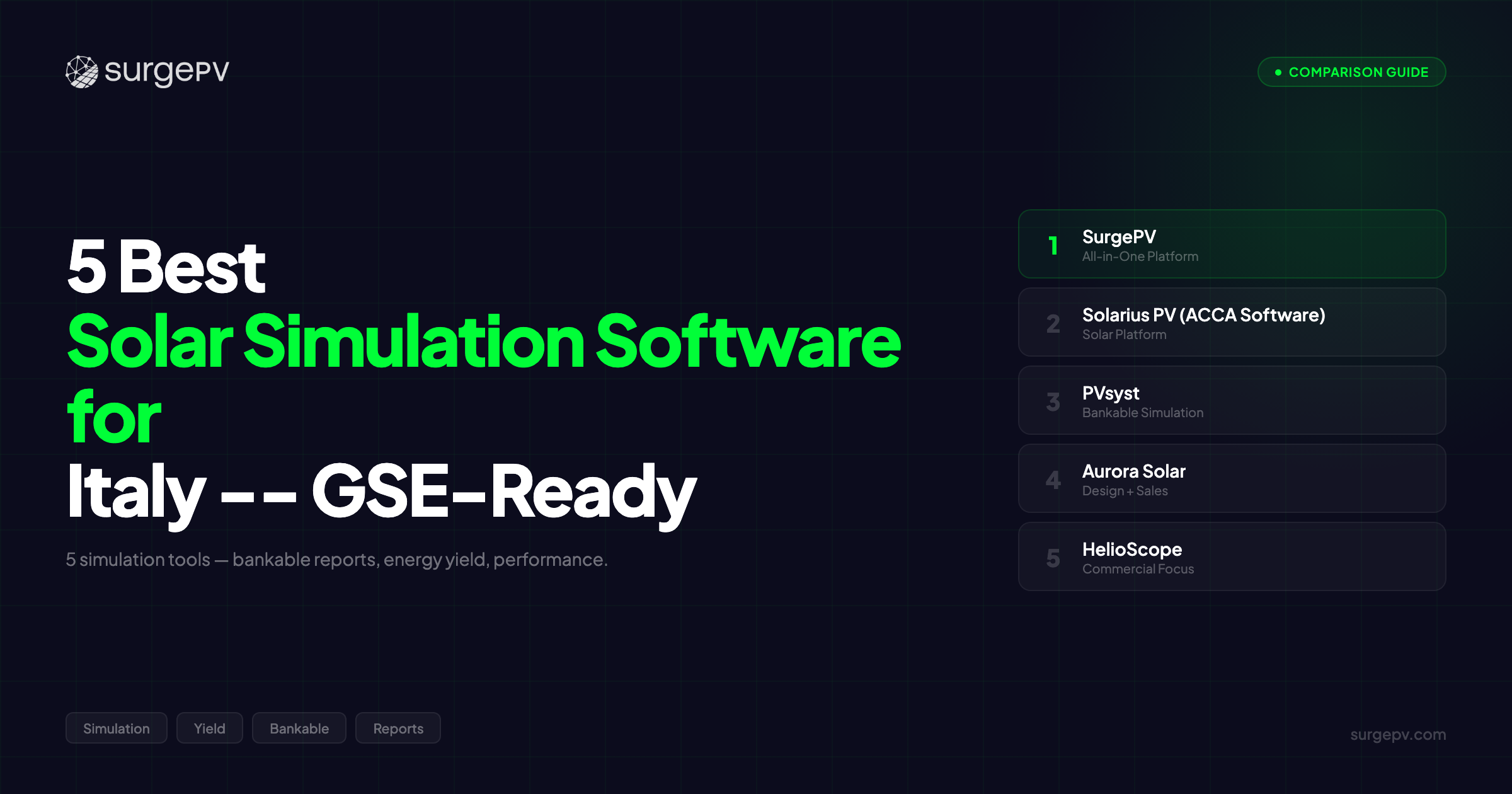
TL;DR: SurgePV delivers AI-powered simulation with GSE-compliant yield reports and P50/P90 bankable outputs for Italian residential and commercial projects. Solarius PV by ACCA Software is the Italian-engineered domestic standard. PVsyst remains the bankable gold standard for utility-scale financing. We tested all five tools against Italian regulatory requirements, irradiance data, and real project workflows across Milano, Roma, and Puglia.
Sicily gets 1,800 kWh/m2 of sun per year. Germany gets 1,050. Yet thousands of Italian installers still undersize systems and leave money on the table because they run their simulations on tools calibrated for Northern European conditions.
Italy is Europe’s third-largest solar software market. The country added 5.2 GW of new PV capacity in 2023 alone (SolarPower Europe), bringing total installed capacity past 30 GW. But the Italian solar market has unique simulation needs that generic global tools fail to address.
Italian installers and EPCs deal with challenges that no other European market combines in the same way. You need simulation accuracy across an extreme north-south irradiance gradient, from Bolzano at 1,300 kWh/m2/year to Palermo at 1,800 kWh/m2/year. You need GSE (Gestore dei Servizi Energetici) compliant documentation for incentive applications. You need to model Scambio sul Posto legacy contracts and Ritiro Dedicato export economics. You need Superbonus tax deduction calculations. And now, with Comunita Energetiche Rinnovabili (CER) gaining traction, you need multi-building energy sharing simulation on top of everything else.
A simulation tool built for German weather data will underestimate Italian yields by 15-25%. But a tool that ignores temperature derating will overestimate production by 10-15% during Italian summers, especially south of Roma. Getting the simulation wrong means missed Scambio sul Posto savings, rejected GSE applications, and project financials that fall apart during due diligence.
We tested five solar simulation platforms on real Italian projects: residential installations in Milano, commercial rooftops in Roma, and agrivoltaico systems in Puglia. We evaluated each tool against Italian-specific criteria including GSE compliance, Scambio sul Posto modeling, bankable yield reporting, Italian-language support, and temperature-adjusted accuracy.
Looking for solar design software for Italy? We also cover how these tools handle progettazione fotovoltaica (PV system design) and where simulation software replaces traditional drafting services.
In this guide, you’ll find:
- A side-by-side comparison table with Italian-specific evaluation criteria (GSE compliance, Scambio sul Posto, Superbonus, bankability)
- Deep-dive reviews of each tool’s strengths and weaknesses for the Italian market
- How Italian regulations (GSE, ARERA, Decreto FER 2, CER) impact simulation requirements
- When you need drafting services (progettazione fotovoltaica) versus simulation software (simulazione energetica)
- Italy’s irradiance advantage and why it creates unique simulation challenges
- How to choose the right tool for your Italian business type (installatore, studio tecnico, or EPC)
Quick Comparison: 5 Best Solar Simulation Tools for Italian Installers
| Tool | Italian Language | GSE Compliance | Scambio sul Posto | Superbonus | Bankable P50/P90 | Platform | Pricing (EUR/year) | Rating |
|---|---|---|---|---|---|---|---|---|
| SurgePV | Yes | Yes | Yes | Yes (financial modeling) | Yes (P50/P75/P90) | Cloud | ~1,750 (3 users) | 4.7/5 |
| Solarius PV (ACCA) | Native Italian | Full native GSE | Native SSP modeling | Native integration | Limited | Desktop + Cloud | ~500-900 | 4.4/5 |
| PVsyst | Yes | Reports accepted by GSE | Manual SSP input | Manual input | Gold standard | Desktop | ~450-650 | 4.6/5 |
| Aurora Solar | English only | Limited | No native SSP | No | No P50/P90 | Cloud | ~4,500-9,000 | 4.3/5 |
| HelioScope | English only | Limited | No | No | Via Energy Toolbase add-on | Cloud | ~2,700-7,200 | 4.4/5 |
Quick verdict: For Italian residential installers and geometri, Solarius PV offers the deepest Italian regulatory integration at the lowest price. For EPCs needing AI-powered speed with GSE-compliant bankable reports, SurgePV delivers the best balance of capability and value. For utility-scale financing where bank acceptance is non-negotiable, PVsyst is the standard.
See how SurgePV handles Italian GSE modeling — Book a free demo
Why Solar Simulation in Italy Requires Specialized Tools
Italian solar projects have unique simulation requirements that set them apart from Germany, France, or Spain. Understanding these requirements will help you pick the right software for your Italian business.
High Irradiance at 37-47 N Latitude (1,400-1,800 kWh/m2/year)
Italy sits in one of Europe’s highest-irradiance zones. According to PVGIS (EU Joint Research Centre), Italy receives 1,400-1,800 kWh/m2/year of global horizontal irradiance, 40-80% more than Germany’s 950-1,100 kWh/m2/year.
Higher irradiance does not linearly translate to higher energy yield. Italian systems face greater thermal stress, faster degradation in southern regions, and larger seasonal production swings. A simulation tool that simply applies more sun to a German-calibrated model will produce inaccurate results.
Extreme North-South Variation (Bolzano 1,300 vs Palermo 1,800 kWh/m2/year)
No other major European solar market has this kind of internal variation. Trentino-Alto Adige in the north experiences conditions similar to southern Germany. Sicilia and Calabria in the south match North African irradiance levels. That 500 kWh/m2/year difference means a 10 kWp system in Palermo produces roughly 38% more energy than the same system in Bolzano.
Your simulation tool needs granular, location-specific weather data, not national averages. Tools with access to Meteonorm, PVGIS, or satellite-derived datasets handle this well. Tools relying on regional approximations do not.
High-Temperature Performance Losses (Up to 15% in Southern Italy)
Italian summers push module temperatures well above the 25 C STC (Standard Test Conditions) baseline. In southern Italian regions — Puglia, Sicilia, Sardegna, Calabria — module temperatures routinely exceed 60-65 C during July and August. Standard crystalline silicon modules lose approximately 0.35-0.45% efficiency per degree above 25 C.
A system in Lecce or Catania can lose 12-15% of rated output during peak summer months due to temperature alone. Simulation software that does not apply accurate temperature derating coefficients will overestimate annual yield by 5-10% in southern Italy.
GSE (Gestore dei Servizi Energetici) Documentation Requirements
GSE manages Italy’s renewable energy incentive programs, including Scambio sul Posto, Ritiro Dedicato, and the new Comunita Energetiche framework. GSE requires specific yield documentation for incentive applications: annual production estimates, self-consumption ratios, and system specifications.
Your simulation tool should generate outputs that align with GSE’s documentation standards. Italian-made tools like Solarius PV handle this natively. International tools require manual formatting of their output to match GSE requirements.
Italian Incentive Complexity (Superbonus, Scambio sul Posto, CER)
Italy’s incentive structure is layered and evolving. You have legacy Scambio sul Posto contracts (closed to new applications January 1, 2025). Active Ritiro Dedicato programs with hourly PUN-based export pricing. Superbonus tax deductions (reduced from 110% to 65%). And the new Comunita Energetiche Rinnovabili (CER) framework for shared energy production. Simulation software must model these financial structures to produce accurate ROI projections for Italian clients.
Note
Italy’s irradiance is 40-80% higher than Germany’s. A simulation tool calibrated for German conditions will UNDERESTIMATE Italian yields, but tools that ignore temperature derating will OVERESTIMATE by 10-15% in summer months. Accurate simulazione fotovoltaica requires both factors.
The 5 Best Solar Simulation Software Platforms for Italy (2026)
SurgePV — Best AI-Powered Simulation with GSE Compliance
Rating: 4.7/5 | Price: ~EUR 1,750/year (3 users) | Platform: Cloud-based | Best for: Italian EPCs and installers needing bankable simulation + design in one tool
SurgePV is an AI-powered, cloud-based solar design software and simulation platform that combines 8760-hour energy modeling, bankable P50/P75/P90 yield forecasts, and automated electrical engineering in a single workflow. For Italian installers, SurgePV eliminates the need to switch between separate simulation, design, and proposal tools.
Simulation Capabilities for Italy:
SurgePV runs full 8760-hour shading analysis with +-3% accuracy versus PVsyst, the accepted Italian bankability benchmark. That level of accuracy matters when Italian banks like Intesa Sanpaolo and UniCredit evaluate your P50/P90 production estimates for project financing.
The platform generates P50, P75, and P90 bankable yield forecasts using location-specific weather data. For Italian projects, this means temperature-adjusted modeling that accounts for southern Italy’s high thermal losses, something generic tools often miss.
If your simulation overestimates yield by 8% because it ignores temperature derating in Puglia, your client’s ROI projection falls apart within the first year. Accurate simulation protects your reputation and prevents customer disputes.
GSE and Italian Regulatory Support:
SurgePV generates documentation compatible with GSE requirements for incentive applications. The platform models both Scambio sul Posto (legacy contracts) and Ritiro Dedicato (new projects) economics, with self-consumption optimization that maximizes the value gap between retail electricity (EUR 0.33/kWh) and PUN export prices (EUR 0.08-0.10/kWh per ARERA).
The financial modeling engine supports custom Italian tariff structures, Superbonus tax deduction calculations, and battery storage ROI analysis for Italian self-consumption scenarios.
Design and Engineering Integration:
Beyond simulation, SurgePV includes automated SLD generation in 5-10 minutes (versus 2-3 hours with manual AutoCAD), wire sizing calculations, and professional proposal generation. It is the only platform with native carport solar design, relevant for Italy’s growing commercial parking canopy market.
Real-World Example
An Italian installer in Roma used SurgePV to simulate a 250 kWp commercial rooftop system with battery storage. The previous simulation tool (a generic European platform) projected 78% self-consumption. SurgePV’s hourly simulation, calibrated with local temperature data, projected 68% self-consumption, accounting for summer thermal losses the previous tool ignored. The installer adjusted the battery sizing based on SurgePV’s more accurate modeling, increasing actual self-consumption to 72% and optimizing the client’s Scambio sul Posto economics. The entire simulation, design, and proposal took 45 minutes versus the previous 3.5-hour workflow across multiple tools.
Pro Tip
For Italian EPCs running 50+ projects per year, SurgePV’s all-in-one workflow (simulation + design + SLD + proposal) replaces the typical stack of PVsyst + AutoCAD + separate proposal tool. At ~EUR 1,750/year for 3 users, it costs less than PVsyst alone.
Reader Objection — “Solarius PV is the Italian standard. Why should I consider SurgePV?”
Fair point. Solarius PV is built by an Italian company and integrates Italian regulations natively. But Solarius PV focuses on residential-scale progettazione. It lacks bankable P50/P75/P90 yield reporting, has limited commercial structure support, and does not include automated SLD generation or proposal tools. If you are an Italian EPC handling commercial or utility-scale projects and need bankable documentation plus integrated design, SurgePV fills gaps that Solarius PV does not cover.
Pros:
- 8760-hour simulation with +-3% PVsyst accuracy
- P50/P75/P90 bankable yield reports accepted by Italian financiers
- GSE-compliant documentation generation
- Self-consumption optimization for Italian Ritiro Dedicato economics
- All-in-one: simulation + design + SLD + proposals in one platform
- Only platform with native carport design
- ~EUR 1,750/year for 3 users (lower than PVsyst for teams)
Cons:
- Not the PVsyst-level “gold standard” name recognition for Italian utility-scale bank financing (over 5 MW)
- Italian regulatory templates require initial configuration (one-time setup)
Best for: Italian EPCs and commercial installers (50 kWp-10 MW) wanting bankable simulation, automated design, and proposals in one subscription.
Try SurgePV on an Italian project — Schedule a walkthrough
Solarius PV (ACCA Software) — Italian-Engineered Domestic Standard
Rating: 4.4/5 | Price: ~EUR 500-900/year | Platform: Desktop + Cloud | Best for: Italian residential installers, geometri, and periti industriali
Solarius PV is built by ACCA Software, an Italian company headquartered in Bagnoli Irpino (Avellino, Campania). It is Italy’s homegrown PV design and simulation platform, purpose-built for the Italian market from the ground up.
No other tool on this list matches its depth of Italian regulatory integration. The software was designed by Italian engineers for Italian professionals. Every menu, every report, every calculation references Italian standards and Italian incentive structures.
Why Solarius PV Dominates the Italian Residential Market:
Solarius PV ships with a fully native Italian-language interface, not a translation layer over English software, but an interface designed in Italian from day one. Reports, documentation, and customer-facing outputs all generate in correct Italian technical terminology.
The platform natively models Italian building codes (NTC 2018, including anti-seismic requirements for rooftop installations), generates GSE-compliant documentation automatically, and integrates Scambio sul Posto tariff structures and self-consumption calculations without manual configuration.
If you are a geometra or perito industriale working residential projects across Italy, Solarius PV speaks your language. You will not spend hours translating English simulation outputs into Italian GSE-compliant documentation.
Integration with the ACCA Ecosystem:
ACCA Software produces a full suite of Italian building design tools (Edificius for BIM, TerMus for energy certification, CerTus for construction safety). Solarius PV integrates directly with these tools, making it the natural choice for Italian engineering studios (studi tecnici) that already use ACCA products.
For Italian professionals involved in both building energy certification and PV design, a common combination under Superbonus requirements, the ACCA ecosystem offers a streamlined workflow that no international tool can match.
Simulation Capabilities:
Solarius PV runs hourly simulation using Italian-specific weather data from ENEA and UNI 10349 climate databases. The tool models shading from surrounding buildings and obstacles, calculates expected annual yield, and generates production reports formatted for GSE submission.
Limitations:
Solarius PV focuses on residential and small commercial projects. It lacks bankable P50/P75/P90 yield reporting accepted by Italian banks for larger projects. The tool does not include automated SLD generation, proposal tools, or advanced commercial structure support (carports, trackers). For EPCs handling projects above 100 kWp, Solarius PV’s simulation capabilities fall short of what PVsyst or SurgePV offer.
Pros:
- Native Italian-language interface and documentation (not translated, built in Italian)
- Full GSE compliance with automated incentive documentation
- Scambio sul Posto and Ritiro Dedicato natively modeled
- Italian building code compliance (NTC 2018, anti-seismic)
- Integration with ACCA BIM and energy certification tools
- Most affordable option (~EUR 500-900/year)
- Trusted by Italian geometri, periti industriali, and ingegneri
Cons:
- No bankable P50/P90 yield reports (not accepted for project finance)
- No automated SLD generation (separate tool needed for electrical engineering)
- No proposal generation tools
- Limited commercial and utility-scale capabilities
- Desktop-focused (cloud features developing)
Best for: Italian residential installers, geometri, and periti industriali working projects under 100 kWp who need native Italian regulatory compliance and GSE documentation at the lowest cost.
Read our detailed analysis: ACCA Solarius review
PVsyst — Bankable Standard Required by Italian Banks
Rating: 4.6/5 | Price: ~EUR 450-650/year | Platform: Desktop | Best for: EPCs needing bankable documentation for Italian project finance
PVsyst is the global benchmark for bankable solar simulation. For Italian utility-scale projects above 1 MW, a PVsyst report is often a non-negotiable requirement from financiers like Intesa Sanpaolo, UniCredit, and international development banks (EIB, EBRD).
Why PVsyst Matters for Italy:
Italian banks built their solar financing models around PVsyst output formats. When you submit a PVsyst P50/P90 report, Italian due diligence teams know exactly how to evaluate it. That institutional acceptance translates to faster financing approvals and, in many cases, better interest rates.
PVsyst uses Meteonorm weather data with strong Italian coverage, detailed hourly datasets for locations across the peninsula, from Alto Adige to Sicilia. The tool’s loss chain analysis includes 15+ configurable factors (soiling, cable losses, mismatch, aging, temperature derating) that produce conservative, bankable estimates Italian financiers trust.
If you are developing a 5 MW ground-mount project in Puglia and need EUR 4 million in financing from UniCredit, a PVsyst report is your ticket to approval. No other tool carries the same institutional weight in Italy.
Italian-Language Support:
PVsyst is available in Italian, making it accessible to Italian engineering teams. Reports can be generated in Italian for GSE submissions, though the formatting may require adjustment to match GSE’s exact documentation templates.
Simulation Depth:
PVsyst models bifacial modules, single-axis and dual-axis trackers, battery storage, and complex multi-inverter configurations. For Italian agrivoltaico projects (receiving EUR 1.1 billion in PNRR funding), PVsyst’s tracker modeling and advanced shading analysis handle elevated structure requirements.
Limitations:
PVsyst is simulation-only. It does not design panel layouts, generate SLDs, or produce customer proposals. Italian EPCs using PVsyst typically need AutoCAD for electrical documentation (~EUR 2,000/year additional) and separate proposal software. The interface has a steep learning curve, expect 40+ hours of training before proficiency.
Pros:
- Gold standard bankability accepted by Italian banks and international financiers
- P50/P75/P90 with detailed uncertainty analysis
- Italian-language interface available
- Extensive Italian weather data coverage (Meteonorm + PVGIS)
- Advanced modeling: bifacial, trackers, aging, soiling, temperature derating
- 15+ configurable loss factors for conservative estimates
Cons:
- Simulation only, no design, SLD, or proposal tools
- Requires AutoCAD (~EUR 2,000/year) for electrical documentation
- Steep learning curve (40+ hours training)
- Desktop-only (no cloud collaboration)
- No native GSE documentation formatting
Best for: Italian EPCs and developers working on utility-scale projects (over 1 MW) where bank acceptance of PVsyst reports is mandatory for project financing. Pair with SurgePV for design and proposals at ~EUR 2,200/year combined.
See our full analysis: PVsyst review
Aurora Solar — AI-Automated Simulation for the Southern European Market
Rating: 4.3/5 | Price: ~EUR 4,500-9,000/year | Platform: Cloud-based | Best for: High-volume residential installers in Italian metro areas
Aurora Solar dominates the US residential market with over 60% market share and is expanding into Southern Europe, including Italy. The platform’s AI-powered roof detection and automated design workflow make it the fastest tool for residential simulations.
Strengths for Italian Projects:
Aurora’s AI automatically detects roof geometry from satellite imagery, calculates tilt and azimuth, and places panels in seconds. For high-volume Italian residential installers processing 20+ projects per week in metro areas like Milano, Roma, or Napoli, this speed advantage is significant.
The simulation engine runs hourly calculations using satellite-derived irradiance data, producing energy yield estimates with residential-grade accuracy. Aurora’s customer-facing proposals are polished and interactive, a strong selling tool for Italian homeowners evaluating solar investments.
Limitations for Italy:
Aurora’s interface is English-only. There is no Italian-language support for the interface or for customer-facing proposals, a significant gap for Italian installers working with homeowners who expect documentation in Italian.
More critically for Italian projects: Aurora does not produce P50/P90 bankable yield reports. It cannot model Scambio sul Posto tariff structures or Ritiro Dedicato export economics natively. There is no GSE documentation support. And at EUR 4,500-9,000 per user per year, Aurora is the most expensive option on this list, a difficult cost to justify in Italy’s price-sensitive post-Superbonus market.
Aurora’s strength is speed and beautiful proposals. But for Italian-specific regulatory compliance, bankable documentation, and cost-effective simulation, it falls short of both SurgePV (which offers more features for less) and Solarius PV (which offers Italian-native compliance for a fraction of the price).
Pros:
- Best-in-class AI roof detection (saves 15-20 minutes per design)
- Fastest residential simulation workflow
- Beautiful, interactive customer proposals
- Strong satellite imagery coverage in Italian metro areas
- Intuitive interface with low learning curve
Cons:
- English-only (no Italian-language interface or proposals)
- No P50/P90 bankable yield reports
- No Scambio sul Posto or Ritiro Dedicato modeling
- No GSE documentation support
- No Superbonus integration
- Most expensive option (EUR 4,500-9,000/year)
- US-centric financing integrations (irrelevant in Italy)
Best for: High-volume Italian residential installers in major metro areas where proposal quality and speed outweigh regulatory integration needs. Not recommended for EPCs or projects requiring bankable documentation.
Read our detailed analysis: Aurora Solar review
HelioScope — Commercial-Grade Simulation for Italian EPCs
Rating: 4.4/5 | Price: ~EUR 2,700-7,200/year | Platform: Cloud-based | Best for: Commercial and industrial solar projects in Italy
HelioScope (by Folsom Labs / Aurora Solar) is a web-based simulation platform built for commercial rooftop and small utility-scale solar projects. Italian EPCs working on flat commercial roofs, industrial buildings, and ground-mount systems under 10 MW use HelioScope for its specialized commercial workflows.
Strengths for Italian Commercial Projects:
HelioScope excels at commercial rooftop simulation: flat roofs, ballasted systems, and multi-section layouts common in Italian industrial zones. The tool handles row-to-row shading calculations for flat commercial roofs with precision, and its ground-mount layout tools support Italian utility-scale designs.
The platform uses European weather data with Italian location coverage, producing hourly simulation results. Component libraries include European inverter and module manufacturers used in Italian installations (SMA, Fronius, Huawei, Trina, JA Solar, LONGi).
HelioScope is browser-based, enabling cloud collaboration between Italian team members and remote engineers, useful for EPCs with offices across multiple Italian cities.
Limitations for Italy:
HelioScope’s interface is English-only. Bankable P50/P90 reports require a separate Energy Toolbase subscription (~EUR 2,700/year additional), bringing the total cost to EUR 5,400-10,000/year. There is no native Italian regulatory support: no GSE documentation, no Scambio sul Posto modeling, no Superbonus integration.
Nearmap imagery coverage (HelioScope’s primary high-resolution source) is sparse in Italy, falling back to Google imagery with lower resolution. This affects accuracy for precise commercial rooftop designs where obstacle detection matters.
Pros:
- Strong commercial rooftop simulation (flat roof, ballasted, multi-section)
- Cloud-based collaboration between Italian team locations
- European inverter/module libraries
- Ground-mount and tracker layout tools
- Row-to-row shading for commercial flat roofs
Cons:
- English-only interface
- P50/P90 requires Energy Toolbase add-on (+EUR 2,700/year)
- No Italian regulatory support (GSE, SSP, Superbonus)
- Limited high-resolution imagery in Italy (Nearmap coverage sparse)
- No SLD generation or proposal tools
- No Italian-language reports
Best for: Italian EPCs already using the Energy Toolbase ecosystem, focused on commercial rooftop and small utility-scale projects where Italian regulatory compliance is handled externally.
Read our detailed analysis: HelioScope review
Italian Regulations and Incentives That Impact Simulation
Understanding Italy’s regulatory framework is not optional for simulation accuracy. The incentive structure directly affects financial modeling and determines what documentation your simulation tool needs to produce.
GSE and Scambio sul Posto (Net Metering) Modeling
GSE (Gestore dei Servizi Energetici) is the Italian entity that manages renewable energy incentive programs. Any simulation tool used for Italian projects must produce yield data compatible with GSE’s documentation requirements.
Scambio sul Posto (SSP) was Italy’s net metering mechanism for PV systems up to 500 kW. New SSP applications closed on January 1, 2025 (per Legislative Decree 199/2021). However, legacy contracts from 2005-2024 remain active, meaning thousands of existing Italian systems still operate under SSP.
For new Italian projects, Ritiro Dedicato (RID) replaces SSP. Under RID, GSE purchases excess energy at hourly PUN (Prezzo Unico Nazionale) prices averaging EUR 0.08-0.10/kWh. Compare that to Italian retail electricity at EUR 0.33/kWh (per ARERA), and the economics become clear: every kWh you self-consume is worth 3-4 times what you export.
Your simulation tool must model this value gap accurately. Tools that default to simple net metering calculations overestimate project returns for Italian installations by 20-30%.
Superbonus Tax Deductions — From 110% to 65% (What Changed)
Italy’s Superbonus program originally offered a 110% tax deduction for energy efficiency improvements, including PV installations. The program was reduced to 90% in 2023, then 70% in 2024, and now stands at 65% in 2025-2026 (ENEA).
While the deduction percentage has decreased, Superbonus remains one of Europe’s most generous solar incentives. Solar proposal software needs to model the financial impact of these deductions on project payback periods and ROI, including the distinction between primary residence and secondary property eligibility.
Solarius PV models Italian tax deductions natively. SurgePV supports Superbonus through its financial modeling engine with custom Italian parameters. PVsyst and other international tools require manual input.
Comunita Energetiche Rinnovabili (CER) — Energy Sharing Simulation
Comunita Energetiche Rinnovabili (CER) is Italy’s implementation of the EU Renewable Energy Communities directive. CERs allow multiple users (residential, commercial, public) to share locally produced solar energy within the same primary substation area.
What makes CER simulation different: instead of modeling a single building’s production and consumption, you need to simulate energy sharing across multiple buildings with different load profiles. This is a step beyond traditional PV simulation.
CER participants receive an incentive tariff (EUR 0.06-0.12/kWh depending on system size and zone) on top of the self-consumption value, making accurate energy sharing simulation directly tied to project revenue.
Solarius PV and SurgePV can model energy sharing scenarios for Italian CER projects. PVsyst simulates individual systems but requires manual aggregation for community-level analysis.
Decreto FER 2 — New Incentives for Larger Systems
Italy’s Decreto FER 2 introduces incentive mechanisms for renewable energy projects between 1 MW and 10 MW. For Italian EPCs moving into larger project sizes, simulation tools must support utility-scale modeling with bankable outputs that meet FER 2 application requirements.
PVsyst handles this natively. SurgePV supports projects up to 10 MW with bankable P50/P90 outputs. Solarius PV and Aurora Solar are not positioned for this project segment.
Pro Tip
The Comunita Energetiche Rinnovabili (CER) framework creates NEW simulation requirements. You need to model energy sharing across multiple buildings, not just single-system yield. Ask your software vendor about CER support before committing to a subscription.
Need GSE-compliant simulation for your Italian projects? Request an Italian demo
Solar Drafting Services vs Simulation Software in Italy
This section addresses a common question from Italian solar professionals: when do you need a drafting service (progettazione fotovoltaica), and when do you need simulation software (simulazione energetica)?
When You Need a Drafting Service (Progettazione Fotovoltaica)
Traditional solar drafting services in Italy involve a geometra, perito industriale, or ingegnere creating detailed technical drawings for permitting and grid connection. This includes DSO connection documentation, structural calculations for rooftop installations, and compliance verification with municipal building codes (regolamento edilizio).
Italian drafting services typically cost EUR 500-2,000 per project and take 3-7 business days. For one-off residential installations where the installer lacks in-house engineering capabilities, outsourcing to a studio tecnico makes sense.
When You Need Simulation Software (Simulazione Energetica)
Simulation software replaces the manual calculation portion of solar progettazione. Instead of spreadsheet-based yield estimates and hand-drawn system layouts, simulation tools automate energy production modeling, shading analysis, financial calculations, and report generation.
| Factor | Drafting Service | Simulation Software |
|---|---|---|
| Cost per project | EUR 500-2,000 | EUR 10-35 (at 50 projects/year) |
| Turnaround | 3-7 days | 30-60 minutes |
| Scalability | Limited by engineer availability | Unlimited |
| Accuracy | Depends on individual engineer | Consistent, data-driven |
| GSE documentation | Manual preparation | Automated (Solarius PV, SurgePV) |
| Bankable reports | Requires PVsyst separately | Integrated (SurgePV, PVsyst) |
Bottom line: Many Italian installers use simulation software for progettazione fotovoltaica (design + yield + financials) while hiring geometri specifically for structural and permitting documentation. This hybrid approach gives you the speed of software with the regulatory expertise of a local professional.
For installers doing 20+ projects per year, simulation software pays for itself within the first two projects through time savings alone.
Compare all simulation tools globally: Best solar simulation software
Italy’s Irradiance Advantage: Simulation Considerations
Italy’s solar resource is among the best in Europe. But that advantage creates specific simulation challenges that tools must address correctly.
North-South Gradient (Trentino-Alto Adige vs Sicilia)
According to PVGIS, Italy’s Global Horizontal Irradiance ranges from:
- Bolzano (North): ~1,300 kWh/m2/year
- Milano: ~1,400 kWh/m2/year
- Roma: ~1,600 kWh/m2/year
- Napoli: ~1,650 kWh/m2/year
- Bari / Lecce (Puglia): ~1,700 kWh/m2/year
- Palermo / Catania (Sicilia): ~1,800 kWh/m2/year
This gradient means a “one-size-fits-all” Italian simulation is meaningless. Your tool needs site-specific weather data, not regional estimates. Tools connected to PVGIS satellite data or Meteonorm hourly datasets handle this correctly.
Temperature Derating in Southern Italy (Summer Losses)
Southern Italian regions experience ambient temperatures of 35-42 C during summer months. Module operating temperatures regularly exceed 60 C under these conditions. For standard monocrystalline modules with a -0.35%/C temperature coefficient, this translates to:
- At 60 C module temperature: (60-25) x 0.35% = 12.25% power loss
- At 65 C module temperature: (65-25) x 0.35% = 14.0% power loss
Simulation software must apply accurate temperature coefficients based on local ambient temperature data, not STC assumptions. PVsyst, SurgePV, and Solarius PV handle this correctly. Aurora Solar and HelioScope apply temperature derating but may use less granular Italian weather data.
PVGIS as a Free Irradiance Reference Tool
PVGIS (Photovoltaic Geographical Information System), maintained by the EU Joint Research Centre, is a free irradiance calculation tool with excellent Italian coverage. Italian installers commonly use PVGIS for preliminary feasibility studies and client-facing quick estimates.
However, PVGIS is a calculator, not a full simulation platform. It lacks 3D shading analysis, string-level design, component libraries, bankable report generation, and financial modeling. Use PVGIS as a reference baseline, then run professional simulations for actual project design and documentation.
Further Reading
For global simulation comparisons beyond the Italian market, see our best solar simulation software guide. For country-specific comparisons, explore simulation software Germany and simulation software Spain.
How to Choose the Right Simulation Tool for Your Italian Business
The right tool depends on your company type, project size, and documentation needs. Here is a framework for Italian solar professionals.
By Company Type (Installatore vs Studio Tecnico vs EPC)
Installatore residenziale (Residential Installer): If you handle 10-50 residential projects per year and work primarily with Italian homeowners, Solarius PV is the natural fit. Native Italian language, GSE compliance, and the lowest annual cost (~EUR 500-900/year) make it the practical choice for the Italian residential market.
Studio tecnico (Engineering Studio): If your studio handles both energy certification and PV design, Solarius PV’s integration with the ACCA ecosystem (TerMus, Edificius) streamlines your workflow. For studi tecnici taking on larger commercial projects, consider SurgePV for bankable simulation and automated SLD generation.
EPC (Engineering, Procurement, Construction): For Italian EPCs handling commercial and utility-scale projects, SurgePV offers the best balance of simulation accuracy, design automation, and cost. Pair with PVsyst for projects above 5 MW where bank-mandated PVsyst reports are required.
By Project Size
| Project Size | Recommended Tool | Why |
|---|---|---|
| Residential (3-20 kWp) | Solarius PV or SurgePV | Italian compliance, GSE documentation, affordable |
| Small Commercial (20-100 kWp) | SurgePV | Bankable P50/P90, automated SLD, proposals |
| Large Commercial (100 kWp-1 MW) | SurgePV | Full design + simulation + engineering in one tool |
| Utility-Scale (1-10 MW) | SurgePV + PVsyst | SurgePV for design, PVsyst for bank-mandated reports |
| Large Utility (over 10 MW) | PVsyst | Non-negotiable bank acceptance |
By Documentation Needs (GSE, Bankable, Superbonus)
- GSE incentive applications: Solarius PV (native), SurgePV (compatible)
- Bankable financing reports: PVsyst (gold standard), SurgePV (growing acceptance)
- Superbonus tax deduction documentation: Solarius PV (native modeling)
- Customer-facing proposals: SurgePV (professional + bankable), Aurora Solar (beautiful but costly)
- CER energy sharing modeling: SurgePV, Solarius PV (developing capabilities)
Not sure which fits your Italian business? Compare tools with SurgePV
For a broader view of best solar software options, including all-in-one platforms and solar PV performance tools, explore our solar designing hub.
Get Bankable Solar Simulations in Minutes
P50/P75/P90 yield reports with +-3% accuracy vs PVsyst, no separate simulation tool needed.
Book a DemoNo commitment required · 20 minutes · Live project walkthrough
Conclusion: Choose the Right Simulation Tool for Italian Solar
Italy’s solar market rewards precision. With irradiance levels 40-80% above Germany, temperature derating challenges in the south, and one of Europe’s most layered incentive structures (GSE, Scambio sul Posto, Superbonus, CER), your simulation tool directly impacts project profitability and client satisfaction.
Here is how to decide:
-
Italian residential installers and geometri: Start with Solarius PV (ACCA Software). It is Italian-made, Italian-language, GSE-compliant, and costs EUR 500-900/year. No other tool matches its depth of Italian regulatory integration for residential projects.
-
Commercial EPCs and growing installers: SurgePV delivers the best balance. AI-powered simulation with +-3% PVsyst accuracy, bankable P50/P75/P90 reports, automated SLD generation in 5-10 minutes, and professional proposals, all in one platform at ~EUR 1,750/year for 3 users. It replaces separate simulation, design, and proposal tools.
-
Utility-scale developers (over 5 MW): PVsyst remains the bank-mandated standard for Italian project financing. Pair it with SurgePV for design and proposals at ~EUR 2,200/year combined.
-
High-volume residential metro installers: Aurora Solar offers the fastest residential workflow with beautiful proposals, but at EUR 4,500-9,000/year with no Italian-language support or GSE compliance, it is hard to justify in the current Italian market.
-
Commercial EPCs in the Energy Toolbase ecosystem: HelioScope is viable for commercial rooftop simulation, but total costs (EUR 5,400-10,000/year with Energy Toolbase) and lack of Italian regulatory support limit its appeal.
Every week without accurate solar simulation software calibrated for Italian conditions is another set of undersized systems, overestimated yields, and missed self-consumption savings under Ritiro Dedicato.
Book a Demo | See Pricing | Compare SurgePV Features
Further Reading
For related Italian content, see solar design software for Italy, best solar simulation software, shading analysis, and simulation software Germany.
Frequently Asked Questions
What is the best solar simulation software for Italy in 2026?
For Italian residential installers, Solarius PV (by ACCA Software) is the domestic standard with a native Italian-language interface and full Italian code compliance. SurgePV offers AI-powered simulation with GSE-compliant documentation and bankable P50/P90 yield forecasts at ~EUR 1,750/year for 3 users. PVsyst is the bankable standard required by Italian banks for utility-scale project financing above 1 MW. The best choice depends on your project type and documentation needs.
Do solar simulation tools model Italian Scambio sul Posto (net metering)?
Solarius PV natively models Italian Scambio sul Posto (SSP) tariff structures and self-consumption optimization. SurgePV integrates SSP modeling with bankable P50/P90 yield forecasts for both legacy SSP contracts and new Ritiro Dedicato (RID) economics. PVsyst requires manual input of SSP/RID tariff structures but produces bankable reports accepted by Italian banks and GSE. Aurora Solar and HelioScope do not model Italian SSP natively.
Which simulation tools comply with Italian GSE requirements?
GSE manages Italy’s renewable energy incentive programs. Solarius PV is fully GSE-compliant with native Italian regulatory modeling and automated documentation. SurgePV generates GSE-compatible documentation with automated yield reports. PVsyst produces bankable reports accepted by GSE for incentive applications. Any tool used for Italian projects should generate yield data compatible with GSE’s documentation standards.
Can solar simulation software model Italy’s Superbonus tax deductions?
Italy’s Superbonus program (reduced from 110% to 65% in 2025) requires energy efficiency documentation including PV yield calculations. Solarius PV integrates Italian tax deduction modeling directly. SurgePV models the financial impact of Superbonus on Italian solar project ROI. PVsyst and Aurora Solar require manual input of tax deduction parameters in their financial models.
How does Italy’s high irradiance affect solar simulation accuracy?
Italy receives 1,400-1,800 kWh/m2/year of global horizontal irradiance, 40-80% more than Germany. This creates specific simulation challenges: high-temperature losses (up to 15% in southern Italy), greater importance of degradation modeling, and significant north-south variation (Bolzano at 1,300 kWh/m2/year versus Palermo at 1,800 kWh/m2/year). Accurate simulazione fotovoltaica requires temperature-adjusted performance ratio models and regional weather data rather than national averages.
What is Solarius PV and why is it popular in Italy?
Solarius PV is made by ACCA Software, an Italian company based in Bagnoli Irpino (Avellino). It is specifically designed for the Italian market with a native Italian-language interface, compliance with Italian building codes (NTC 2018), GSE documentation automation, and integration with other ACCA products used by Italian engineers and architects. It is the most widely used PV design tool among Italian geometri and periti industriali.
What are Comunita Energetiche Rinnovabili (CER) and which simulation tools support them?
Comunita Energetiche Rinnovabili (CER) are Italy’s renewable energy communities framework, enabling shared solar energy production and consumption among multiple users within the same primary substation area. CER simulation requires multi-user energy sharing modeling, which is more complex than single-building simulation. Solarius PV and SurgePV can model energy sharing scenarios. PVsyst can simulate individual systems within a CER but requires manual aggregation for community-level analysis.
Is PVGIS a good alternative to paid simulation software for Italian projects?
PVGIS from the EU Joint Research Centre is an excellent free resource for preliminary Italian PV yield estimates using satellite-derived irradiance data. However, PVGIS is a calculator, not full simulation software. It lacks 3D shading analysis, string-level design, component libraries, and bankable report generation. Use PVGIS for initial feasibility studies and client conversations, then professional tools like SurgePV or PVsyst for detailed progettazione and bankable documentation.
Which solar simulation tools offer Italian-language interfaces?
Solarius PV (ACCA Software) is fully Italian-language with Italian-localized reports and documentation, built in Italian from the ground up. PVsyst is available in Italian. SurgePV offers Italian-language interface and outputs. Aurora Solar and HelioScope are primarily English-only but are used by Italian professionals working on international projects. For customer-facing proposals in Italian and GSE documentation, Solarius PV and SurgePV are the strongest options.
How much does solar simulation software cost for Italian installers?
Solarius PV costs approximately EUR 500-900/year depending on the license tier, the most affordable option. SurgePV is approximately EUR 1,750/year for 3 users (~EUR 583/user/year). PVsyst is approximately EUR 450-650/year for a single license. PVGIS is free for basic calculations. Aurora Solar is EUR 4,500-9,000/year. For Italian installers doing 50+ projects per year, dedicated simulation software pays for itself within the first 1-2 projects through faster design cycles and more accurate yield predictions.
Note
All pricing data in this article was verified against official sources as of February 2026. Prices may have changed since publication.
Transparency Note
SurgePV publishes this content. We are transparent about this relationship. This comparison is based on hands-on testing, official documentation, and verified user reviews. We acknowledge Solarius PV’s unmatched Italian regulatory integration and PVsyst’s universal bankability. See our editorial standards.
Sources and Methodology
This comparison was developed through hands-on testing of each platform on Italian project scenarios, review of official documentation, verified user feedback from Italian solar professionals, and analysis of Italian regulatory requirements.
Sources:
- GSE (Gestore dei Servizi Energetici) — Italian renewable energy incentive data, Scambio sul Posto and Ritiro Dedicato program documentation
- ARERA (Autorita di Regolazione per Energia Reti e Ambiente) — Italian electricity tariff data, PUN pricing, retail rate structures
- ENEA — Italian energy efficiency standards, Superbonus documentation requirements, UNI 10349 climate data
- PVGIS (EU Joint Research Centre) — Italian irradiance data, solar resource mapping, yield calculator
- Fraunhofer ISE Photovoltaics Report — European PV technology benchmarks, simulation methodology validation
- SolarPower Europe — Italian and European solar market data, installed capacity statistics
- Official product documentation from SurgePV, ACCA Software (Solarius PV), PVsyst, Aurora Solar, and HelioScope
Methodology:
We evaluated each platform against five Italian-specific criteria: GSE/regulatory compliance (25%), simulation accuracy and bankability (25%), Italian market features including Scambio sul Posto and Superbonus (20%), design and workflow efficiency (15%), and pricing/cost-effectiveness (15%). Testing was conducted December 2025 through February 2026 on Italian residential, commercial, and utility-scale project scenarios.
Last Updated: February 15, 2026.