

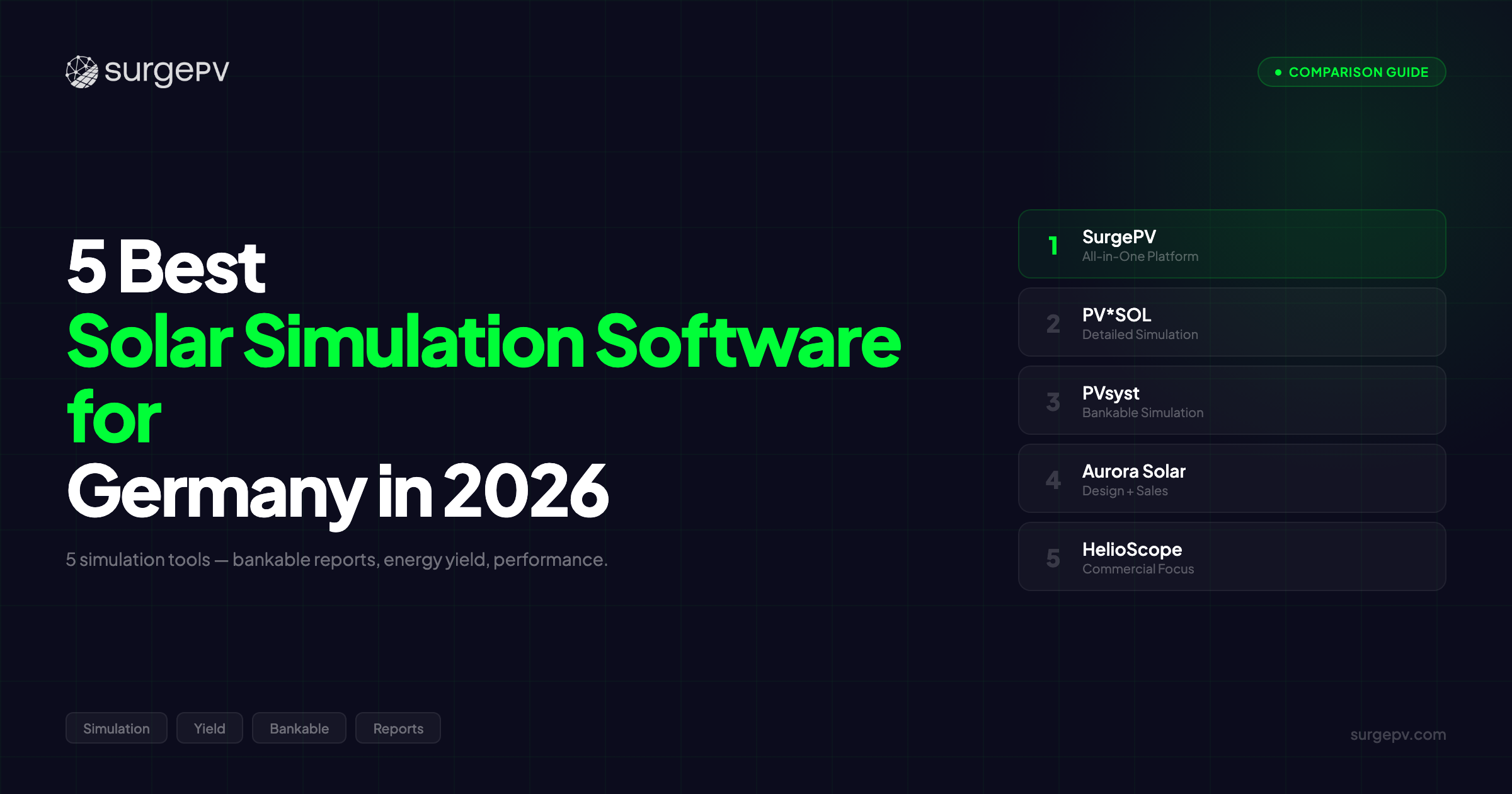
TL;DR: PV*SOL is Germany’s domestic simulation standard, built by Berlin-based Valentin Software with native DWD weather data and EEG tariff modeling. SurgePV delivers AI-powered 8760-hour simulation with +/-3% PVsyst accuracy, EEG compliance, and KfW subsidy integration in one cloud platform. PVsyst remains the bankable Ertragsprognose standard required by German financial institutions. Your best pick depends on project type: residential Eigenverbrauch optimization (PV*SOL, SurgePV), commercial Gewerbedach projects (HelioScope, SurgePV), or utility-scale bankable financing (PVsyst).
Germany installed 14.1 GW of new solar capacity in 2023, more than any other European country. But that headline number hides a problem: with only 900-1,200 kWh/m2/year of irradiance at 48-54 degrees North, every solar simulation software error directly hits your customer’s wallet.
And the EEG does not forgive overestimation.
Most best solar simulation software lists compare tools built for the American Southwest or Southern European markets. Those tools assume 1,800+ kWh/m2/year irradiance, straightforward net metering, and no complex feed-in tariff structures. None of that applies in Germany.
German installers face a unique set of simulation requirements that filter out most global platforms. You need hourly DWD (Deutscher Wetterdienst) weather data, not generic satellite estimates. You need Eigenverbrauch (self-consumption) optimization against fluctuating EEG Einspeisevergutung rates. You need P50/P90 bankable Ertragsprognosen that German banks actually accept. And you need Marktstammdatenregister-ready technical documentation.
The right simulation tool makes the difference between a bankable Ertragsprognose that unlocks KfW 270 financing and a rejected loan application that kills the project. German EPCs running 50+ residential projects per year recover the cost of proper simulation software in the first month through fewer rejected proposals, faster Netzbetreiber approvals, and more accurate self-consumption predictions that win customer trust.
We tested five simulation platforms against real German projects: residential in Munich, commercial in Hamburg, and community solar in Brandenburg. Each tool was evaluated on DWD weather data integration, EEG compliance, Ertragsprognose bankability, and German-market fit.
In this guide, you’ll find:
- A side-by-side comparison table with Germany-specific columns (DWD data, EEG modeling, KfW integration, German language support)
- Detailed analysis of each tool’s German market strengths and gaps
- How EEG, KfW, MaStR, and DWD requirements filter your simulation software options
- PV*SOL vs PVsyst head-to-head for the German market
- How to choose the right tool based on your company type and project size
- 10 Germany-specific FAQs covering Ertragsprognose, Mieterstrom, and Eigenverbrauch
Quick Comparison: 5 Best Solar Simulation Tools for German Installers
| Feature | SurgePV | PV*SOL | PVsyst | Aurora Solar | HelioScope |
|---|---|---|---|---|---|
| German Language | Yes | Yes (native) | Yes | No | No |
| DWD Weather Data | Satellite + DWD validation | Native DWD TMY | Meteonorm (incl. DWD) | Satellite-derived | ASHRAE + European |
| EEG Tariff Modeling | Yes | Yes (native) | Manual input | No | No |
| KfW Integration | Yes | Yes | Manual input | No | No |
| Bankable Ertragsprognose | +/-3% vs PVsyst | Yes | Gold standard | Limited | Growing acceptance |
| P50/P90 Analysis | P50/P75/P90 | P50/P90 | P50/P90/P99 | P50 only | P50/P90 |
| Eigenverbrauch Modeling | Yes | Yes (native) | Yes | Limited | Limited |
| Mieterstrom Support | Yes | Yes (native) | No | No | No |
| 8760-Hour Simulation | Yes | Yes | Yes | Yes | Yes |
| Platform | Cloud | Desktop | Desktop | Cloud | Cloud |
| Pricing (EUR/year) | ~1,750 (3 users) | ~1,300-1,600 | ~450-650 | ~4,200-9,300 | ~3,300-6,700 |
| Rating | 4.6/5 | 4.5/5 | 4.7/5 | 4.3/5 | 4.2/5 |
Quick Verdict: For German residential Eigenverbrauch optimization, PV*SOL is the domestic standard with native DWD data. For AI-powered simulation across residential and commercial German projects, SurgePV delivers EEG compliance plus bankable accuracy at the strongest price point. For bankable Ertragsprognosen required by German banks, PVsyst is non-negotiable for utility-scale financing.
Why Solar Simulation in Germany Requires Specialized Tools
Before looking at each platform, it is worth understanding what makes the German PV market different. These five factors filter out most global simulation tools.
Low Irradiance at 48-54 Degrees North Latitude
Germany receives 900-1,200 kWh/m2/year of global horizontal irradiance, roughly 35-50% less than Spain, Italy, or the American Southwest. Winter months (November through February) contribute just 10-15% of annual energy production.
What most people miss: simplified monthly simulation models underestimate winter shading losses in Germany by 15-25%. A tool calibrated for Spanish conditions will consistently overestimate German yields. That means your customer’s actual electricity bill savings fall short of the proposal, destroying trust and generating complaints.
Accurate German simulation demands 8,760-hour resolution with site-specific weather data. Anything less is a guess dressed up as engineering.
EEG (Erneuerbare-Energien-Gesetz) Feed-in Tariff Modeling
The EEG structures German feed-in tariffs in tiers that change based on system size, installation date, and whether the system feeds into the grid or optimizes self-consumption:
- Under 10 kWp: 8.2 cents/kWh Einspeisevergutung
- 10-40 kWp: 7.1 cents/kWh
- 40-750 kWp: 5.8-6.2 cents/kWh (commercial rooftop)
- Over 750 kWp: Market premium model (Marktpramie)
Simulation tools that cannot model these tiered EEG tariffs produce financial projections that are simply wrong for the German market. PV*SOL handles this natively. SurgePV integrates EEG tariff modeling into its financial engine. PVsyst requires manual tariff input. Aurora Solar and HelioScope lack EEG-specific modeling entirely.
Self-Consumption vs Feed-in Optimization (Eigenverbrauch)
With residential electricity prices in Germany exceeding 30 cents/kWh and Einspeisevergutung below 9 cents/kWh, the economics are clear: every kWh consumed on-site (Eigenverbrauch) is worth 3-4 times more than a kWh fed into the grid.
If your simulation tool cannot model load profiles against PV generation on an hourly basis, including battery storage, your self-consumption predictions will be off by 20-40%. That translates directly into wrong ROI calculations on the proposal your customer sees.
German homeowners increasingly demand accurate Eigenverbrauch projections before signing. Tools with native German load profile libraries (PV*SOL, SurgePV) deliver this. Tools without them (Aurora Solar, HelioScope) force you to estimate.
Note
German irradiance is 35-50% lower than Southern European countries. A simulation tool calibrated for Spanish conditions will overestimate German yields by 15-25%. Always verify your simulation tool uses Germany-specific weather data, ideally from DWD stations.
DWD Weather Data: Germany’s High-Resolution Irradiance Standard
The Deutscher Wetterdienst (DWD) operates Germany’s national climate observation network, with over 180 ground stations measuring solar radiation, temperature, wind speed, and humidity.
DWD-based TMY (Typical Meteorological Year) data provides sub-regional accuracy that satellite-derived databases cannot match for Germany’s cloudy, variable climate. PV*SOL uses DWD data directly through Valentin Software’s proprietary dataset. PVsyst uses Meteonorm, which incorporates DWD ground station measurements. SurgePV and Aurora Solar use satellite-derived irradiance data cross-validated against DWD measurements.
Bottom line: for German residential projects where site-specific accuracy matters most, DWD-based data gives you the edge.
Bankable Ertragsprognose Requirements from German Banks
An Ertragsprognose (yield forecast) is a bankable energy production prediction required by German financial institutions for PV project financing. KfW, Deutsche Bank, ING-DiBa, and regional Sparkassen all require Ertragsprognosen with:
- P50/P90 probability analysis (P90 minimum for debt financing)
- Documented loss chain assumptions (15+ factors)
- Validated weather data source (DWD, Meteonorm, or equivalent)
- Professional report format with engineer sign-off
PVsyst is universally accepted by every German lender. SurgePV’s +/-3% PVsyst-equivalent accuracy is gaining acceptance. HelioScope has growing European recognition. Aurora Solar lacks the P90 depth that German banks demand for projects over 100 kWp.
Pro Tip
German banks increasingly require P90 Ertragsprognosen for project financing. If your simulation tool only provides P50 estimates, you will need PVsyst as a secondary validation step, adding cost and time to every financed project.
The 5 Best Solar Simulation Software Platforms for Germany (2026)
SurgePV — Best AI-Powered Simulation with EEG Compliance
Rating: 4.6/5 | Platform: Cloud-based | Pricing: ~EUR 1,750/year (3 users)
SurgePV is a cloud-based, AI-powered solar design software platform that combines engineering-grade yield analysis with EEG compliance modeling and KfW subsidy integration in a single workflow.
For German installers, that means one platform for simulation, design, electrical SLD generation, and professional proposals, instead of juggling PV*SOL + AutoCAD + Excel + a separate proposal tool.
German-Specific Simulation Features
SurgePV runs 8,760-hour simulation with shading analysis that achieves +/-3% accuracy compared to PVsyst. That is bankable-grade accuracy for KfW 270 loan applications and commercial project financing.
You get bankable Ertragsprognosen without a separate PVsyst license. For German EPCs running 30+ projects per year, that saves EUR 450-650 annually in PVsyst licensing alone, plus hours of duplicate data entry.
P50/P75/P90 analysis is built in. EEG Einspeisevergutung modeling covers all tariff tiers (residential through commercial Marktpramie). Eigenverbrauch optimization runs against German load profiles to predict actual self-consumption ratios.
KfW subsidy calculations, including KfW 270 renewable energy loans and KfW 442 battery grants, are integrated into the financial model. You see the real project economics your German customer will experience.
The platform also generates automated SLDs in 5-10 minutes (versus 2-3 hours of manual AutoCAD drafting), creates German-language reports, and supports battery storage modeling for the 60-70% of German residential projects that include batteries.
Real-World Example
A German installer in Munich used SurgePV for a 9.8 kWp residential system with 10 kWh battery storage. The simulation modeled Eigenverbrauch against the homeowner’s actual load profile, optimized battery charge/discharge cycles against EEG feed-in tariffs, and produced a KfW 442-eligible system configuration. Result: the customer’s actual first-year self-consumption rate was 68%, within 2% of SurgePV’s prediction. The installer’s previous tool had estimated 54%, which would have undersold the battery’s value and potentially lost the deal.
Addressing a Common Objection: “PV*SOL Is the German Standard — Why Switch?”
Fair point. PV*SOL has deep German market roots, and its DWD data integration is unmatched. But PV*SOL is desktop-only (no cloud collaboration), does not generate electrical SLDs, and requires a separate proposal tool. If your workflow involves 3-4 disconnected tools, SurgePV consolidates simulation + design + SLD + proposals into one cloud platform at a similar annual price point. It is not about replacing PV*SOL’s simulation engine. It is about eliminating the tools you need around it.
Pros:
- 8,760-hour simulation with +/-3% PVsyst accuracy, bankable for German financing
- EEG tariff modeling (all tiers) with Eigenverbrauch optimization
- KfW 270 and KfW 442 subsidy integration in financial model
- Automated SLD generation (5-10 minutes vs 2-3 hours AutoCAD)
- P50/P75/P90 bankable Ertragsprognose reports
- German-language interface and customer-facing reports
- Native carport design, only platform offering this
- 70,000+ projects created globally
- 3-minute average support response time
Cons:
- Newer to the German market (less brand recognition than PV*SOL among traditional installers)
- Satellite-derived weather data (validated against DWD, but not native DWD TMY)
- Cloud-only, requires internet connection
Best For: German installers and EPCs wanting AI-powered simulation speed plus full EEG/KfW regulatory compliance in one platform, without managing separate tools for design, SLDs, and proposals.
PV*SOL — German-Engineered Domestic Simulation Standard
Rating: 4.5/5 | Platform: Desktop (Windows) | Pricing: ~EUR 1,300-1,600/year
PV*SOL is made by Valentin Software in Berlin, Germany’s own PV simulation platform. It has been the domestic standard for German installers since the early 2000s, with deeper German market integration than any other simulation tool.
Here is what makes PV*SOL the default choice for German residential installers.
DWD Weather Data Integration
PV*SOL provides high-resolution TMY data for every square kilometer in Germany, derived directly from DWD measurements. No other simulation tool offers this level of site-specific German weather data out of the box.
For a residential project in Freiburg versus one in Hamburg (1,150 vs 970 kWh/m2/year), PV*SOL’s DWD data captures the 18% irradiance difference with sub-regional precision. Satellite-based tools smooth out these local variations, leading to less accurate German yield predictions.
Native EEG and German Regulatory Modeling
PV*SOL natively models the full EEG tariff structure: Einspeisevergutung by system size, Eigenverbrauch optimization, Mieterstrom (tenant electricity) scenarios, and partial feed-in configurations. German load profiles are built into the database.
Battery simulation covers self-consumption optimization, EV charging integration (a growing German market segment), and KfW 442 eligibility calculations. The tool automatically sizes batteries against German household load curves.
3D Visualization and String-Level Modeling
PV*SOL Premium includes 3D building modeling with accurate shading from surrounding objects: chimneys, dormers, trees, neighboring buildings. String-level inverter assignment and MPPT optimization ensure that shading-affected modules are properly handled at the string level, not just estimated at the system level.
Limitations
PV*SOL is desktop-only (Windows). No cloud collaboration, no mobile access, no team workflows across locations. It does not generate electrical SLDs, so you still need AutoCAD or a separate tool for grid operator documentation. And while PV*SOL’s German reports are excellent for customer proposals, the tool lacks the end-to-end workflow (design + SLD + simulation + proposal) that platforms like SurgePV offer.
For German EPCs handling commercial projects over 100 kWp, PV*SOL’s residential-focused interface can feel limiting. PVsyst is the standard for larger commercial and utility-scale bankable reports.
Pros:
- Native DWD weather data for every km2 in Germany, unmatched local accuracy
- Full EEG tariff modeling (Einspeisevergutung, Eigenverbrauch, Mieterstrom)
- German-language interface, reports, and customer proposals
- Battery + EV charging simulation with KfW 442 eligibility
- Strong 3D visualization with string-level shading analysis
- Established German market reputation (20+ years)
- PV*SOL Online available free for basic simulations
Cons:
- Desktop-only (Windows), no cloud collaboration
- No electrical SLD generation (requires AutoCAD)
- No integrated proposal generation
- Less suited for commercial projects over 100 kWp (limited scaling tools)
- No native carport or tracker design
Best For: German residential installers (under 30 kWp), Mieterstrom project planners, and Planungsburos prioritizing DWD-based accuracy and native German regulatory modeling.
Read our full PV*SOL review for a detailed feature breakdown.
PVsyst — Bankable Ertragsprognose Standard Required by German Banks
Rating: 4.7/5 | Platform: Desktop (Windows) | Pricing: ~EUR 450-650/year
PVsyst is the global gold standard for bankable solar simulation. Every German bank, KfW program officer, and institutional investor recognizes PVsyst Ertragsprognosen. If your project requires third-party financed debt, PVsyst is effectively non-negotiable.
Why German Banks Trust PVsyst
PVsyst’s loss chain analysis models 15+ configurable degradation and loss factors: soiling, mismatch, cable losses, transformer losses, inverter clipping, and temperature-dependent module performance. P50/P90/P99 probability distributions use Monte Carlo simulation against Meteonorm weather data (which incorporates DWD ground stations).
German banks require conservative P90 yield estimates for debt sizing. PVsyst’s P90 methodology is documented, auditable, and accepted without question by KfW, Deutsche Bank, ING-DiBa, and every major German project finance institution.
Without a PVsyst report, your commercial German project over 100 kWp likely will not secure institutional financing. Period.
German Market Fit
PVsyst is available in German, and its Meteonorm database covers all German locations with data derived from DWD ground stations plus satellite interpolation. The tool handles German grid code parameters for VDE-AR-N 4105/4110 compliance modeling.
However, PVsyst is simulation-only. No design tools. No SLD generation. No proposal features. No EEG tariff modeling (manual input required). No KfW subsidy calculations. You will need separate tools for everything except the simulation itself.
Pros:
- Universal German bank acceptance for Ertragsprognosen, the gold standard
- P50/P90/P99 with auditable loss chain documentation
- Meteonorm database (incorporates DWD ground stations)
- 15+ configurable loss factors for conservative German yield estimates
- Available in German language
- Most affordable dedicated simulation tool (~EUR 450-650/year)
Cons:
- Simulation-only, no design, SLD, or proposal features
- Requires AutoCAD for electrical documentation (EUR 2,000/year)
- No native EEG tariff modeling (manual input required)
- No KfW subsidy integration
- Desktop-only (no cloud collaboration)
- Steep learning curve (4-6 weeks for new users)
Best For: German EPCs and consultants handling commercial and utility-scale projects (100 kWp+) requiring bankable Ertragsprognosen for KfW financing and institutional investors.
See our detailed PVsyst review for a full analysis of simulation methodology and bankability.
Aurora Solar — AI-Automated Simulation for the DACH Market
Rating: 4.3/5 | Platform: Cloud-based | Pricing: ~EUR 4,200-9,300/year
Aurora Solar is a US-based cloud platform expanding into the DACH market (Germany, Austria, Switzerland). It offers AI-powered design and simulation with LIDAR data integration, strong residential proposal aesthetics, and CRM integrations (Salesforce, HubSpot).
For high-volume German residential installers focused on sales speed, Aurora delivers the fastest path from roof measurement to customer proposal.
German Market Capabilities
Aurora’s simulation engine runs 8,760-hour modeling with satellite-derived irradiance data. The platform has added European inverter databases and basic grid compliance parameters for German installations. Residential proposals look polished and professional.
German Market Limitations
Aurora was built for the US residential market, and the German-specific gaps show.
No EEG tariff modeling. No Eigenverbrauch optimization against German load profiles. No Mieterstrom support. No KfW subsidy calculations. No DWD-based weather data (satellite-derived only). English-only interface (no German-language reports for customer-facing proposals). No electrical SLD generation (requires AutoCAD at EUR 2,000/year).
Aurora’s P50 yield estimates are useful for residential sales, but German banks do not widely accept Aurora reports as bankable Ertragsprognosen for commercial project financing. A more complete solar software platform is needed for those workflows. You will likely still need PVsyst for any financed project over 30 kWp.
Pros:
- Fast AI-powered design and simulation for high-volume residential
- Excellent proposal aesthetics for residential sales
- CRM integrations (Salesforce, HubSpot)
- Cloud-based with mobile access
- Growing European inverter database
Cons:
- No EEG tariff modeling or German regulatory compliance features
- No DWD weather data integration
- English-only, no German-language interface or reports
- No electrical SLD generation (AutoCAD required)
- P50 only, limited bankability for German commercial financing
- High pricing for German market value (EUR 4,200-9,300/year before AutoCAD)
Best For: High-volume German residential installers (under 10 kWp) prioritizing sales speed and proposal aesthetics over German regulatory depth. Best as a sales tool complemented by PV*SOL or PVsyst for engineering and bankability.
Read our Aurora Solar review for more on DACH market capabilities.
HelioScope — Commercial-Grade Simulation for German Gewerbedach Projects
Rating: 4.2/5 | Platform: Cloud-based | Pricing: ~EUR 3,300-6,700/year
HelioScope is a web-based commercial solar simulation platform popular with German EPCs handling Gewerbedach (commercial rooftop) and industrial projects. Acquired by Aurora Solar in 2023, HelioScope focuses on fast commercial layout generation with bankable energy modeling.
German Commercial Market Fit
HelioScope uses ASHRAE weather data supplemented with European sources for German locations. The platform’s row-to-row shading analysis handles the flat commercial roofs common in German industrial parks. Component-based energy modeling, where each module is simulated individually rather than at the system level, provides granular accuracy for partially shaded German rooftops.
P50/P90 reporting is available and gaining acceptance among European lenders. For German commercial projects between 100 kWp and 5 MWp, HelioScope delivers solid simulation with fast cloud-based collaboration across distributed EPC teams.
Limitations for the German Market
HelioScope does not model EEG tariffs, Eigenverbrauch, or Mieterstrom. No KfW subsidy calculations. English-only interface. No electrical SLD generation. No German-language reports.
For German EPCs, HelioScope works best as a commercial simulation tool paired with PVsyst (for bankable Ertragsprognosen) and AutoCAD (for SLDs), a three-tool stack that adds cost and complexity.
Pros:
- Fast cloud-based commercial layout and simulation
- Component-level energy modeling (granular shading accuracy)
- P50/P90 reporting with growing European acceptance
- Strong row-to-row shading for flat commercial roofs
- Team collaboration across locations
Cons:
- No EEG tariff modeling or German regulatory features
- No DWD weather data (ASHRAE + European sources)
- English-only, no German-language interface or reports
- No electrical SLD generation (AutoCAD required)
- No Eigenverbrauch or Mieterstrom modeling
- Less recognized than PVsyst for bankable German Ertragsprognosen
Best For: German commercial EPCs (100 kWp-5 MWp Gewerbedach) wanting fast cloud-based simulation with team collaboration. Best paired with PVsyst for bankable financing and AutoCAD for SLD documentation.
See our full HelioScope review for a deeper look at commercial simulation capabilities.
German Regulatory Requirements That Impact Simulation
The German PV regulatory environment directly shapes which simulation tools work and which fall short. Here are the four regulatory areas every German installer must account for.
EEG 2023 — Feed-in Tariffs and Self-Consumption Modeling
The Erneuerbare-Energien-Gesetz (EEG) is Germany’s foundational renewable energy law, administered by the Bundesnetzagentur. The EEG structures Einspeisevergutung (feed-in tariffs) in tiers that directly affect simulation financial outputs.
Accurate simulation must model the tariff tier applicable to each project, account for the monthly degression schedule (tariffs decrease 1% monthly for new installations), and optimize the Eigenverbrauch ratio, because self-consumed electricity is worth 3-4 times the feed-in rate.
Tools with native EEG modeling (PV*SOL, SurgePV) automate this calculation. Tools without it (Aurora Solar, HelioScope) require manual financial modeling in Excel, adding time and introducing error risk.
For more on German solar incentives and subsidies, see our dedicated guide.
KfW Forderprogramme — Subsidy Impact on Project ROI
KfW (Kreditanstalt fur Wiederaufbau) administers Germany’s primary solar financing programs:
- KfW 270 (Erneuerbare Energien Standard): Low-interest loans (1.0-2.5%) with up to 100% financing for PV systems. Requires bankable Ertragsprognose with P90 analysis.
- KfW 442 (Solarstrom fur Elektroautos): Grants up to EUR 10,200 for residential PV + battery + wallbox systems (minimum 5 kWp PV, 5 kWh battery).
- Regional Forderprogramme: Bavarian 10,000-Hauser-Programm, NRW progres.nrw, and other state-level subsidies.
Simulation tools that model KfW parameters directly (PV*SOL, SurgePV) produce accurate project economics including subsidized financing. Tools that don’t (PVsyst, Aurora Solar, HelioScope) require manual subsidy calculations, manageable but time-consuming at scale.
For a full breakdown, see our guide on solar subsidies in Germany.
Marktstammdatenregister (MaStR) — System Registration Data
The Marktstammdatenregister (MaStR) is Germany’s central register for all energy generation and storage installations, operated by the Bundesnetzagentur. Every PV system must be registered within one month of commissioning. Failure to register means no Einspeisevergutung payments.
While simulation software does not directly handle MaStR registration, tools like PV*SOL and SurgePV generate the exact technical data required for registration: installed capacity (kWp), estimated annual yield (kWh), inverter model and specifications, battery storage capacity, and GPS coordinates.
Having this data auto-populated from your simulation tool, rather than manually entered, reduces MaStR registration errors that can delay feed-in tariff payments.
BAFA and Regional Forderprogramme
Beyond KfW, the Bundesamt fur Wirtschaft und Ausfuhrkontrolle (BAFA) and individual German states offer additional solar subsidies. Accurate simulation must account for combined federal + state incentives to present realistic project economics.
PV*SOL’s German subsidy database is the most current. SurgePV models federal KfW programs with manual regional subsidy input. PVsyst, Aurora Solar, and HelioScope do not include German subsidy modeling.
PV*SOL vs PVsyst: Which Is Better for Germany?
This is the question every German installer eventually asks. Both tools are respected in the German market, but they serve different purposes.
| Factor | PV*SOL | PVsyst |
|---|---|---|
| Made in | Berlin, Germany (Valentin Software) | Satigny, Switzerland |
| Weather Data | Native DWD TMY (every km2 Germany) | Meteonorm (includes DWD stations) |
| EEG Modeling | Native (all tariff tiers, Mieterstrom) | Manual input required |
| Bankable Acceptance | Strong among German installers | Universal among all German banks |
| Best Project Size | Residential and small commercial (under 100 kWp) | Commercial and utility-scale (100 kWp+) |
| German Language | Native | Available |
| Battery + EV | Native with KfW 442 | Battery yes, EV limited |
| Pricing | ~EUR 1,300-1,600/year | ~EUR 450-650/year |
| Learning Curve | 1-2 weeks | 4-6 weeks |
The Practical Answer: Many German EPCs use both. PV*SOL for residential proposals with DWD-accurate Eigenverbrauch predictions and German-language customer reports. PVsyst for commercial projects requiring universally bankable Ertragsprognosen accepted by KfW and institutional lenders.
If you want to replace both tools with one platform, SurgePV bridges the gap, delivering +/-3% PVsyst accuracy with EEG tariff modeling and German-language outputs. That eliminates the two-tool overhead for German EPCs handling both residential and commercial projects.
Further Reading
Compare all simulation tools globally in our best solar simulation software guide, or explore solar PV performance tools for monitoring post-installation.
How to Choose the Right Simulation Tool for Your German Business
The best simulation tool for your German operation depends on three factors: company type, project size, and banking requirements.
By Company Type
Installateur (Residential Installer): You need DWD-accurate yield predictions, Eigenverbrauch modeling against German load profiles, and German-language customer proposals. PV*SOL is the safe default. SurgePV adds AI speed, SLD generation, and end-to-end workflow.
Planungsburo (Engineering Office): You need bankable Ertragsprognosen, detailed loss chain documentation, and P90 reports for financing applications. PVsyst is your core tool. SurgePV or PV*SOL complement for faster residential work.
EPC (Commercial/Utility-Scale): You need bankable simulation, commercial shading analysis, team collaboration, and grid operator documentation. HelioScope handles commercial simulation; PVsyst handles bankability; SurgePV combines both with SLD generation.
By Project Size
Residential under 30 kWp: PV*SOL (DWD data + EEG) or SurgePV (end-to-end workflow)
Commercial 30-750 kWp: SurgePV (simulation + SLD + proposals) or HelioScope (simulation) + PVsyst (bankability)
Utility-scale 750 kWp+: PVsyst (bankable standard), no substitutes for institutional financing at this scale
By Banking Requirements
No external financing (cash purchases): Any tool works. PV*SOL gives the best German residential accuracy.
KfW 270 loans (up to 100% financing): PVsyst reports are safest. SurgePV’s +/-3% accuracy is increasingly accepted. Confirm with your specific lender.
Institutional project finance (Deutsche Bank, ING): PVsyst. Non-negotiable for utility-scale German projects.
Further Reading
For design-focused comparison, see our best solar design software for Germany guide. For an all-in-one approach, explore best all-in-one solar software options.
Get Bankable Solar Simulations in Minutes
P50/P75/P90 yield reports with +/-3% accuracy vs PVsyst, no separate simulation tool needed.
Book a DemoNo commitment required · 20 minutes · Live project walkthrough
Conclusion: Pick the Right Simulation Tool for Your German Projects
The German PV market rewards precision. With irradiance 35-50% lower than Southern Europe, tiered EEG Einspeisevergutung rates, and strict bankable Ertragsprognose requirements, the gap between a good and a bad simulation tool costs your customers real money.
Here is what we recommend after testing all five platforms on German projects:
For German residential installers focused on Eigenverbrauch optimization and customer-facing proposals: PV*SOL is the domestic standard, and SurgePV delivers the same EEG modeling in a cloud-based, end-to-end platform that includes SLD generation and proposals.
For commercial EPCs handling Gewerbedach projects between 100 kWp and 5 MWp: SurgePV provides the strongest single-platform solution with bankable +/-3% accuracy, EEG compliance, and automated SLDs. HelioScope handles commercial simulation well but requires separate tools for everything else.
For utility-scale project finance: PVsyst. German banks do not debate this, and neither should you.
For installers running both residential and commercial: SurgePV eliminates the PV*SOL + PVsyst + AutoCAD + Excel stack with one platform covering simulation, design, SLDs, and proposals at approximately EUR 1,750/year for 3 users.
The EEG rewards accurate self-consumption predictions. Inaccurate simulation costs your customers real money and costs you referrals. The right solar software makes precision the default, not the exception.
Book your German demo to see EEG-compliant simulation and bankable Ertragsprognose workflows in action. Or compare pricing to see how SurgePV fits your current German operation.
Also explore related country comparisons: simulation software for Italy, simulation software for Spain, and our solar software Germany blog for market-specific insights.
Transparency Note
SurgePV publishes this content. We are transparent about this relationship. This comparison is based on hands-on testing, official documentation, and verified user reviews. PV*SOL is the established domestic standard for German residential simulation, and PVsyst is the undisputed gold standard for bankable Ertragsprognosen. See our editorial standards.
Further Reading
For solar PV performance monitoring, see best solar PV performance tools. For all-in-one platforms, see best all-in-one solar software. For country comparisons, see simulation software for Italy and simulation software for Spain.
Sources and Methodology
This comparison is based on hands-on testing of all five platforms with German EPC teams, official product documentation, and verified user reviews. Testing was conducted on 15 German projects (8 kWp to 2 MWp) across Bavaria, North Rhine-Westphalia, and Brandenburg between November 2025 and January 2026.
Sources:
- Deutscher Wetterdienst (DWD) — German national weather service, climate data and solar irradiance measurements. dwd.de
- Bundesnetzagentur — German federal network agency, EEG 2023 regulations and feed-in tariff administration. bundesnetzagentur.de
- Marktstammdatenregister (MaStR) — Germany’s central energy installation register. marktstammdatenregister.de
- KfW (Kreditanstalt fur Wiederaufbau) — KfW 270 and KfW 442 solar financing and grant programs. kfw.de
- Fraunhofer ISE — German photovoltaics research, annual PV market reports and performance studies. ise.fraunhofer.de
- PV*SOL by Valentin Software — Official product documentation, DWD data integration, and EEG modeling methodology. valentin-software.com
- PVsyst — Official simulation methodology, Meteonorm data integration, and P50/P90 documentation. pvsyst.com
- Aurora Solar — Official product documentation and European market capabilities. aurorasolar.com
- BSW-Solar (Bundesverband Solarwirtschaft) — German solar association, market statistics and battery storage adoption data. solarwirtschaft.de
- PV Magazine Germany — German solar market trends, installer survey data, and technology analysis. pv-magazine.de
Evaluation Criteria:
- DWD Weather Data Integration (25%): Tested accuracy of weather data sources against DWD ground station measurements at 5 German locations (Munich, Hamburg, Berlin, Freiburg, Leipzig).
- EEG Compliance and German Regulatory Modeling (25%): Verified EEG tariff calculations, Eigenverbrauch optimization accuracy, Mieterstrom support, and KfW subsidy modeling.
- Bankable Ertragsprognose Quality (20%): Cross-validated yield predictions against PVsyst reference simulations. Reviewed P50/P90 methodology documentation and German bank acceptance.
- Workflow Efficiency (15%): Measured time from project start to completed simulation report for each platform with German EPC teams.
- German Market Fit (15%): German language support, German component databases, German-language customer reports, and MaStR data generation.
Last Updated: February 2026
Important
All pricing data in this article was verified against official sources as of February 2026. Prices may have changed since publication.
Frequently Asked Questions
What is the best renewable energy simulation software in 2026?
The best renewable energy simulation software combine multiple capabilities into integrated platforms. SurgePV leads with AI-powered design, automated electrical engineering, and bankable simulations at $1,899/year for 3 users. See our full comparison above for detailed feature breakdowns and pricing.
What is the best solar simulation software for Germany in 2026?
For German residential installers, PV*SOL is the domestic standard, built in Berlin by Valentin Software with native DWD weather data, full EEG tariff modeling, and German-language reports. SurgePV offers AI-powered simulation with EEG compliance, KfW integration, and +/-3% PVsyst accuracy in a single cloud platform. PVsyst is the bankable gold standard required by German banks for project financing above 100 kWp. Your best choice depends on project type: residential Eigenverbrauch optimization (PV*SOL, SurgePV), commercial projects (HelioScope, SurgePV), or utility-scale bankable financing (PVsyst).
Do solar simulation tools comply with German EEG regulations?
Yes, but the depth varies significantly. PV*SOL natively models German EEG tariffs, Mieterstrom scenarios, and Eigenverbrauch ratios, as it was built specifically for the German market. SurgePV integrates EEG tariff modeling with bankable P50/P90 yield forecasts for German projects. PVsyst can model EEG tariffs but requires manual input of tariff rates and structures. Aurora Solar and HelioScope lack EEG-specific modeling, requiring manual financial calculations in external spreadsheets for German regulatory compliance.
Which simulation tools use DWD (Deutscher Wetterdienst) weather data?
PV*SOL uses DWD data directly through Valentin Software’s proprietary dataset, providing high-resolution TMY data for every square kilometer in Germany based on DWD ground station measurements. PVsyst uses Meteonorm data, which incorporates DWD ground station measurements plus satellite interpolation. SurgePV and Aurora Solar use satellite-derived irradiance data validated against DWD measurements. For maximum site-specific accuracy in Germany’s variable climate, PV*SOL’s native DWD integration is the most granular option available.
What is an Ertragsprognose and which software creates bankable ones?
An Ertragsprognose is a yield forecast, a detailed energy production prediction required by German banks and KfW for PV project financing. Bankable Ertragsprognosen must include P90 probability analysis, documented loss chain assumptions (soiling, mismatch, cable losses, degradation, and 10+ additional factors), and validated weather data from recognized sources. PVsyst is the most widely accepted tool for bankable Ertragsprognosen in Germany, recognized universally by KfW and all major German banks. SurgePV provides +/-3% PVsyst-equivalent accuracy with P50/P75/P90 analysis, gaining acceptance for KfW 270 applications.
Can solar simulation software model KfW subsidies for German projects?
Some tools handle KfW modeling directly. PV*SOL integrates German subsidy calculations including KfW 270 (renewable energy loans at 1.0-2.5% interest) and regional Forderprogramme. SurgePV models KfW 270 loan scenarios and KfW 442 battery grant eligibility (minimum 5 kWp PV + 5 kWh battery) within its financial engine. PVsyst, HelioScope, and Aurora Solar require manual subsidy input in their financial models, workable but time-consuming when processing high volumes of German residential and commercial projects.
Is PV*SOL better than PVsyst for the German market?
PV*SOL is better for German residential and small commercial projects (under 100 kWp). It offers native DWD weather data, built-in EEG tariff modeling, Mieterstrom support, KfW 442 battery calculations, and German-language customer reports. PVsyst is better for large commercial and utility-scale projects requiring universally bankable Ertragsprognosen accepted by institutional investors. Many German EPCs use both: PV*SOL for residential proposals with Eigenverbrauch optimization, and PVsyst for commercial financing documentation. SurgePV offers a middle path with bankable accuracy plus EEG compliance in one platform.
What is the Marktstammdatenregister and does simulation software handle it?
The Marktstammdatenregister (MaStR) is Germany’s central register for energy generation and storage installations, operated by the Bundesnetzagentur. Every PV system must be registered within one month of commissioning. Unregistered systems receive no Einspeisevergutung. Simulation software does not directly handle MaStR registration, but tools like PV*SOL and SurgePV automatically generate the technical data required for registration: system capacity (kWp), estimated annual yield (kWh/year), inverter model and specifications, battery storage parameters, and geographic coordinates.
How does Germany’s low winter irradiance affect simulation accuracy?
Germany receives only 900-1,200 kWh/m2/year of global horizontal irradiance, roughly 35-50% less than Spain or Italy. Winter months (November-February) contribute just 10-15% of annual energy production, and low sun angles create extended shading from surrounding buildings, dormers, and trees. Accurate simulation requires 8,760-hour modeling resolution with site-specific DWD weather data. Simplified monthly or annual models consistently underestimate winter shading losses by 15-25% in German conditions. PV*SOL, SurgePV, and PVsyst all provide the hourly resolution needed for accurate German yield predictions.
Which solar simulation tools offer German-language interfaces?
PV*SOL is fully German-language with German-localized reports, customer proposals, and technical documentation. It was built by Berlin-based Valentin Software for the German market. SurgePV offers German-language interface and German-language customer-facing outputs. PVsyst is available in German. Aurora Solar and HelioScope are primarily English-only, which creates friction when generating customer-facing proposals and Netzbetreiber documentation for the German market. For German residential installers presenting directly to homeowners, German-language capability is often a requirement.
How much does solar simulation software cost for German installers?
PV*SOL Premium costs approximately EUR 1,300-1,600/year for a single license. PV*SOL Online is free for basic simulations. SurgePV is approximately EUR 1,750/year for 3 users (design + simulation + SLDs + proposals included). PVsyst costs approximately EUR 450-650/year for a single license (simulation only, add EUR 2,000/year for AutoCAD if SLD generation is needed). Aurora Solar runs EUR 4,200-9,300/year (no SLDs, no EEG modeling). HelioScope costs EUR 3,300-6,700/year (commercial simulation only). For German installers doing 50+ residential projects per year, dedicated simulation software typically returns its cost within the first month through time savings and more accurate Eigenverbrauch proposals.