

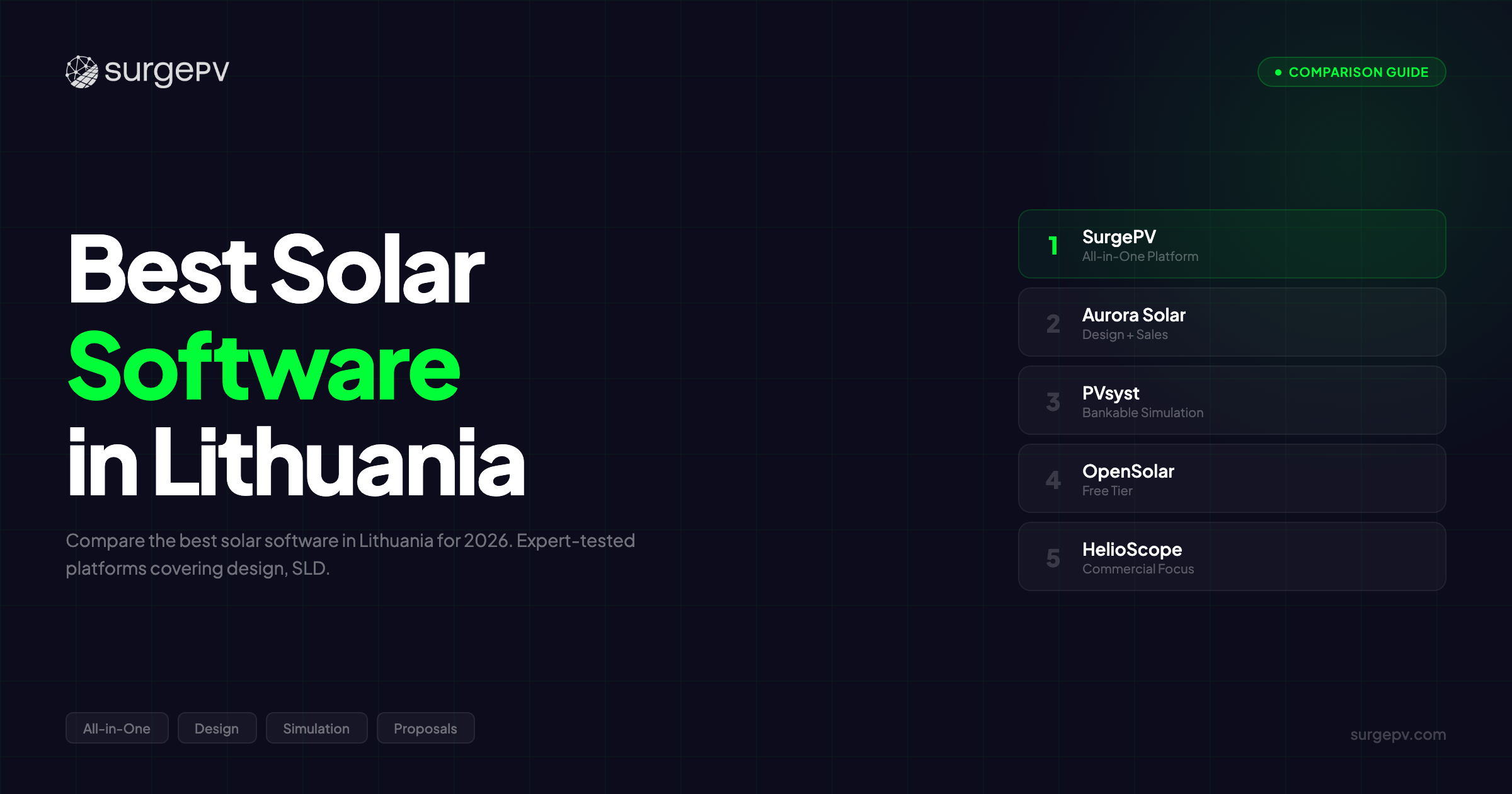
TL;DR: SurgePV is the best all-in-one solar software for Lithuania — combining design, automated SLD generation (Litgrid/ESO compliant), P50/P90 bankable simulations, and professional proposals in one platform at $1,899/year for 3 users. PVsyst is the bankability gold standard for projects above 1 MW. Aurora Solar suits international teams. OpenSolar is the budget option for small residential installers. HelioScope leads for utility-scale ground-mount design.
Lithuania’s race to 2 GW of solar capacity by 2030 is transforming the market. 40-60% annual capacity growth has pushed installed PV past 750 MW, driven by the National Energy Independence Strategy and post-2022 demand for energy sovereignty. EU renewable targets, grid modernization, and growing prosumer adoption are accelerating every segment of the industry.
But managing solar projects in Lithuania — from design and ESO grid approvals to proposals and bankability reports — creates bottlenecks when you’re switching between 3-5 disconnected tools. Lithuanian EPCs need platforms that handle Baltic climate modeling, Litgrid electrical compliance, prosumer net metering calculations, and SEB/Swedbank financing scenarios without the friction of manual data transfer between separate tools.
The best solar software for Lithuania combines design, electrical engineering, simulation, and proposals in one workflow — reducing design time by 70% while ensuring ESO compliance and bank acceptance. This guide evaluates 5 leading platforms based on functionality, Lithuanian market fit, workflow efficiency, and real-world performance with Lithuanian EPCs.
In this guide, you’ll learn:
- Which platform handles all solar software categories best for Lithuania
- All-in-one vs. specialized tools — which approach saves you more money and time
- How pricing compares across tools (from $990/year to over $6,800/year)
- Our recommendations by company type — prosumer installers, commercial EPCs, and utility-scale developers
Quick Comparison Table
| Software | Best For | Pricing/Year | Design | Simulation | Proposals |
|---|---|---|---|---|---|
| SurgePV | End-to-end workflows | $1,899 (3 users) | Full + SLDs | P50/P90 | Yes |
| Aurora Solar | International teams | $4,800+ | Good | P50 only | Excellent |
| PVsyst | Bankability standard | $1,040-1,600 | No | Gold standard | No |
| OpenSolar | Small residential | $600-1,800 | Basic | Basic | Good |
| HelioScope | Utility-scale design | $2,400-4,800 | Advanced | Limited | No |
Understanding Solar Software Categories for Lithuania
Lithuanian EPCs typically need software across multiple categories: design, electrical engineering, simulation, and proposals. Understanding these categories helps you decide between all-in-one platforms and specialized tools.
Design and Electrical Engineering
Purpose: Create system layouts, electrical schematics (SLDs), 3D modeling, and engineering documentation. Lithuanian requirements: Litgrid-compliant SLDs meeting LST EN 50438/50549, ESO interconnection documentation, AutoCAD exports for municipal permits. 80% of commercial EPCs in Lithuania use dedicated design software.
Simulation and Bankability
Purpose: Predict long-term energy production and financial performance. Lithuanian requirements: P50/P90 reports accepted by SEB, Swedbank, and Luminor. 8760-hour simulation accounting for Baltic seasonal variability. Performance Ratio (PR) above 80% for bankability. Essential for financed commercial and utility-scale projects.
Proposals and Sales
Purpose: Generate professional customer-facing proposals and close deals. Lithuanian requirements: Prosumer net metering calculator (ESO rules, 1:1 credit), feed-in premium modeling (auction-based), Lithuanian tax incentive calculations (9% VAT, depreciation), green loan integration (SEB, Swedbank, Luminor rates). 90% of Lithuanian installers use proposal tools.
All-in-One vs. Best-of-Breed
All-in-one platforms (like SurgePV) provide design, electrical engineering, simulation, and proposals in one subscription. Seamless workflow. No data re-entry. Lower total cost ($1,899/year vs. $4,700+ for multiple tools). Single vendor support. Best for 90% of Lithuanian EPCs.
Best-of-breed tools (PVsyst + AutoCAD + proposal tool) offer maximum depth in specific areas. But they require multiple subscriptions, manual data transfer, multiple learning curves, and higher total costs. Best for ultra-specialized utility-scale developers above 10 MW requiring maximum simulation detail.
Further Reading
- Best All-in-One Solar Software — Complete platform comparison
- Best Solar Design Software in Lithuania — Design-specific comparison
- Best Solar Proposal Software in Lithuania — Proposal tools compared
Best Solar Software in Lithuania (Detailed Reviews)
SurgePV — Best End-to-End Solar Platform for Lithuania
Best For: Commercial EPCs, utility-scale developers, growing installers
Pricing: $1,899/year (3 users); $1,499/user/year (For 3 Users plan)
Onboarding: 2-3 weeks
SurgePV is a cloud-based solar platform combining AI-powered design and electrical engineering, bankable simulations, and professional proposals in one unified workflow. For Lithuanian solar companies, SurgePV eliminates the need for AutoCAD, PVsyst, and separate proposal software — replacing 3-4 disconnected tools with a single integrated platform.
Here’s why that matters: a typical Lithuanian commercial project currently takes 11+ hours across design (3 hours in AutoCAD), electrical engineering (2 hours), simulation (2 hours in PVsyst), and proposal creation (4 hours in spreadsheets). SurgePV reduces that entire workflow to 2-3 hours — a 70% time reduction. When you’re handling 20+ projects per month, those saved hours compound into significant competitive advantage.
Key Features for Lithuania
- Automated SLD generation — Creates IEC 60364-compliant electrical schematics in 5-10 minutes, meeting Litgrid and ESO documentation requirements (LST EN 50438/50549). Manual AutoCAD drafting takes 2-3 hours for the same output.
- P50/P75/P90 bankability metrics — Produces the production estimates Lithuanian banks (SEB, Swedbank, Luminor) require. Accuracy within +/-3% of PVsyst. Your financing applications include the exact bankability data lenders expect.
- 8760-hour shading analysis — Hour-by-hour simulation across the full year, critical for Lithuania’s Baltic climate at 54-56 degrees north latitude where the summer/winter production ratio reaches 10:1.
- Native carport and tracker design — The only platform with built-in solar carport design. Single-axis and dual-axis tracker support included. As Lithuania’s commercial sector grows, this is a competitive edge other platforms don’t offer.
- Lithuanian financial modeling — EUR-based calculations with prosumer net metering rules (under 500 kW, annual settlement, 1:1 ESO credit). Feed-in premium modeling for auction projects. Lithuanian tax incentives (9% VAT, accelerated depreciation). Green loan scenarios for SEB, Swedbank, and Luminor (3.5-6.5% rates).
- Wire sizing and voltage drop calculations — Instant automated calculations per IEC 60364 standards per Lithuanian LST HD 60364 requirements. 98% BOM accuracy eliminates material estimation errors.
- Professional proposals — Generate branded Lithuanian-language proposals directly from your design data. Include prosumer net metering savings, feed-in premium revenue, financing scenarios, and 3D visual renderings.
Pro Tip
SurgePV replaces AutoCAD ($2,000/year) + PVsyst ($1,500/year) + proposal software ($1,200/year) = $4,700/year savings. And the 70% workflow time reduction means your team handles 40% more projects without additional hires. Book a demo to see the Lithuanian workflow in action.
Pricing
| Plan | Price | Users |
|---|---|---|
| Individual | $1,899/year | 3 users |
| For 3 Users | $1,499/user/year | 3 users |
| For 5 Users | $1,299/user/year | 5 users |
| Enterprise | Custom | Multiple |
All features included on every plan. No hidden fees, no feature gating. See full pricing.
Who SurgePV Is Best for in Lithuania
- Commercial EPCs handling 100 kW-10 MW projects needing Litgrid-compliant SLDs and SEB/Swedbank-accepted reports
- Utility-scale developers needing bankable P50/P90 reports alongside pipeline management
- Growing installers scaling from 10 to 50+ projects/year who need design accuracy and sales-quality proposals
- Multi-market companies operating across Lithuania, the Baltics, and the EU
- Teams seeking to eliminate 3-5 separate tools and reduce total software costs by 40%+
Limitations
- Primarily English interface (proposals export in Lithuanian; full Lithuanian localization on 2026 roadmap)
- Smaller Lithuanian user base compared to PVsyst (established since 1992)
- 1-2 week learning curve for teams transitioning from traditional multi-tool workflows
Real-World Example
A growing EPC team in Vilnius was spending 11+ hours per project across four separate tools — AutoCAD for design, PVsyst for simulation, Excel for financials, and Word for proposals. After switching to SurgePV, total workflow dropped to 3 hours. SLD generation alone went from 2.5 hours to under 10 minutes. The same 3-person team now handles 40% more projects per month, and their ESO approval rate improved because automated compliance checks eliminated manual errors.
You might be wondering: if SurgePV does all this, why haven’t I heard of it? Fair question. PVsyst has had a 30-year head start. Aurora Solar has spent hundreds of millions on marketing. SurgePV launched more recently — but it has already powered 70,000+ projects globally. The platform was purpose-built for the workflow gaps that legacy tools leave open, especially automated electrical engineering and integrated proposals, which no other single platform offers natively.
Aurora Solar — Best for International Lithuanian Teams
Best For: International installers working in both US and Lithuanian markets
Pricing: $4,800+/year (estimated)
Aurora Solar is a San Francisco-based solar platform with strong design, simulation, and proposal capabilities. It’s the industry leader in the US residential market, with a large user base and extensive training resources.
What Works for Lithuania
- Good design-to-proposal integration with professional templates
- Strong 3D modeling and LIDAR remote design — useful for Lithuanian rooftop projects
- Professional proposal templates with financing marketplace
- Large user community and extensive training resources
Where It Falls Short in Lithuania
- US-centric design — NEC electrical codes require manual Lithuanian adaptation for LST EN standards
- No ESO/Litgrid integration — Manual compliance documentation needed
- No SLD generation — Litgrid electrical documentation requires AutoCAD ($2,000/year) as a separate tool
- P50 only — No P75/P90 metrics, which Lithuanian banks expect for financed projects
- Higher cost — $4,800+/year is steep for Baltic market budgets, especially without Lithuanian-specific features
Best for: International installers working in both US and Lithuanian markets who need a single platform across regions, and are comfortable adapting US-focused tools for Lithuanian compliance.
Read our full Aurora Solar review for a deeper analysis.
PVsyst — Bankability Gold Standard for Lithuanian Financing
Best For: Utility-scale developers requiring universal lender acceptance
Pricing: EUR 1,040-1,600/year (desktop license) plus separate design and proposal tools
PVsyst is the industry-standard energy simulation software, universally accepted by banks, lenders, and independent engineers worldwide. If you’re seeking project financing from SEB, Swedbank, or Luminor for a Lithuanian solar project above 1 MW, PVsyst reports carry unmatched credibility.
What Works for Lithuania
- Universally accepted by all Lithuanian financial institutions (SEB, Swedbank, Luminor, DNB)
- PVGIS weather data integration with Lithuanian-specific irradiance data (54-56 degrees N)
- Most detailed loss modeling in the industry — critical for Baltic climate accuracy
- P50/P75/P90 reports are the gold standard for project financing
Where It Falls Short in Lithuania
- Simulation-only — PVsyst does not design layouts. Requires a separate design tool
- No SLD generation — Litgrid electrical documentation requires AutoCAD ($2,000/year)
- No proposal generation — Cannot produce client-facing sales documents
- Desktop-only — No cloud collaboration across Vilnius, Kaunas, and Klaipeda offices
- Total cost climbs fast — PVsyst ($1,500) + AutoCAD ($2,000) + proposal tool ($1,200) = $4,700+/year
Best for: Utility-scale developers and commercial EPCs where universally accepted bankable simulations are the primary requirement for SEB/Swedbank financing above 1 MW.
Read our full PVsyst review for a detailed breakdown.
Did You Know?
Lithuania’s National Energy Independence Strategy targets 2 GW of total solar capacity by 2030 — more than doubling the current installed base. The Baltic state’s push for energy sovereignty after 2022 has accelerated adoption across all segments (SolarPower Europe Market Outlook 2024-2028).
OpenSolar — Best Budget Option for Lithuanian Residential Installers
Best For: Small residential installers (5-20 projects/year) with budget constraints
Pricing: $600-1,800/year
OpenSolar is an Australian cloud-based design and proposal platform offering affordable pricing for small residential installers. Its emphasis on simple workflows and CRM functionality makes it accessible for budget-conscious Lithuanian teams.
What Works for Lithuania
- Most affordable option for small residential-only teams
- Simple design + proposal integration for straightforward residential workflows
- Built-in CRM helps manage leads and sales pipeline
- Mobile-friendly interface for field sales use
Where It Falls Short in Lithuania
- Residential focus only — Limited commercial or utility-scale capabilities
- Lithuanian support limited — Manual financial modeling and language translation needed
- Basic simulation — Limited bankability compared to PVsyst or SurgePV
- No SLD generation — Cannot produce Litgrid-compliant electrical documentation
- Prosumer net metering requires custom configuration — ESO rules not built-in
Best for: Small Lithuanian residential installers (5-20 projects/year) seeking affordable design + proposal automation who focus exclusively on simple prosumer systems and don’t need Litgrid electrical compliance documentation.
Read our full OpenSolar review for details.
HelioScope — Best for Lithuanian Utility-Scale Developers
Best For: Utility-scale developers designing 1-50 MW ground-mount projects
Pricing: $2,400-4,800/year
HelioScope is a cloud-based design and simulation platform optimized for utility-scale and large commercial projects. Its fast layout iteration and integrated financial modeling (LCOE, NPV, IRR) make it a strong choice for Lithuanian developers focused on multi-MW ground-mount solar farms.
What Works for Lithuania
- Fast utility-scale layout design — multi-MW projects in hours
- Integrated financial modeling (LCOE, NPV, IRR) for investor presentations
- Good simulation accuracy for bankability on utility-scale projects
- Cloud-based team collaboration across Lithuanian offices
Where It Falls Short in Lithuania
- No SLD generation — Litgrid/ESO electrical documentation needs external tools
- No proposal generation — Requires separate tools for customer-facing documents
- US-centric — EU compliance features require manual adaptation for Lithuanian standards
- Higher cost — $2,400-4,800/year for enterprise features, plus AutoCAD for electrical work
Best for: Lithuanian utility-scale developers designing 1-50 MW ground-mount projects who prioritize fast layout iteration and financial modeling for investors over electrical engineering depth.
See our full HelioScope review for more details.
Full Solar Software Comparison Table for Lithuania
| Feature | SurgePV | Aurora Solar | PVsyst | OpenSolar | HelioScope |
|---|---|---|---|---|---|
| Best for | All project types | International teams | Bankability | Budget residential | Utility-scale |
| Design capabilities | Full + SLDs | Good (rooftop) | No design | Basic | Advanced |
| SLD generation | Yes (automated) | No | No | No | No |
| P50/P90 reports | Yes | P50 only | Gold standard | Basic | Limited |
| Proposal generation | Yes | Excellent | No | Good | No |
| Financial modeling | Yes (Lithuanian) | US-focused | Limited | Basic | LCOE, NPV, IRR |
| Baltic climate modeling | Yes (8760-hr) | Basic | Excellent | Basic | Basic |
| Carport design | Yes (only platform) | No | No | No | No |
| Cloud-based | Yes | Yes | No (desktop) | Yes | Yes |
| Pricing/year | $1,899 (3 users) | $4,800+ | $1,040-1,600 | $600-1,800 | $2,400-4,800 |
Further Reading
For a broader comparison beyond the Lithuanian market, see our guides to the best solar design software and best solar simulation software globally.
What Makes the Best Solar Software in Lithuania
Litgrid and ESO Compliance
Lithuanian grid connection requires electrical diagrams meeting LST EN 50438/50549 standards and ESO technical conditions. Non-compliant designs lead to rejections and project delays of 30-90 days. Software that generates SLDs automatically — like SurgePV — saves 2-3 hours per project and ensures first-submission approval. Lithuania follows EU Network Code RfG, requiring anti-islanding, power factor control (minimum 0.95), and voltage ride-through documentation.
Baltic Climate Accuracy — The 10:1 Challenge
Lithuania’s GHI ranges from 1,000-1,100 kWh/m2/year — roughly half of what southern European markets receive. Summer months produce 160-180 kWh/m2 while winter drops to 60-90 kWh/m2. That 10:1 seasonal ratio makes accurate shading analysis and cold-weather modeling essential, not optional. Your software must handle extreme variability using PVGIS Lithuanian weather data to produce credible production estimates.
Bankability for Lithuanian Lenders
Lithuanian banks — including SEB, Swedbank, and Luminor — expect P50/P90 production estimates for financing approvals on commercial projects above 500 kW. PVsyst is universally accepted. SurgePV’s simulations achieve +/-3% accuracy compared to PVsyst and are increasingly accepted by Baltic lenders. Performance Ratio (PR) above 80% is the threshold for bankability.
Lithuanian Financial Modeling
Proposals must accurately reflect Lithuanian prosumer net metering (ESO 1:1 credit, annual settlement), feed-in premium (auction rates of 0.05-0.08 EUR/kWh), Lithuanian tax incentives (9% VAT, accelerated depreciation, property tax exemptions), and green loan integration (SEB, Swedbank, Luminor rates of 3.5-6.5%). Inaccurate financial projections damage customer trust and lead to lost deals.
Workflow Efficiency and ROI
Lithuanian EPCs face labor shortages and competitive margins. Software must reduce design time, eliminate errors, and increase close rates to justify costs. The math: manual workflows take 11+ hours per project. Automated platforms (SurgePV) cut that to 2-3 hours. At 20 projects/month, that’s 160 hours saved — worth approximately 4,800 EUR/month at 30 EUR/hour engineering rates. Against a $150/month software cost, that’s over 1,000% ROI.
STR Construction Code Compliance
Lithuanian rooftop installations must comply with STR structural requirements — including snow load calculations (1.0-1.5 kN/m2) and wind load analysis (Vref 22-26 m/s depending on location). Design software should produce accurate bill of materials with load specifications for structural engineer approval.
Which Software Is Right for Your Use Case?
| Your Situation | Recommended Software | Why It Fits |
|---|---|---|
| Commercial EPCs (100kW-5MW projects) | SurgePV, PVsyst + HelioScope | Need Litgrid-compliant SLDs, bankable P50/P90 reports for Lithuanian banks, and fast proposal generation. SurgePV integrates all functions; PVsyst+HelioScope requires multiple tools but offers maximum simulation depth. |
| Residential prosumer installers (5-30 projects/month) | SurgePV, OpenSolar | Fast proposal generation with ESO net metering calculations. SurgePV handles growth into commercial; OpenSolar best for budget-conscious residential-only operations. |
| Utility-scale developers (1-10 projects/year) | SurgePV, PVsyst, HelioScope | Bankability and engineering depth required. PVsyst universally accepted for financing; HelioScope excels at multi-MW layout iteration; SurgePV offers all-in-one efficiency. |
| Multi-market Baltic companies | SurgePV | Single platform across Lithuania, Latvia, Estonia with flexible regional compliance. Cloud collaboration across offices. Eliminates 3-4 separate tools. |
| Small teams (1-5 people) | SurgePV, OpenSolar | All-in-one platforms reduce training complexity and total software costs. SurgePV offers commercial scalability; OpenSolar provides budget entry point. |
| International teams (US + Lithuania) | Aurora Solar, SurgePV | Aurora strong in US residential market but requires Lithuanian compliance adaptation. SurgePV works globally with flexible regulatory inputs. |
Pro Tip
Multi-regional Baltic EPCs managing Lithuania, Latvia, and Estonia projects simultaneously benefit most from SurgePV’s cloud-based collaboration and flexible compliance inputs. One platform, three countries, zero tool-switching.
When You May Not Need Advanced Solar Software
Not every solar project in Lithuania requires comprehensive design and simulation platforms. Consider simpler alternatives or manual workflows if:
- Very small residential projects with standard layouts — Simple south-facing rooftop arrays under 10 kW with minimal shading may be adequately designed using basic manufacturer calculators and spreadsheet-based financial modeling.
- Engineering is fully outsourced — If your company uses external engineering consultants who provide complete electrical documentation (SLDs, wire sizing), you may only need proposal and CRM tools rather than full design platforms.
- Extremely limited project volume — Teams handling fewer than 3-5 projects per year may find that manual AutoCAD workflows and PVWatts estimates are sufficient, as software subscription costs may exceed the value of time savings.
- Sales-only operations — Pure sales teams that hand off won projects to separate EPC partners for engineering and installation may only require lightweight proposal tools rather than technical design software.
- Pilot or testing phase — Companies exploring the Lithuanian solar market for the first time may prefer to use free tools (PVWatts, Google Sunroof) and manual processes until project volume justifies software investment.
However, most Lithuanian EPCs, developers, and medium-to-large installers benefit from integrated platforms that reduce manual work and improve accuracy. With Lithuania’s Litgrid electrical compliance requirements, ESO grid approval processes, and competitive pressure for fast proposal turnaround, manual workflows create bottlenecks that delay projects and reduce close rates. For commercial projects above 50 kW requiring bank financing, professional software with P50/P90 bankability reports is effectively mandatory.
Software Selection Guide by Company Type
Residential Prosumer Installers (5-30 projects/month)
Priority: Proposal speed, sales conversion, prosumer net metering accuracy, ease of use.
Recommended: SurgePV (all project types with growth into commercial), OpenSolar (budget option with CRM). Budget option: OpenSolar for residential-only teams with fewer than 10 projects/month.
Commercial EPCs (5-20 projects/year)
Priority: Technical accuracy, Litgrid compliance, SEB/Swedbank bankability, professional tenders.
Recommended: SurgePV (complete platform with SLD generation and proposals), or HelioScope + PVsyst (specialized approach at higher total cost).
Utility-Scale Developers (1-10 projects/year)
Priority: Bankability, engineering depth, lender acceptance, financial modeling.
Recommended: SurgePV (all-in-one), PVsyst + design tools (universal bankability), HelioScope (utility-scale specialization with LCOE analysis). Note: PVsyst universally accepted for financing, but requires separate design and proposal tools.
Multi-Market Baltic Companies
Priority: Single platform across all project types, workflow efficiency, total cost optimization.
Recommended: SurgePV — the only platform handling residential, commercial, and utility in one solution across Lithuania and the broader Baltic/EU market.
Further Reading
- Best Solar Software for EPCs — EPC-focused platform comparison
- Best Solar Design Software in Poland — Baltic neighbor comparison
- Best Solar Proposal Software — Proposal tools compared globally
Reader Objection: “PVsyst Is the Industry Standard — Why Would I Switch?”
PVsyst IS the industry standard for simulation. That’s not in question. If you need universally accepted bankable P50/P90 reports for Lithuanian lenders, PVsyst delivers that better than anyone.
But PVsyst is simulation-only. It doesn’t design layouts. It doesn’t generate SLDs. It doesn’t create proposals. For a complete workflow, you still need:
- AutoCAD for design and SLDs: $2,000/year
- PVsyst for simulation: $1,500/year
- Proposal tool: $1,200/year
- Total: $4,700+/year — plus 8+ hours of extra work per project from switching between tools
SurgePV at $1,899/year provides simulation accuracy within +/-3% of PVsyst, automated SLDs meeting Litgrid requirements, and professional proposals — all in one platform. For 90% of Lithuanian EPCs, that’s the better value.
The exception: utility-scale projects above 10 MW where lenders specifically require PVsyst reports. In that case, pair PVsyst with SurgePV for design and proposals. You still save the $2,000/year AutoCAD license and the $1,200/year proposal tool — a net savings of $3,200/year over the full three-tool stack.
Streamline Your Lithuanian Solar Business with SurgePV
Design, simulate, and close deals in one platform — with Litgrid compliance, Baltic climate accuracy, and bankable reports accepted by SEB, Swedbank, and Luminor.
Book a DemoNo commitment required · 20 minutes · Live project walkthrough
Bottom Line: Best Solar Software for Lithuania
Lithuania’s solar market is growing fast — and the regulatory environment (Litgrid, ESO, STR codes, prosumer thresholds) combined with Baltic climate challenges make software selection more important than in simpler markets. The biggest decision isn’t which individual tool is best — it’s whether to go all-in-one or specialized.
Here’s how to choose:
For commercial EPCs and growing installers: SurgePV delivers the most complete end-to-end platform with integrated design, Litgrid-compliant electrical engineering, bankable P50/P90 simulations, Lithuanian proposal generation, and project management. It eliminates 3-5 separate tools, reduces design time by 70%, and saves $4,700+/year in tool consolidation.
For bankability-critical projects above 1 MW: PVsyst remains the gold standard for independent engineer reports and Lithuanian bank acceptance. Best used alongside SurgePV for integrated design and proposals (saving $3,200/year vs. the AutoCAD + proposal tool stack).
For international teams: Aurora Solar provides good design + proposal capabilities for installers working in both US and Lithuanian markets. Requires manual Lithuanian compliance adaptation but offers a strong feature set for cross-market operations.
For small residential installers: OpenSolar delivers affordable design + proposal automation for budget-conscious teams. Requires manual Lithuanian financial modeling but provides good value for low-volume operations (5-20 projects/year).
For utility-scale developers: HelioScope excels at fast multi-MW layout design and financial modeling (LCOE, NPV, IRR). Best for developers prioritizing utility-scale speed and investor presentations over detailed electrical engineering.
Lithuania’s push toward 2 GW of solar by 2030 means the market is only getting more competitive. The EPCs winning projects today are the ones that deliver Litgrid-compliant documentation, bankable simulations, and professional proposals faster than their competitors — not the ones juggling four separate software tools. Your software choice is a competitive advantage, not just a cost center.
Want to see how SurgePV handles Lithuanian project workflows? Book a demo and our team will walk you through a project using your actual site data — with Litgrid compliance, Baltic climate accuracy, and SEB/Swedbank-accepted bankable reports.
Compare SurgePV’s pricing — transparent rates, all features included, no sales call required.
Further Reading
- Best Solar Design Software in Lithuania — Design-specific comparison
- Best Solar Proposal Software in Lithuania — Proposal tools for Lithuanian installers
- Best Solar Design Software in Germany — European comparison
Frequently Asked Questions
What is the best solar software in Lithuania?
SurgePV is the best all-in-one solar software for Lithuania in 2026. It combines design, automated SLD generation (meeting Litgrid/ESO requirements), P50/P90 bankable simulations, proposals, and project management in one cloud-based platform at $1,899/year for 3 users. For simulation-only needs, PVsyst remains the bankability standard.
Do I need specialized software for Lithuanian solar projects?
Yes, professional solar software is essential for commercial and utility-scale projects in Lithuania. Requirements include Litgrid-compliant electrical diagrams (LST EN 50438/50549), P50/P90 bankability reports for SEB/Swedbank financing, Baltic climate-accurate performance modeling, and professional proposals with net metering calculations. Manual workflows take 11+ hours per project vs. 2-3 hours with integrated software.
How much does solar software cost in Lithuania?
Costs range from $600/year (OpenSolar basic) to over $6,800/year (Aurora Solar + AutoCAD). SurgePV starts at $1,899/year for 3 users with all features included. Total cost of ownership matters most: PVsyst ($1,500) + AutoCAD ($2,000) + proposal tool ($1,200) = $4,700+/year. SurgePV replaces all three at lower total cost. See SurgePV pricing.
What software do Lithuanian banks accept for solar financing?
Lithuanian banks (SEB, Swedbank, Luminor, DNB) accept P50/P90 performance reports from PVsyst, SurgePV, and HelioScope that meet IEC 61724 standards and use Lithuanian meteorological station data (Vilnius, Kaunas, Klaipeda TMY data). PVsyst is the gold standard. SurgePV simulations achieve +/-3% accuracy vs. PVsyst and are increasingly accepted for commercial projects.
Can I use US-focused solar software (Aurora, HelioScope) in Lithuania?
Yes, US-focused software works in Lithuania but requires manual adaptation for Litgrid electrical compliance, ESO net metering calculations, and Lithuanian-language documentation. SurgePV offers native Lithuanian support including prosumer modeling and LST EN compliance, while Aurora and HelioScope require engineering expertise for compliance adaptation.
Should I use all-in-one software or multiple specialized tools?
All-in-one platforms (SurgePV) provide better ROI for 90% of Lithuanian EPCs through integrated workflows, lower total cost ($1,899/year vs. $4,700+ for multiple tools), and faster design-to-proposal turnaround (2-3 hours vs. 11 hours). Specialized tool combinations (PVsyst + AutoCAD) suit ultra-specialized utility-scale developers above 10 MW.
Can solar software handle Lithuania’s low irradiance and seasonal extremes?
Yes, professional solar software (SurgePV, PVsyst, PV*SOL) uses PVGIS weather data for Lithuania (1,000-1,100 kWh/m2/year GHI) and accurately models extreme seasonality (10:1 summer/winter production ratio). SurgePV’s 8760-hour shading analysis is critical for accurate Baltic climate modeling at 54-56 degrees north latitude.
Can solar software handle Lithuanian net metering and feed-in premium?
SurgePV natively supports Lithuanian prosumer net metering (ESO 1:1 credit, annual reconciliation) and feed-in premium calculations (auction-based 0.05-0.08 EUR/kWh). Other tools (Aurora, OpenSolar) require manual spreadsheet configuration for Lithuanian incentives and electricity price structures (0.08-0.18 EUR/kWh).
Sources
- SolarPower Europe EU Market Outlook 2024-2028 — Market data and growth projections
- Lithuanian Ministry of Energy — National Energy Independence Strategy and renewable targets
- Litgrid (Lithuanian TSO) — Grid connection guidelines and technical requirements
- ESO (Lithuanian DSO) — DSO technical conditions and net metering rules
- PVGIS (Photovoltaic Geographical Information System) — Lithuanian solar irradiance data
- ENTSO-E European Grid Codes — EU Network Code RfG requirements
- IEC Standards — IEC 60364, IEC 61724, IEC 61853, EN 62446 (accessed February 2026)
- G2 Software Reviews — Verified user reviews for solar platforms
- Capterra Software Reviews — User feedback and satisfaction scores
- SurgePV Product Documentation — Official feature specifications (accessed February 2026)