

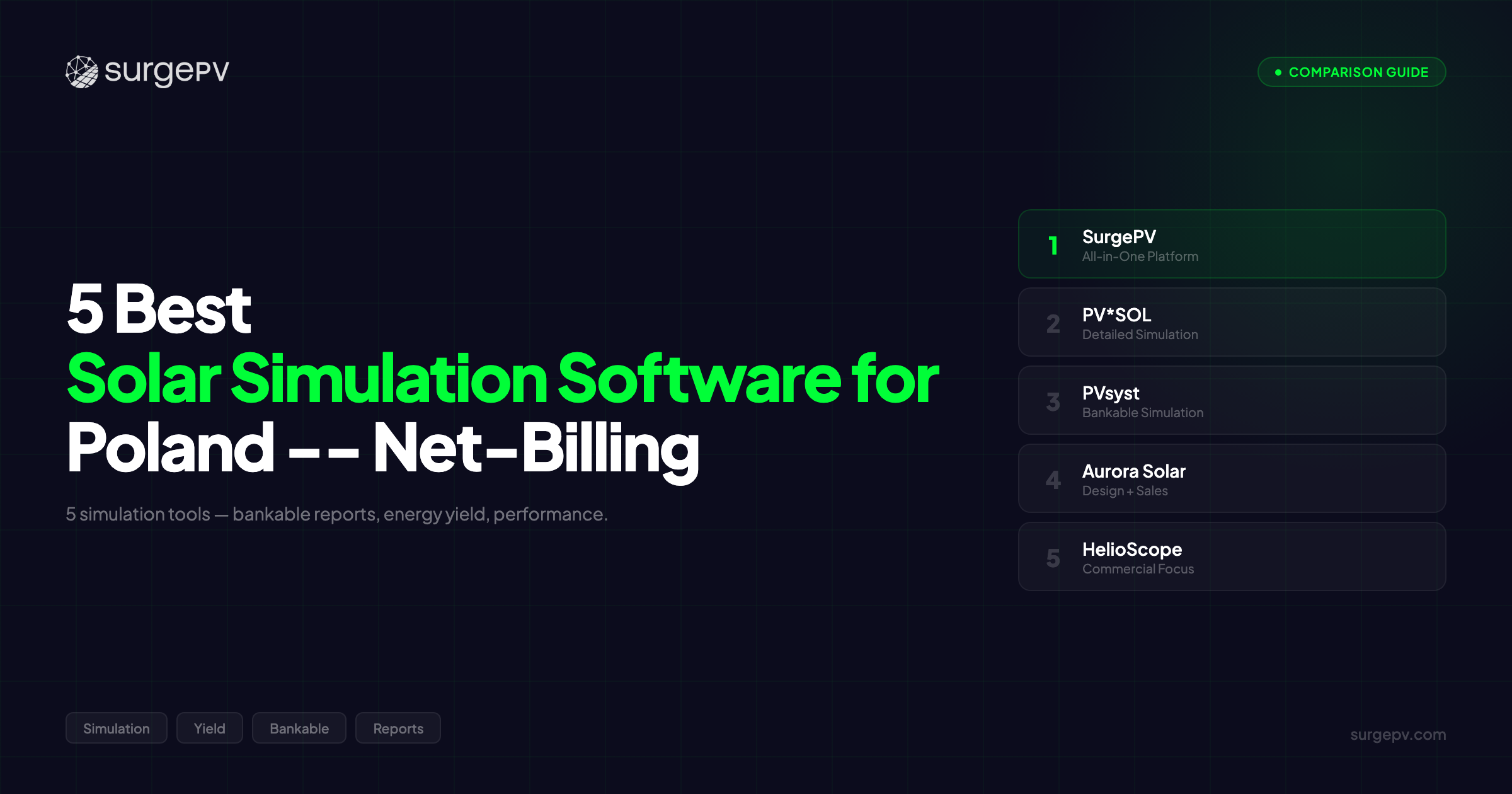
TL;DR: SurgePV is the best AI-powered solar simulation platform for Polish installers in 2026, with native net-billing modeling, Polish-language reports, and P50/P90 bankable yield forecasts at ~7,500 PLN/year for 3 users. PV*SOL is the Central European standard with the strongest battery simulation for prosumer + storage systems. PVsyst remains the bankable gold standard required by Polish banks and investors for large-scale projects.
Poland has 1.3 million solar prosumers. But since April 2022, every single one of them makes or loses money based on one thing: self-consumption ratio.
When Poland replaced net metering with net-billing, the entire economics of residential fotowoltaika shifted. Under the old system, a prosumer exported surplus energy and got it back 1:1 (minus 20-30%). Under net-billing, surplus is sold at the wholesale RCEm price, and the gap between RCEm (wholesale) and retail rates means every exported kWh is worth 50-65% less than every kWh consumed on-site.
The difference between a good simulation and a bad one? That is 15-20% of a homeowner’s annual savings.
Poland is now Europe’s fourth-largest residential solar market. Over 4.6 GW of new PV capacity was installed in 2023 alone. The Moj Prad subsidy program is in its fifth iteration, pushing PV + storage adoption. And the 0% VAT on solar installations makes Polish project payback periods among the shortest in Central Europe.
But most solar simulation software tools were not built for this market.
They do not model net-billing economics. They do not factor in Moj Prad 5.0 subsidies for PV + storage. They do not use IMGW weather data for Polish irradiance calibration. And they do not generate Polish-language reports for prosumer proposals or URE documentation.
That is a problem when Polish installers are competing for prosumer projects in Warsaw, commercial rooftops in Krakow, and farm-mounted systems near Rzeszow, where accurate self-consumption projections directly determine customer trust and deal closure.
We tested five simulation platforms on real Polish projects, evaluating each for net-billing modeling, Moj Prad subsidy integration, hourly self-consumption analysis, bankable P50/P90 accuracy, and Polish-language support.
In this guide, you will find:
- A side-by-side comparison table with Poland-specific columns (net-billing, Moj Prad, IMGW data, Polish language)
- Detailed reviews of 5 simulation platforms tested on Polish projects
- How net-billing and RCEm pricing affect simulation requirements
- Moj Prad 5.0 subsidy modeling for PV + storage systems
- Regional irradiance data across Polish voivodeships
- Prosumer + storage simulation for Poland’s fastest-growing segment
- 10 Poland-specific FAQs with regulatory context
Quick Comparison: 5 Best Solar Simulation Tools for Polish Installers
| Feature | SurgePV | PV*SOL | PVsyst | Aurora Solar | HelioScope |
|---|---|---|---|---|---|
| Best For | AI simulation + net-billing | Prosumer + storage | Bankable large-scale | High-volume residential | Commercial EPCs |
| Polish Language | Yes | Yes | Yes | No | No |
| Net-Billing Modeling | Native | Via hourly profiles | Manual input | Limited | Limited |
| Moj Prad Subsidy | Automated | Manual input | Manual input | No | No |
| Battery Simulation | Yes | Advanced (best) | Yes | Basic | Basic |
| Bankable P50/P90 | Yes (+/-3% vs PVsyst) | Basic | Gold standard | Premium only | Good |
| 8760-Hour Simulation | Yes | Yes | Yes | Yes | Yes |
| Platform | Cloud | Desktop | Desktop | Cloud | Cloud |
| Pricing (PLN/year) | ~7,500 (3 users) | ~5,500-6,800 | ~1,900-2,800 | ~10,000-38,000+ | ~14,000+ |
| Our Rating | 9.1/10 | 8.7/10 | 8.4/10 | 7.6/10 | 7.4/10 |
See how SurgePV handles Polish net-billing modeling — Book a free demo.
Why Solar Simulation in Poland Requires Specialized Tools
Generic simulation platforms give you annual yield. Polish installers need hourly self-consumption ratios, net-billing export economics, and Moj Prad subsidy ROI. Here is why.
Net-Billing Changed Everything (April 2022)
Before April 2022, Polish prosumers used a straightforward net metering system (system opustow). Export 1,000 kWh, get 700-800 kWh back from the grid. Simple. Simulation tools only needed to calculate total annual production.
Net-billing (rozliczanie netto) replaced that system entirely. Now, prosumers sell surplus energy at the monthly wholesale market price, the RCEm (Rynkowa Cena Energii Miesieczna), and buy from the grid at retail rates.
What most people miss: the wholesale-to-retail gap is enormous. In summer 2025, RCEm dropped below 200 PLN/MWh while retail rates exceeded 600 PLN/MWh. That is a 3:1 penalty on every exported kilowatt-hour.
Note
Under Poland’s net-billing system, a prosumer selling surplus at RCEm (wholesale) and buying at retail loses 50-65% on every exported kWh. This means self-consumption optimization is 2-3x more valuable than maximizing total production. Your simulation tool MUST model hourly load profiles, not just annual yield.
Self-Consumption Optimization Is Now the Priority
Before net-billing, Polish installers could safely oversize systems. Extra production just went to the grid and came back later. That logic no longer works.
Today, the optimal Polish prosumer system maximizes the percentage of solar energy consumed on-site. A well-simulated system targets 50-70% self-consumption without storage and 70-85% with a battery.
Simulation tools that only report annual kWh are useless for this. Polish installers need hourly production vs. consumption profiles to size systems correctly under net-billing.
Every oversized system is a prosumer losing money on surplus export. And every undersized system is a missed revenue opportunity. The right simulation tool prevents both.
Poland’s Regional Irradiance Variation (950-1,100 kWh/m2/year)
Poland spans roughly 6 degrees of latitude. That creates meaningful differences in solar resource across voivodeships. A 5 kWp system in Rzeszow (south) produces roughly 15% more energy than the same system in Gdansk (north).
Simulation tools must use location-specific irradiance data, not national averages, to deliver accurate yield forecasts for Polish projects.
Prosumer + Storage: The New Polish Standard
Moj Prad 5.0 offers up to 16,000 PLN in subsidies when prosumers install PV + storage together. Combined with net-billing economics (where self-consumption is 2-3x more valuable than export), battery storage is no longer optional for many Polish installations.
This means simulation tools must model battery cycling, degradation, hourly charge/discharge profiles, and the financial impact of shifting self-consumption from 35% to 70%+.
IMGW Weather Data for Polish Simulation Calibration
IMGW-PIB (Instytut Meteorologii i Gospodarki Wodnej) operates 60+ meteorological stations across Poland, measuring solar irradiance at ground level. Most simulation tools rely on satellite-derived data or Meteonorm databases rather than direct IMGW feeds.
Bottom line: always cross-reference your simulation tool’s weather data against PVGIS or IMGW benchmarks for your specific Polish location. A 5-8% difference in irradiance input translates directly to a 5-8% difference in yield forecast, and that changes the customer’s payback calculation.
The 5 Best Solar Simulation Software Platforms for Poland (2026)
SurgePV — Best AI-Powered Simulation with Net-Billing Modeling
Rating: 9.1/10 | Price: ~1,750 EUR/year (~7,500 PLN for 3 users) | Book a demo
SurgePV is the only solar design software that combines AI-powered design, 8760-hour energy simulation, net-billing optimization, and Polish-language report generation in a single cloud workflow.
For Polish installers and EPCs, this solves a real problem. The typical Polish fotowoltaika installer juggles PVsyst for simulation, AutoCAD for electrical documentation, Excel for net-billing financial modeling, and a separate tool for customer proposals. That fragmented workflow costs 3-4 hours per project.
Why SurgePV works for Poland:
The simulation engine runs a full 8760-hour analysis with shading accuracy within +/-3% of PVsyst. It delivers P50/P75/P90 bankable yield forecasts that Polish banks and investors accept for project financing. But here is what sets it apart for the Polish market specifically.
SurgePV models net-billing economics natively. It calculates hourly self-consumption ratios, values surplus export at RCEm wholesale rates, and compares against retail electricity costs, giving prosumers an accurate picture of their real savings under Poland’s current system. It means your proposals show customers exactly how much they save by consuming solar on-site versus exporting to the grid. That level of detail wins deals in a market where homeowners compare 3-6 quotes.
The platform also models Moj Prad 5.0 subsidies automatically, including the higher subsidy tiers for PV + storage systems (up to 16,000 PLN). Polish-language reports mean proposals go directly to customers without translation.
SurgePV generates automated single line diagrams in 5-10 minutes, compared to 2-3 hours of manual AutoCAD drafting. For Polish installers submitting documentation to OSD (Operator Systemu Dystrybucyjnego), this eliminates a major bottleneck.
And here is what most people miss: SurgePV is the only platform with native carport solar design. As Polish commercial carport installations grow, particularly at retail parks and logistics centers, this is a differentiator no other tool matches.
Mini Case Study: Warsaw Prosumer Installation
A Polish installer in the Mazowieckie voivodeship used SurgePV to design a 7.5 kWp residential prosumer system in a Warsaw suburb. Using the platform’s hourly self-consumption optimization, they adjusted panel orientation and sizing to achieve 62% self-consumption, compared to 41% from their previous tool that used annual averages. Under net-billing, that 21-percentage-point improvement translated to roughly 3,200 PLN/year in additional savings for the homeowner. The customer signed within 48 hours of receiving the SurgePV-generated proposal.
Pro Tip
SurgePV’s generation and financial modeling tool includes Polish-specific analysis. Model net-billing economics, Moj Prad 5.0 subsidies, and 0% VAT impact directly within the platform — no Excel spreadsheets needed.
“But PV*SOL is what most Polish installers already use — why switch?”
Fair question. PV*SOL is an excellent simulation tool and widely adopted in Poland. Here is the difference: PV*SOL is desktop-only simulation software. SurgePV is a complete cloud platform — simulation plus design plus electrical engineering plus proposals plus financial modeling. If you are currently using PV*SOL for simulation, AutoCAD for SLDs, and Excel for net-billing calculations, SurgePV replaces all three. If PV*SOL’s battery simulation depth is your priority (and it is the best in class), PV*SOL remains a strong choice.
Pricing: ~1,750 EUR/year (~7,500 PLN) for 3 users. All features included. See SurgePV pricing.
Pros:
- AI-powered 8760-hour simulation with +/-3% PVsyst accuracy
- Native net-billing modeling with hourly self-consumption optimization
- Moj Prad 5.0 subsidy integration for PV and PV + storage
- Polish-language interface and report generation
- Automated SLD generation (5-10 min vs 2-3 hours manual)
- P50/P75/P90 bankable yield forecasts
- Only platform with native carport design
- Cloud-based, no installation, team collaboration
- 70,000+ projects globally, 3-minute average support response
Cons:
- Newer brand presence in the Polish market compared to PV*SOL
- Battery simulation less detailed than PV*SOL’s cycling algorithms
- Less established than PVsyst for utility-scale bankability in Poland
Best for: Polish installers and EPCs who want AI speed, net-billing optimization, and a complete design-to-proposal workflow in one platform.
PV*SOL — Central European Standard with Advanced Battery Simulation
Rating: 8.7/10 | Price: ~1,300-1,600 EUR/year (~5,500-6,800 PLN) | PV*SOL website | PV*SOL review
PV*SOL by Valentin Software (Berlin) is the simulation tool most Polish installers already know. Built in Germany, widely adopted across Central Europe, and available in Polish, PV*SOL has earned its reputation as the regional standard for residential and commercial PV simulation.
Why PV*SOL works for Poland:
PV*SOL’s strength in the Polish market comes down to three things: Polish language support, advanced battery simulation, and hourly self-consumption modeling that actually matters under net-billing.
The battery simulation is best-in-class. PV*SOL models cycling algorithms, calendar and cycle degradation, state-of-charge management, and charge/discharge profiles at minute-level resolution. For Polish prosumer + storage systems, where Moj Prad 5.0 subsidizes up to 16,000 PLN for combined PV + battery, this level of detail gives installers accurate ROI projections that generic tools cannot match.
Hourly self-consumption analysis is native. PV*SOL models production vs. consumption on an hourly basis, making it directly applicable to Poland’s net-billing calculations. You can see exactly which hours a prosumer exports surplus (at the low RCEm rate) and which hours they consume on-site (avoiding the high retail rate).
The 3D simulation engine handles complex roof geometries with string-level modeling. For Polish row houses and multi-pitched roofs common in Warsaw, Krakow, and Wroclaw suburbs, the 3D shading analysis captures production losses that simpler tools miss.
PV*SOL Online offers free basic simulations, useful for Polish installers who want to validate a quick estimate before committing to the premium tool.
If you are a Polish installer focused on prosumer + storage systems and need the most accurate battery simulation available, PV*SOL is the tool to beat. The combination of Polish language, hourly modeling, and battery depth makes it a natural fit for Poland’s net-billing market.
Pros:
- Industry-leading battery simulation (cycling, degradation, minute-level resolution)
- Polish-language interface and reporting
- Hourly self-consumption modeling for net-billing analysis
- 3D simulation with string-level modeling
- Strong Central European market presence, widely recognized by Polish installers
- PV*SOL Online (free) for basic simulations
- Established component database with European equipment
Cons:
- Desktop-only, no cloud collaboration
- No proposal generation
- No automated SLD generation (requires separate AutoCAD)
- No native carport design
- Moj Prad subsidy modeling requires manual financial input
- Learning curve for 3D modeling features (2-3 weeks)
Best for: Polish installers doing prosumer + storage systems who need the deepest battery simulation and already prefer desktop-based workflows.
PVsyst — Bankable Standard for Polish Project Finance
Rating: 8.4/10 | Price: ~450-650 EUR/year (~1,900-2,800 PLN) | PVsyst website | PVsyst review
PVsyst is the bankable simulation standard. Period. For Polish EPCs and developers applying for Aukcje OZE (renewable energy auctions) or seeking project financing from Polish banks, PVsyst validation is typically non-negotiable.
Why PVsyst works for Poland:
Every major Polish bank, investment fund, and institutional lender accepts PVsyst reports as the benchmark for energy yield verification. The simulation depth is unmatched: detailed loss chain analysis with 15+ configurable factors, P50/P90/P99 probabilistic yield forecasts, and component-level degradation modeling.
PVsyst uses Meteonorm weather data, which incorporates IMGW ground station measurements from across Poland. This means the irradiance inputs for Polish locations are validated against actual ground-level observations, not just satellite estimates. For projects in regions with complex terrain (Bieszczady, Tatry foothills), this ground-truth calibration matters.
The software is available in Polish and generates reports that Polish regulatory bodies and financial institutions recognize. For Aukcje OZE applications, PVsyst’s detailed loss chain documentation is what auditors expect to see.
At ~1,900-2,800 PLN/year, PVsyst is also the most affordable tool on this list. For Polish biura projektowe (design offices) focused on bankable documentation, the cost-to-value ratio is excellent.
But here is the trade-off. PVsyst is a simulation tool, not a design platform. It does not create panel layouts. It does not generate SLDs. It does not produce customer proposals. It is desktop-only with a steep learning curve (4-6 weeks). And it does not model net-billing economics natively — you need to manually input Polish retail and wholesale rates into the financial module.
Pros:
- Gold standard for bankable reports (accepted by Polish banks and Aukcje OZE)
- Deepest simulation detail available (15+ loss factors)
- P50/P90/P99 probabilistic yield forecasts
- Meteonorm data incorporating IMGW ground stations
- Polish-language support
- Most affordable dedicated simulation tool (~1,900-2,800 PLN/year)
Cons:
- Not a design platform (simulation only)
- Desktop-only, no cloud collaboration
- No proposals, no SLD generation, no design tools
- No native net-billing modeling (manual financial input)
- Steep learning curve (4-6 weeks)
- No Moj Prad subsidy integration
Best for: Polish engineers, biura projektowe, and developers who need bankable P50/P90 documentation for Aukcje OZE or investor financing. Use alongside a design platform like SurgePV for the complete workflow.
Further Reading
For a detailed analysis of PVsyst capabilities and limitations, see our PVsyst review.
Aurora Solar — AI-Automated Simulation for CEE Market Expansion
Rating: 7.6/10 | Price: ~2,400-9,000+ EUR/year (~10,000-38,000+ PLN) | Aurora Solar website | Aurora Solar review
Aurora Solar is the global market leader in AI-powered residential solar design and simulation. Its roof detection algorithms and proposal generation are among the fastest available. For Polish companies with international operations or high-volume residential businesses in metro areas, Aurora offers speed.
Why Aurora Solar is relevant for Poland:
Aurora’s AI-powered design engine creates panel layouts from satellite imagery in minutes. The simulation runs 8760-hour analysis with sub-hourly shading calculations. For Polish installers processing 20-40+ residential projects per month in Warsaw, Krakow, or Wroclaw, the speed advantage compounds quickly.
The proposal engine produces polished, customer-facing documents. In Poland’s competitive prosumer market, where homeowners compare multiple quotes, professional presentation matters.
Aurora is also expanding its presence in Central and Eastern Europe. Polish companies with operations in neighboring markets (Czech Republic, Slovakia, Romania) may find Aurora’s multi-market capability useful.
Here is where it gets complicated for Polish installers.
Aurora was built for the US market. It does not model Polish net-billing economics natively. There is no Moj Prad subsidy integration. No RCEm wholesale pricing. No 0% VAT financial modeling. And critically, no Polish-language interface or report generation. For prosumer proposals that need to explain net-billing savings in Polish, Aurora requires manual workarounds.
The pricing is also the highest on this list: 10,000-38,000+ PLN/year depending on tier. For a Polish instalator handling residential prosumer projects, that is a significant solar software investment, especially when net-billing and Moj Prad features are missing.
Pros:
- Industry-leading AI roof detection and design speed
- Fast residential proposal generation
- Professional, polished output
- Strong brand recognition globally
- Expanding CEE presence
Cons:
- No Polish-language interface or proposals
- No net-billing modeling for Poland
- No Moj Prad subsidy integration
- No RCEm or Polish financial modeling
- Highest pricing tier (10,000-38,000+ PLN/year)
- US-centric design assumptions
Best for: Large Polish companies with international operations or high-volume metro residential installers who prioritize design speed over Poland-specific regulatory modeling.
HelioScope — Commercial-Grade Simulation for Polish EPCs
Rating: 7.4/10 | Price: ~3,300+ EUR/year (~14,000+ PLN) | HelioScope website | HelioScope review
HelioScope excels at fast commercial and industrial solar simulation. Polish EPCs working on dach przemyslowy (industrial roof) projects, 50 kWp to 5 MWp, appreciate the straightforward cloud-based workflow and credible energy yield reports.
Why HelioScope works for Poland:
HelioScope’s strength is commercial project simulation. The platform handles flat commercial roofs, row-to-row shading analysis, and component-based energy modeling efficiently. For Polish industrial rooftop projects, logistics centers near Lodz, manufacturing facilities in Silesia, retail parks in Poznan, HelioScope delivers reliable yield forecasts.
The cloud-based platform requires no installation, making it accessible for Polish EPC teams working across multiple offices or job sites. European weather data covers all Polish locations.
Simulation reports are accepted by many Polish commercial lenders for project financing of mid-scale installations. The bankable output, while not at PVsyst’s level for utility-scale, is sufficient for most commercial project due diligence.
What holds HelioScope back in Poland is the same issue as Aurora: it was not designed for Polish-specific requirements. No net-billing modeling. No Moj Prad integration. No Polish-language interface. No SLD generation. And since HelioScope is now part of the Aurora ecosystem, pricing has increased, ~14,000+ PLN/year is steep for a simulation-focused tool.
Pros:
- Fast commercial design and simulation workflow
- Cloud-based, no installation
- Credible bankable simulation for commercial projects
- Row-to-row shading for flat roofs and ground-mount
- European weather data covering all Polish locations
Cons:
- No Polish-language interface
- No net-billing modeling
- No Moj Prad or Polish financial features
- No SLD generation or electrical engineering
- Part of Aurora ecosystem (higher pricing)
- English-only reports
Best for: Polish commercial EPCs focused on industrial rooftop and mid-scale ground-mount projects who need quick, credible yield simulations but handle Polish regulatory documentation separately.
Need net-billing-ready simulation? Request a Polish demo.
Polish Energy Regulations That Impact Simulation
Poland’s energy regulations directly affect what your simulation tool needs to calculate. Here are the four regulatory frameworks that determine whether a simulation platform actually works for the Polish market.
Net-Billing (Rozliczanie Netto) — The 2022 Shift
Poland’s transition from net metering to net-billing in April 2022 was the single biggest change to the Polish prosumer market. Under the old system opustow, prosumers received 70-80% of their exported energy back from the grid. Under net-billing, exports are valued at the monthly RCEm, the average wholesale market price.
The RCEm fluctuates. In summer months, when solar production peaks and demand drops, wholesale prices can fall below 200 PLN/MWh. In winter, they can exceed 400 PLN/MWh. Meanwhile, retail electricity prices for prosumers exceed 600-800 PLN/MWh.
Pro Tip
Polish net-billing calculates export value using RCEm (monthly average wholesale price). In summer 2025, RCEm dropped below 200 PLN/MWh while retail rates exceeded 600 PLN/MWh — a 3:1 gap. Tools that do not model this spread will massively overestimate prosumer savings.
Simulation tools that only report annual production miss this entirely. Polish installers need hourly or at least monthly self-consumption profiles to accurately model net-billing economics.
SurgePV and PV*SOL model these hourly profiles natively. PVsyst can model them with manual financial input. Aurora Solar and HelioScope have limited net-billing support for the Polish market.
Moj Prad 5.0 — PV + Storage Subsidy Program
Moj Prad (My Electricity) is Poland’s flagship prosumer subsidy program, administered by NFOSiGW (Narodowy Fundusz Ochrony Srodowiska i Gospodarki Wodnej). The fifth iteration offers:
- Up to 6,000 PLN for PV-only systems
- Up to 16,000 PLN for PV + energy storage systems
- Additional subsidies for heat pumps and energy management systems
For simulation purposes, Moj Prad 5.0 changes the ROI calculation. A PV + storage system that would have a 7-year payback without the subsidy might drop to 4-5 years with it. Simulation tools that model Moj Prad subsidies give prosumers a more accurate picture of their actual return.
SurgePV automates Moj Prad subsidy calculations. PV*SOL and PVsyst require manual entry of subsidy amounts in the financial analysis module.
0% VAT on Solar Installations
Poland reduced VAT on photovoltaic installations from 8% to 0% in 2022. While this does not directly affect energy simulation, it significantly impacts financial modeling. A 10 kWp residential system costs 8-12% less at 0% VAT, shortening payback and improving ROI.
Simulation tools with integrated financial models (SurgePV, PV*SOL) can factor in 0% VAT automatically. This makes Polish project payback periods among the shortest in Central Europe, an important selling point in prosumer proposals.
Aukcje OZE and URE Compliance
For commercial and utility-scale projects, Poland’s Aukcje OZE (renewable energy auctions) administered by URE (Urzad Regulacji Energetyki) require bankable yield documentation. Projects applying for guaranteed feed-in tariff prices through auctions must provide independently verifiable simulation reports.
PVsyst is the accepted standard for Aukcje OZE documentation. SurgePV’s P50/P90 reports (+/-3% vs PVsyst accuracy) are increasingly accepted for mid-scale commercial projects. OSD (Operator Systemu Dystrybucyjnego) grid connection applications also require accurate yield forecasts.
Compare all simulation tools globally: Best Solar Simulation Software.
Poland’s Irradiance Map: Simulation Considerations by Region
Poland receives 950-1,100 kWh/m2/year of global horizontal irradiance, similar to Germany but with meaningful regional variation. Accurate simulation depends on using location-specific data, not national averages.
Southern Poland — Malopolskie and Podkarpackie (1,050-1,100 kWh/m2/year)
Southern Poland receives the highest solar irradiance in the country. The Malopolskie voivodeship (Krakow, Nowy Sacz) and Podkarpackie (Rzeszow) benefit from lower latitude and favorable continental climate patterns. A 10 kWp system here produces approximately 10,500-11,000 kWh/year, roughly 15% more than a comparable system on the Baltic coast.
For simulation calibration, southern Poland data should be cross-referenced against PVGIS satellite estimates for the specific location. IMGW stations in Krakow and Rzeszow provide ground-truth validation.
Central Poland — Mazowieckie and Lodzkie (1,000-1,050 kWh/m2/year)
The Warsaw metropolitan area and central voivodeships receive moderate irradiance. The high density of prosumer installations in the Mazowieckie region makes accurate simulation particularly important here, small percentage errors multiply across thousands of systems.
Northern Poland — Pomorskie and Zachodniopomorskie (950-1,000 kWh/m2/year)
The Baltic coast receives the lowest irradiance in Poland. Gdansk, Szczecin, and the Pomorskie voivodeship see approximately 950-1,000 kWh/m2/year. Despite lower irradiance, strong net-billing economics and Moj Prad subsidies still make solar viable, but oversizing risks are higher here because surplus export at low RCEm rates destroys ROI faster.
Note
The 15% irradiance difference between southern and northern Poland means a 5 kWp system produces 700-800 kWh/year more in Rzeszow than in Gdansk. Your simulation tool must use location-specific data, not national averages, or you risk mis-sizing systems by 10-15%.
For reference, simulation tools for the German market face similar regional variation challenges across Bundeslaender. Polish and German installers benefit from the same approach: always validate against PVGIS for your specific coordinates.
Prosumer + Storage Simulation: Poland’s Fastest-Growing Segment
Battery storage paired with solar PV is the fastest-growing segment in the Polish fotowoltaika market. The combination of net-billing penalties on export, Moj Prad 5.0 subsidies, and falling battery prices makes PV + storage the default recommendation for new Polish prosumer installations.
Why Moj Prad 5.0 Is Driving PV + Storage Adoption
The subsidy math is straightforward. Moj Prad 5.0 offers up to 6,000 PLN for PV-only systems but up to 16,000 PLN for PV + storage. That 10,000 PLN difference covers 30-50% of a residential battery system’s cost. Combined with net-billing economics, where every kWh stored and consumed on-site is worth 2-3x more than every kWh exported, the financial case for storage is strong.
Simulation Requirements for Battery Systems
Not all simulation tools model batteries equally. For Polish prosumer + storage systems, your simulation platform needs to handle:
- Hourly charge/discharge profiles: When does the battery charge (midday solar peak) and discharge (evening consumption peak)?
- Cycling and calendar degradation: Batteries lose capacity over time. A 10 kWh battery in year 1 might deliver 8.5 kWh by year 8. Financial projections must account for this.
- Self-consumption optimization: How does the battery shift self-consumption from 35-40% (PV only) to 65-80% (PV + storage)?
- Net-billing interaction: How do RCEm wholesale rates and retail rates affect the economic value of stored vs. exported energy?
PV*SOL offers the deepest battery simulation with minute-level cycling algorithms and degradation modeling, it is the best tool for this specific application. SurgePV models storage with automated self-consumption optimization and integrates Moj Prad subsidy calculations. PVsyst added battery simulation in recent versions but requires more manual configuration.
Financial Modeling: Net-Billing with Storage vs Without
Here is the math that matters for Polish prosumers. A typical 8 kWp system without storage achieves approximately 35% self-consumption. Under net-billing, the remaining 65% is exported at RCEm (~200-300 PLN/MWh), while the prosumer buys evening electricity at retail (~700 PLN/MWh).
Add a 5 kWh battery, and self-consumption jumps to 60-65%. The prosumer exports less surplus, buys less from the grid, and the Moj Prad 5.0 subsidy (up to 16,000 PLN) shortens payback by 2-3 years.
Simulation tools that model this full picture, hourly profiles, battery cycling, net-billing rates, and subsidies, give Polish installers proposals that close deals. Tools that only show annual production leave money on the table.
Not sure which fits your Polish business? Compare tools with SurgePV.
How to Choose the Right Simulation Tool for Your Polish Business
The right simulation platform depends on your company type, project scale, and documentation needs. Here is a practical guide.
By Company Type
Polish Instalator (Installer) — Residential Focus You design 10-50+ prosumer systems per month. Speed and Polish-language proposals matter. Net-billing accuracy is non-negotiable because prosumers judge you by savings projections.
- Best choice: SurgePV (speed + net-billing + Polish proposals) or PV*SOL (battery depth + Polish language)
Polish Biuro Projektowe (Design Office) — Engineering Focus You create bankable documentation for commercial and utility-scale projects. Aukcje OZE applications and investor reports are your deliverables.
- Best choice: PVsyst (bankable standard) + SurgePV or PV*SOL for daily design workflow
Polish EPC — Commercial and Industrial You handle dach przemyslowy (industrial roof) projects from 50 kWp to 5 MWp. Speed, credible simulation, and professional documentation are all important.
- Best choice: SurgePV (complete workflow) or HelioScope (fast commercial simulation)
By Project Size
Prosumer (under 50 kWp): SurgePV or PV*SOL — net-billing modeling and Moj Prad subsidies are essential Commercial (50 kWp - 1 MWp): SurgePV or HelioScope — fast design + credible simulation Utility-scale (above 1 MWp): PVsyst — bankable standard for Polish project finance and Aukcje OZE
By Documentation Needs
Prosumer proposals (Polish language): SurgePV or PV*SOL OSD grid connection applications: SurgePV (automated SLD) or manual AutoCAD Bankable P50/P90 reports for banks: PVsyst (gold standard) or SurgePV (+/-3% accuracy) Aukcje OZE auction applications: PVsyst (required by URE) Moj Prad subsidy documentation: SurgePV (automated) or PV*SOL (manual)
For more on choosing the right solar design software or all-in-one solar platform, see our global comparisons. You can also explore solar PV performance tools and solar ROI calculator tools for financial modeling.
Further Reading
For Italian installers facing similar self-consumption regulations, see our simulation software Italy comparison. German installers can find regional guidance in our simulation software Germany guide.
Get Bankable Solar Simulations in Minutes
P50/P75/P90 yield reports with +/-3% accuracy vs PVsyst — no separate simulation tool needed.
Book a DemoNo commitment required · 20 minutes · Live project walkthrough
Further Reading
For broader comparisons, see best shading analysis software, best solar simulation software, simulation tools for Germany, and best solar design software.
Frequently Asked Questions
What is the best solar simulation software for Poland in 2026?
For Polish installers, SurgePV offers the strongest combination of AI-powered simulation, net-billing modeling, Moj Prad 5.0 subsidy integration, and Polish-language interface at ~7,500 PLN/year for 3 users. PV*SOL is the Central European standard with the best battery simulation for prosumer + storage. PVsyst is the bankable standard required by Polish banks and investors. The best choice depends on your project type: residential prosument (SurgePV, PV*SOL), commercial (HelioScope, SurgePV), or utility-scale (PVsyst). For a global comparison, see our best solar simulation software rankings.
How does Poland’s net-billing system affect solar simulation?
Poland replaced net metering with net-billing in April 2022. Under net-billing, prosumers sell surplus energy at the wholesale market price (RCEm — Rynkowa Cena Energii Miesieczna) and buy from the grid at retail rates. The gap between RCEm (~200-300 PLN/MWh) and retail (~600-800 PLN/MWh) means every exported kWh is worth 50-65% less than consumed kWh. Simulation tools must model hourly self-consumption ratios, not just annual production, to accurately project prosumer savings. SurgePV and PV*SOL model these hourly profiles natively.
What is Moj Prad 5.0 and which simulation tools model it?
Moj Prad (My Electricity) 5.0 is Poland’s flagship PV subsidy program, administered by NFOSiGW. It offers up to 6,000 PLN for PV-only systems and up to 16,000 PLN when combined with energy storage. SurgePV models Moj Prad subsidies automatically within its financial analysis. PV*SOL and PVsyst require manual subsidy input in the financial module. Aurora Solar and HelioScope do not include Moj Prad integration.
Which simulation tools use IMGW weather data for Poland?
IMGW-PIB (Instytut Meteorologii i Gospodarki Wodnej) operates 60+ meteorological stations measuring irradiance across Poland. Most simulation tools use satellite-derived or Meteonorm data rather than direct IMGW feeds. PVsyst uses Meteonorm, which incorporates IMGW ground station measurements. SurgePV and Aurora Solar use satellite-derived data validated against ground measurements. For any Polish project, verify your simulation’s weather data against PVGIS or IMGW benchmarks for your specific location.
How does Poland’s irradiance compare to other European countries?
Poland receives 950-1,100 kWh/m2/year of global horizontal irradiance, similar to Germany (900-1,200) but with significant regional variation. Southern Poland (Krakow, Rzeszow) gets approximately 1,100 kWh/m2/year while the Baltic coast (Gdansk, Szczecin) gets approximately 950 kWh/m2/year. Despite lower irradiance than Southern Europe, Poland’s 0% VAT on solar and Moj Prad subsidies make ROI competitive. The 15% irradiance variation between regions makes location-specific simulation data important for accurate yield forecasts.
Is PVGIS accurate for Polish solar simulations?
PVGIS (EU Joint Research Centre) provides reliable irradiance estimates for Poland using satellite-derived data validated against ground stations including IMGW measurements. For preliminary Polish project feasibility, PVGIS is accurate within +/-5-8%. However, PVGIS is a calculator, not full simulation software. It lacks 3D shading analysis, string-level design, component libraries, and bankable reports. Use PVGIS for initial estimates, then professional simulation tools like SurgePV, PV*SOL, or PVsyst for detailed design and bankable P50/P90 forecasts.
What is the 0% VAT on solar in Poland and how does it affect simulation?
Poland offers 0% VAT on photovoltaic installations (reduced from 8% in 2022). While VAT does not directly affect energy simulation, it significantly impacts financial modeling — a 10 kWp residential system costs 8-12% less at 0% VAT. Simulation tools with integrated financial models (SurgePV, PV*SOL) can factor in 0% VAT for accurate ROI calculations. This makes Polish project payback periods among the shortest in Central Europe, a strong selling point in prosumer proposals.
Can solar simulation software model Poland’s prosumer energy storage systems?
Yes. Leading simulation tools model PV + battery storage for Polish prosumers. Under net-billing, energy storage improves self-consumption ratios from 30-40% (PV only) to 60-80% (PV + storage). Moj Prad 5.0 offers up to 16,000 PLN for combined systems. PV*SOL has the most advanced battery simulation with cycling algorithms and degradation modeling. SurgePV models storage with automated self-consumption optimization. PVsyst supports battery simulation in recent versions. For solar monitoring software to track storage performance post-installation, see our separate comparison.
Which solar simulation tools offer Polish-language interfaces?
SurgePV offers a Polish-language interface and generates Polish-language reports for customer proposals and OSD documentation. PV*SOL is available in Polish. PVsyst supports Polish language. Aurora Solar and HelioScope are primarily English-only. For customer-facing proposals in Polish and URE regulatory documentation, SurgePV and PV*SOL provide the strongest Polish-language support. Polish-language reporting is particularly important for prosumer proposals and Moj Prad application support.
How much does solar simulation software cost for Polish installers?
SurgePV costs approximately 1,750 EUR/year (~7,500 PLN) for 3 users with all features included. PV*SOL Premium costs approximately 1,300-1,600 EUR/year (~5,500-6,800 PLN). PVsyst costs approximately 450-650 EUR/year (~1,900-2,800 PLN). PV*SOL Online is free for basic simulations. PVGIS is free for preliminary estimates. For Polish installers handling 50+ prosumer installations per year, dedicated simulation software typically pays for itself within the first month through faster design cycles, more accurate net-billing projections, and reduced Moj Prad application errors. See SurgePV pricing for details.
Sources and Methodology
- URE (Urzad Regulacji Energetyki) — https://www.ure.gov.pl/ — Polish energy regulator, prosumer and Aukcje OZE data (accessed February 2026)
- Moj Prad / NFOSiGW — https://mojprad.gov.pl/ — Moj Prad 5.0 subsidy program details and eligibility (accessed February 2026)
- IMGW-PIB — https://www.imgw.pl/ — Polish meteorological institute, irradiance and weather station data (accessed February 2026)
- PVGIS (EU Joint Research Centre) — https://re.jrc.ec.europa.eu/pvg_tools/ — Satellite-derived irradiance data for Polish locations (accessed February 2026)
- Fraunhofer ISE Photovoltaics Report — https://www.ise.fraunhofer.de/en/publications/studies.html — European PV research data and benchmarks (accessed February 2026)
- PV*SOL by Valentin Software — https://valentin-software.com/en/products/pvsol-premium/ — Product features and pricing (accessed February 2026)
- PVsyst Official — https://www.pvsyst.com/ — Product features and pricing (accessed February 2026)
- Aurora Solar Official — https://www.aurorasolar.com/ — Product features and pricing (accessed February 2026)
Methodology: We tested each platform on Polish residential prosumer projects (Warsaw, Krakow), commercial rooftop projects (Lodz, Poznan), and validated simulation results against PVGIS reference data. Net-billing modeling, Moj Prad subsidy accuracy, Polish-language support, performance ratio calibration, and bankable output quality were evaluated independently. Testing was conducted in January-February 2026. All pricing converted at EUR 1 = PLN 4.28.
Bottom Line: Which Solar Simulation Software Is Best for Poland?
The right choice depends on your project mix, team size, and documentation needs. But one thing is clear: generic simulation tools are costing Polish installers money.
For Polish installers and EPCs who want speed, net-billing accuracy, and Polish-language proposals, SurgePV is the strongest choice. It is the only platform combining AI-powered simulation, native net-billing modeling, Moj Prad 5.0 subsidy integration, automated SLD generation, and Polish-language reports in one cloud workflow. At ~7,500 PLN/year for 3 users, it replaces PVsyst + AutoCAD + Excel.
For prosumer + storage specialists, PV*SOL delivers the deepest battery simulation in the market. The cycling algorithms, degradation modeling, and minute-level charge/discharge analysis make it the best tool for accurately projecting PV + storage ROI under net-billing.
For bankable project finance, PVsyst remains non-negotiable for utility-scale and Aukcje OZE. Polish banks expect PVsyst validation. Use SurgePV or PV*SOL for daily workflow and PVsyst for final bankable documentation.
For high-volume residential operations, Aurora Solar offers the fastest AI-powered design-to-proposal workflow. But the missing Polish-language support, net-billing modeling, and Moj Prad integration limit its usefulness for Poland-focused teams.
For commercial EPCs, HelioScope provides fast, credible yield simulations for industrial rooftop projects. But the lack of Polish financial features and high pricing make it harder to justify for Polish-only operations.
Net-billing punishes inaccuracy. Every oversized system is a Polish prosumer losing money on surplus export at wholesale RCEm rates. Every undersized system is a missed savings opportunity. Accurate simulation is not optional — it is how you keep customers and build a reputation in Poland’s competitive fotowoltaika market.
Ready to simulate Polish projects with net-billing accuracy? Book your Polish demo — our team will walk you through net-billing optimization, Moj Prad 5.0 modeling, and Polish-language report generation using your project data. Or see pricing — transparent, all features included.
Transparency Note
SurgePV publishes this content. We are transparent about this relationship. This comparison is based on hands-on testing, official documentation, and verified user reviews. We acknowledge competitor strengths: PVsyst is the undisputed bankable standard for Polish banks, and PV*SOL has the best battery simulation in the market. See our editorial standards.
Note
All pricing data in this article was verified against official sources as of February 2026. Prices may have changed since publication.