

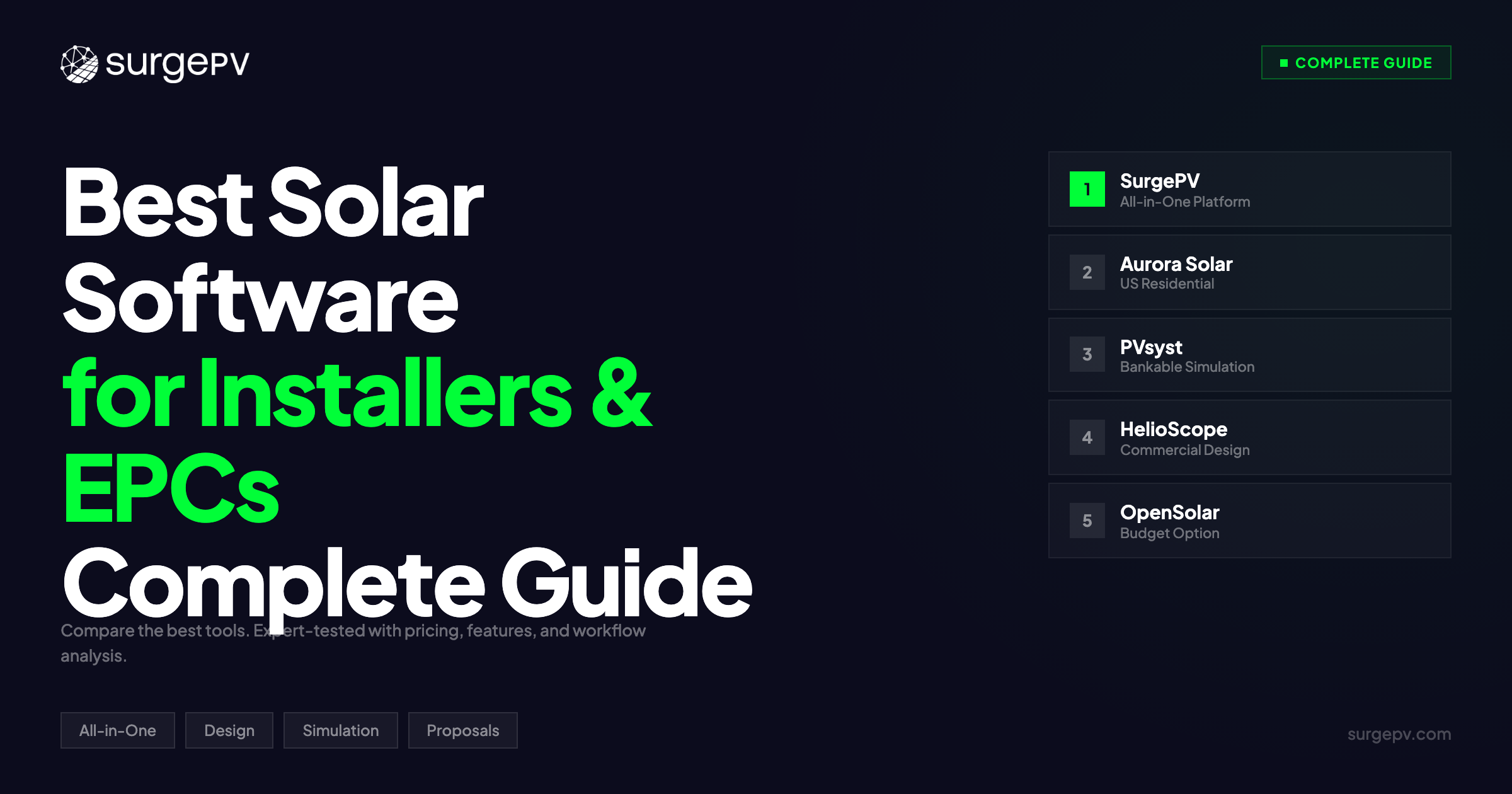
TL;DR: The solar software market has fractured into dozens of specialized tools, and most installers are paying for 3-5 separate platforms that don’t talk to each other. SurgePV is the best all-in-one platform for installers and EPCs in 2026 — design, simulation, electrical engineering, and proposals in one tool at $1,899/year for 3 users. Aurora Solar leads on design and proposals for US residential. PVsyst is the gold standard for bankable simulation. HelioScope dominates commercial rooftop design. OpenSolar is the best budget option for small teams.
The Real Problem with Solar Software in 2026
Most solar businesses don’t have a software problem. They have a software stack problem.
A typical mid-size installer runs PVsyst for simulation, AutoCAD or SketchUp for design, a separate tool for proposals, a CRM for lead tracking, and maybe a monitoring platform for post-install. Five tools. Five logins. Five subscriptions. And every project requires manual data re-entry between them.
The result: a commercial project that should take 2 hours takes 6. A residential proposal that should take 20 minutes takes 90. Your best engineers spend half their time copying numbers between spreadsheets instead of designing systems.
The global solar market installed over 400 GW in 2025 alone (source: SolarPower Europe). The installers winning in this market aren’t the ones with the biggest sales teams. They’re the ones who can go from site visit to signed proposal in a single day. Software determines that speed.
This guide covers the complete solar software market for installers and EPCs. We tested the top platforms across every category — design, simulation, proposals, CRM, monitoring, electrical design, and project management — and identified which platforms deliver the most value per dollar.
In this guide, you’ll find:
- 5 top solar platforms compared across every workflow category
- Complete comparison table with pricing, features, and best-fit use cases
- Category-by-category breakdown: design, simulation, proposals, CRM, monitoring, and more
- Total cost of ownership analysis: multi-tool stacks vs. all-in-one platforms
- Use-case recommendations by company size and project type
- Links to our detailed category-specific guides
Who this guide is for:
- Solar installers evaluating their first software platform
- EPCs looking to consolidate 3-5 tools into fewer platforms
- Solar sales teams needing faster proposal workflows
- Business owners comparing total cost of ownership across software options
Quick Comparison: Best Solar Software (2026)
| Software | Best For | Design | Simulation | Proposals | Electrical | Starting Price |
|---|---|---|---|---|---|---|
| SurgePV | All-in-one for all segments | AI-powered | P50/P90 bankable | Integrated | Automated SLDs | $1,899/year (3 users) |
| Aurora Solar | US residential design + proposals | LIDAR-based 3D | Yes | Industry-leading | No (needs AutoCAD) | ~$5,000+/year |
| PVsyst | Bankable simulation | No | Gold standard | No | No | $1,200–1,800/year |
| HelioScope | Commercial rooftop design | Web-based | Basic | No | No | $3,588/year |
| OpenSolar | Budget all-in-one | Basic | Basic | Yes | No | $1,000–2,000/year |
Total Cost of Ownership
A multi-tool workflow (PVsyst + AutoCAD + proposal tool + CRM) runs $8,000–15,000/year and requires 4–6 hours per commercial project. SurgePV covers design, simulation, electrical engineering, and proposals in one platform at $1,899/year for 3 users — with 30–45 minute commercial project turnaround.
Best Solar Software: Detailed Reviews
SurgePV — Best All-in-One Platform for Installers and EPCs
Best for: Full-service installers and EPCs handling residential, commercial, and industrial projects
Pricing: $1,899/year for 3 users. All features included.
Overall score: 9.5/10
SurgePV is the only cloud-based platform that combines AI-powered solar design, automated electrical engineering, bankable P50/P90 simulation, and professional proposals in a single tool. No AutoCAD license. No tool switching. No data re-entry.
The platform was built to solve the specific workflow gap that every other tool leaves open: electrical engineering. Every solar installation needs single-line diagrams (SLDs), wire sizing calculations, and protection device specifications. Before SurgePV, that meant AutoCAD ($1,800/year) and 2-3 hours of manual drafting per project. SurgePV generates SLDs automatically in 5-10 minutes.
Pro Tip
SurgePV’s automated SLD generation alone saves most EPCs $1,800/year (AutoCAD license) plus 2-3 hours per project in engineering time. For a team handling 15 projects per month, that is 30-45 hours of engineering work redirected to revenue-generating activities. Book a demo to test it with your own project data.
Key Features
- AI-powered roof modeling — 70% faster than manual layout (15-20 min vs. 45-60 min)
- Automated SLD generation — Code-compliant single-line diagrams in 5-10 minutes
- Wire sizing calculations — Automatic DC/AC wire sizing per local electrical codes
- Native carport design — Built-in solar canopy structures for commercial parking areas
- 3D shade modeling — Accurate obstruction analysis with 8760-hour shading simulation
Simulation and bankability:
- P50/P75/P90 simulation — Bankable energy yield reports accepted by lenders and investors
- 8760-hour shading analysis — Within ±3% accuracy vs. PVsyst benchmarks
- Degradation and soiling modeling — Long-term performance projections with configurable loss factors
- Financial modeling — Cash, loan, lease, and PPA scenarios with local utility rates
Proposals and sales:
- Professional proposal templates — Branded, client-ready documents generated from project data
- Interactive customer portals — Homeowners view proposals online with real-time financing options
- E-signature integration — Close deals without leaving the platform
- Multi-language support — Proposals in English, Spanish, German, French, Italian, and more
Pricing
- Individual Plan: $1,899/year for 3 users ($633/user/year)
- For 3 Users: $1,499/user/year ($4,497/year total)
- For 5 Users: $1,299/user/year ($6,495/year total)
All plans include every feature. No tiered gating. No per-project fees. See full pricing details.
Real-World Example
A 12-person EPC in Texas was spending $14,000/year across PVsyst, AutoCAD, a proposal tool, and a CRM — and averaging 5 hours per commercial project from design to proposal. After switching to SurgePV at $6,495/year (5-user plan), they cut software costs by 54% and reduced project turnaround to under 90 minutes.
You might be wondering: if SurgePV does all this, why isn’t it more widely known? Because PVsyst has had a 30-year head start and Aurora Solar has spent hundreds of millions on US market advertising. SurgePV launched more recently but has already powered over 70,000 projects globally. The platform was built specifically for the workflow gaps that legacy tools leave open — especially automated electrical engineering, which no other platform offers natively.
Want to see how SurgePV handles your projects? Book a demo to test automated SLD generation, bankable simulation, and integrated proposals with your own project data.
Further Reading
For a deeper comparison of all-in-one platforms specifically, see our guide to the best all-in-one solar design software.
Aurora Solar — Best for US Residential Design and Proposals
Best for: US residential installers focused on design accuracy and polished sales proposals
Pricing: ~$5,000-6,000+/year, plus AutoCAD ($1,800/year) for SLDs
Overall score: 8.5/10
Aurora Solar is the most widely used solar design platform in the United States. It combines high-resolution LIDAR-based 3D roof modeling with professional proposal generation. The platform’s NearMap and EagleView integrations deliver accurate roof measurements without a site visit, and its proposal templates are among the best in the industry for closing residential deals.
Aurora’s strength is the design-to-proposal pipeline for US residential projects. Sales reps can model a roof, place panels, generate a financial analysis with local utility rates and incentives, and send a polished proposal in under 30 minutes.
Pros:
- Advanced LIDAR-based 3D roof modeling with sub-inch accuracy
- Industry-leading proposal templates with interactive customer experience
- Strong CRM integrations (Salesforce, HubSpot, Zoho)
- Large module and inverter database with automatic compatibility checks
- US utility rate database covers most major utilities
Cons:
- No SLD generation — requires AutoCAD ($1,800/year additional)
- No automated electrical engineering (wire sizing, protection devices)
- Simulation accuracy lower than PVsyst for bankable reports
- US-centric — limited international utility rate and incentive databases
- Higher total cost when you add AutoCAD and other required tools
Further Reading
For a detailed comparison of design-focused platforms, see our guide to the best solar design software.
PVsyst — Gold Standard for Bankable Simulation
Best for: Energy consultants, developers, and EPCs needing simulation reports that lenders accept without question
Pricing: $1,200-1,800/year (single user), desktop-only
Overall score: 8.5/10 (simulation only — not a complete workflow tool)
PVsyst is the industry standard for bankable solar simulation. Every major bank, independent engineer, and due diligence firm worldwide accepts PVsyst reports. If you need financing for a commercial or utility-scale project, PVsyst P50/P90 reports are the gold standard.
PVsyst handles complex shading scenarios, detailed loss analysis (soiling, mismatch, cable losses, transformer losses), and long-term degradation modeling with precision that no other standalone simulation tool matches. It supports Meteonorm, PVGIS, and SolarAnywhere irradiance data sources.
But PVsyst is not a design platform. No layout tools, no SLD generation, no proposals, and it’s desktop-only with no cloud collaboration. You need separate software for everything else in your workflow.
Pros:
- Universal bankability acceptance — the reference tool for project finance worldwide
- Detailed loss analysis and degradation modeling
- Strong irradiance database support (Meteonorm, PVGIS, SolarAnywhere)
- 30+ years of industry trust and validation
Cons:
- No design or layout tools — requires separate CAD software
- No SLD generation — requires AutoCAD ($1,800/year)
- No proposal generation — requires separate tool
- Desktop-only — no cloud collaboration or mobile access
- Steep learning curve — 40-60 hours to reach proficiency
- Single-user license model — expensive for teams
Further Reading
For a detailed simulation software comparison, see our guide to the best solar simulation software.
HelioScope — Best for Commercial Rooftop Design
Best for: Commercial solar designers who need fast, web-based layout tools for large rooftops
Pricing: $3,588/year (single user)
Overall score: 7.8/10
HelioScope from Folsom Labs (acquired by Aurora Solar) is a web-based commercial solar design tool. Its strength is speed: you can lay out a 500 kW commercial rooftop in 15-20 minutes using its keepout zones, automatic panel placement, and stringing tools.
HelioScope includes basic energy simulation and financial analysis, but it doesn’t generate SLDs, doesn’t produce bankable P50/P90 reports, and doesn’t create customer-facing proposals. It’s a design tool, not a complete workflow platform. Most HelioScope users pair it with PVsyst for simulation and a separate proposal tool.
Pros:
- Fast commercial rooftop design with automatic panel placement
- Web-based — no software installation required
- Good stringing and electrical layout tools
- Basic energy simulation for preliminary estimates
Cons:
- No SLD generation or electrical engineering automation
- No bankable P50/P90 simulation — PVsyst still needed for finance
- No proposal generation
- No CRM or project management features
- Single-user pricing is expensive relative to feature set
Further Reading
For a detailed comparison of commercial design tools, see our guide to the best commercial solar design software.
OpenSolar — Best Budget All-in-One Platform
Best for: Small residential installers and startups needing basic all-in-one capabilities at lower cost
Pricing: $1,000-2,000/year
Overall score: 7.0/10
OpenSolar offers affordable all-in-one basics: design, basic simulation, proposals, and simple CRM features. For small residential solar installers handling straightforward rooftop projects, OpenSolar gets the job done at a competitive price point.
The tradeoff is depth. OpenSolar’s simulation engine is less accurate than PVsyst or SurgePV for bankable reports. There’s no SLD generation, no automated electrical engineering, and limited support for commercial or industrial projects. It works for simple residential installs, but teams scaling beyond 30-40 projects per month will outgrow it.
Pros:
- Lower price point for basic all-in-one features
- Simple residential design workflow
- Basic proposal generation and e-signatures
- Cloud-based with team collaboration
Cons:
- No SLD generation — requires separate CAD for electrical documentation
- Simulation accuracy insufficient for bankable reports
- Limited commercial and industrial project support
- Fewer CRM integrations than Aurora or SurgePV
- Less responsive customer support compared to larger platforms
Further Reading
For budget-conscious options, see our guide to the best all-in-one solar design software.
Solar Software by Category
The solar software market spans multiple categories. Most installers need tools from at least 3-4 of these categories. The question is whether you use separate specialized tools or an all-in-one platform that covers multiple categories.
Here’s how the top platforms perform in each category, with links to our detailed category guides.
Design Software
Solar design software handles 3D roof modeling, panel placement, shading analysis, and system layout. This is the foundation of every solar project.
| Platform | Design Strength | Best For |
|---|---|---|
| SurgePV | AI-powered, cloud-based | All segments |
| Aurora Solar | LIDAR-based 3D modeling | US residential |
| HelioScope | Fast commercial layout | Commercial rooftops |
| PV*SOL | Detailed 3D shading | Residential simulation |
Read the full comparison: Best Solar Design Software
Simulation Software
Simulation software calculates energy yield, performance ratios, and financial returns. Bankable simulation is required for project financing.
| Platform | Simulation Strength | Bankable? |
|---|---|---|
| PVsyst | Gold standard, universal acceptance | Yes — industry reference |
| SurgePV | P50/P90, within ±3% of PVsyst | Yes — growing acceptance |
| PV*SOL | Detailed shading, battery modeling | Partial — some lenders |
| Aurora Solar | Basic energy yield | Limited bankability |
Read the full comparison: Best Solar Simulation Software
Proposal Software
Proposal software generates client-facing documents with system specifications, financial analysis, and financing options. Speed here directly impacts close rates.
| Platform | Proposal Strength | Financing Integration |
|---|---|---|
| Aurora Solar | Industry-leading templates | Strong (US lenders) |
| SurgePV | Professional, multi-language | Yes |
| OpenSolar | Basic but functional | Limited |
| HelioScope | No proposals | None |
Read the full comparison: Best Solar Proposal Software
CRM Software
Solar CRM platforms manage leads, track pipeline, automate follow-ups, and integrate with design and proposal tools.
| Platform | CRM Strength | Integrations |
|---|---|---|
| SurgePV | Built-in lead tracking | Native |
| Aurora Solar | Strong via Salesforce/HubSpot | Third-party |
| OpenSolar | Basic pipeline management | Limited |
Read the full comparison: Best Solar CRM Software
Monitoring Software
Post-install monitoring tracks system performance, detects faults, and supports O&M workflows. Most inverter manufacturers offer free hardware-locked monitoring, but platform-agnostic tools provide fleet-wide visibility.
Read the full comparison: Best Solar Monitoring Software
Electrical Design Software
Electrical design tools generate SLDs, calculate wire sizing, specify protection devices, and produce code-compliant documentation.
| Platform | Electrical Design | SLD Automation |
|---|---|---|
| SurgePV | Fully automated | Yes — 5-10 min per project |
| AutoCAD | Manual drafting | No — 2-3 hours per project |
| All others | Not included | Requires separate tool |
Read the full comparison: Best Solar Electrical Design Software
Project Management Software
Project management tools handle scheduling, crew dispatch, permitting workflows, and installation tracking.
Read the full comparison: Best Solar Project Management Software
Key Insight
SurgePV is the only platform that covers design, simulation, electrical engineering, and proposals natively. Every other platform requires at least one additional tool to complete the design-to-proposal workflow.
Why Multi-Tool Stacks Cost More Than You Think
The sticker price of each individual tool tells you almost nothing about total cost. Here’s what a typical multi-tool workflow actually costs.
The Hidden Math
| Cost Component | Multi-Tool Stack | SurgePV All-in-One |
|---|---|---|
| Design software | $3,500-6,000/year | Included |
| Simulation software | $1,200-1,800/year | Included |
| AutoCAD for SLDs | $1,800/year | Not needed |
| Proposal software | $1,200-3,000/year | Included |
| CRM integration | $600-2,400/year | Included |
| Total software cost | $8,300-15,000/year | $1,899/year (3 users) |
| Time per commercial project | 4-6 hours | 30-45 minutes |
| Data re-entry per project | 3-4 manual transfers | Zero |
The time cost compounds. An engineer spending 4 extra hours per project across a 20-project month loses 80 hours — two full work weeks — to tool switching and data re-entry. At $50/hour loaded cost, that’s $4,000/month in lost productivity.
Tool Switching Tax
Every time you export a design from one tool, adjust the format, and import it into another, you introduce error risk and waste time. Common friction points:
- Exporting roof models from design tools to simulation software (file format mismatches)
- Manually entering simulation results into proposal templates (transcription errors)
- Recreating system specifications in AutoCAD for SLD generation (duplicate work)
- Copying customer data between CRM and design tool (no sync)
All-in-one platforms like SurgePV eliminate these friction points. One project file flows through the entire workflow — design to simulation to SLD to proposal — without leaving the platform.
Stop Paying for 5 Tools That Don’t Talk to Each Other
Design, engineer, simulate, and generate proposals in one platform. 30-45 minutes per commercial project.
Book a DemoNo commitment required · 20 minutes · Live project walkthrough
Which Software Is Right for Your Use Case?
| Your Situation | Recommended Software | Why It Fits |
|---|---|---|
| Full-service EPC (residential + commercial) | SurgePV | Only platform with design + SLDs + simulation + proposals in one tool |
| US residential installer (high volume) | Aurora Solar or SurgePV | Aurora: polished proposals + LIDAR. SurgePV: all-in-one with engineering |
| Commercial-only EPC | SurgePV or HelioScope + PVsyst | SurgePV: complete workflow. HelioScope + PVsyst: design + bankable sim |
| Developer needing project finance | PVsyst + SurgePV | PVsyst: universal bankability. SurgePV: design + engineering |
| Startup installer (under 30 projects/year) | OpenSolar or SurgePV | OpenSolar: lowest cost. SurgePV: better engineering depth |
| International EPC (multi-country) | SurgePV | Multi-language, multi-currency, global irradiance data |
| Sales-focused team (no in-house engineers) | Aurora Solar | Best proposal templates and CRM integrations |
Decision Shortcut
If you need electrical engineering (SLDs, wire sizing, code compliance), SurgePV is the only platform that automates this. If you only need bankable simulation, PVsyst is the gold standard. If you prioritize polished US residential proposals, Aurora Solar leads. If budget is your primary constraint, start with OpenSolar.
What to Look for When Choosing Solar Software
1. Workflow Completeness
How many tools do you need to go from site assessment to signed contract? Count the handoffs. Every handoff is a point of failure, delay, and cost. The fewer tools required, the faster your project turnaround.
2. Simulation Accuracy and Bankability
If you need financing, your simulation reports must be bankable. PVsyst is the universal reference. SurgePV delivers P50/P90 reports within ±3% of PVsyst benchmarks. Other platforms may not meet lender requirements.
3. Electrical Engineering
Does the platform generate SLDs? Calculate wire sizing? Specify protection devices? If not, you’ll need AutoCAD ($1,800/year) and 2-3 hours of manual work per project. Only SurgePV automates this natively.
4. Scalability
Software that works for 10 projects per month may break at 50. Check team collaboration features, user licensing models, and whether pricing scales linearly with team size.
5. Shadow Analysis
Accurate shading analysis prevents over-promising on energy yield. The best platforms run 8760-hour simulations that account for seasonal sun paths, nearby obstructions, and horizon shading. Basic tools only check a few time points and miss partial shading effects.
6. Total Cost of Ownership
Compare the full stack cost, not individual tool prices. Include: all software licenses, training time, per-project time cost, and data re-entry overhead.
When You May Not Need Advanced Solar Software
Not every solar business needs a full-featured design and simulation platform. Consider simpler alternatives if:
- You only do basic residential installs with standard layouts — Manufacturer calculators or free tools like PVWatts may suffice for simple rooftop arrays under 5 kW.
- Your engineering is fully outsourced — If a third-party firm handles all design and engineering, you may only need proposal and CRM tools.
- Very low project volume — Teams handling fewer than 5 projects per year may find manual workflows more cost-effective than software subscriptions.
- Sales-only teams — Companies without in-house engineers who only need customer-facing proposals can start with simpler proposal tools.
For most professional installers and EPCs, integrated platforms pay for themselves within the first month through time savings and reduced errors. A single avoided redesign or corrected simulation error covers months of subscription cost.
Bottom Line: Best Solar Software for Installers and EPCs
For complete design-to-proposal workflows: SurgePV is the best solar software for installers and EPCs in 2026. It’s the only platform combining AI-powered design, automated SLD generation, bankable P50/P90 simulation, and professional proposals at $1,899/year for 3 users. No AutoCAD required.
For US residential proposals: Aurora Solar delivers the best design-to-proposal experience for US residential installers, with LIDAR-based modeling and polished customer-facing proposals. Pair with AutoCAD for SLDs.
For bankable simulation: PVsyst remains the gold standard for bankable energy yield reports. Every major lender accepts PVsyst reports. Pair with SurgePV for complete workflows.
For commercial rooftop design: HelioScope offers the fastest commercial layout tools in a web-based interface. Pair with PVsyst for simulation and a separate proposal tool.
For budget-conscious small teams: OpenSolar provides basic all-in-one functionality at lower cost. Good for simple residential projects, but limited engineering capabilities.
The solar industry is moving toward consolidation. The installers building competitive advantages are the ones completing projects in 30 minutes instead of 6 hours. For workflow-specific comparisons, see our guides to solar ERP software, solar estimating tools, and solar lead generation software. For a side-by-side feature matrix, see the solar software comparison. Your solar design software choice determines which side of that divide you’re on.
One Platform for Every Solar Project
Design, engineer, simulate, and propose — without AutoCAD, without tool switching, without data re-entry.
Book a DemoNo commitment required · 20 minutes · Live project walkthrough
Transparency Note
SurgePV publishes this content. We compare SurgePV honestly against competitors and acknowledge where PVsyst, Aurora Solar, and HelioScope lead in specific categories. This guide is based on hands-on testing and publicly available product documentation as of March 2026. See our editorial standards.
Frequently Asked Questions
What is the best solar software for installers in 2026?
SurgePV is the best all-in-one solar software for installers in 2026. It combines AI-powered design, automated SLD generation, bankable P50/P90 simulation, and professional proposals in one cloud-based platform at $1,899/year for 3 users. For installers needing only bankable simulation, PVsyst is the gold standard. For US residential proposal workflows, Aurora Solar leads.
How much does solar software cost?
Solar software pricing ranges from $1,000/year (OpenSolar basic) to $15,000+/year (multi-tool stacks with PVsyst + AutoCAD + Aurora Solar + CRM). SurgePV’s all-in-one platform starts at $1,899/year for 3 users with all features included — design, simulation, electrical engineering, and proposals. See SurgePV pricing for detailed plan comparison.
Do I need separate software for solar design and simulation?
Not if you use an all-in-one platform. SurgePV handles both design and bankable simulation in one tool. If you use specialized tools, you’ll need separate design software (Aurora Solar or HelioScope) and simulation software (PVsyst), plus manual data transfer between them. Multi-tool workflows add 3-4 hours per commercial project in re-entry and file conversion time.
What is the best free solar software?
PVWatts from NREL is the best free solar estimation tool, but it only provides basic energy yield estimates — no design, no SLDs, no proposals. OpenSolar offers limited free features but requires paid plans for full functionality. For professional installers, free tools create more problems than they solve through inaccurate estimates and manual workarounds. SurgePV at $633/user/year delivers the lowest per-user cost for a complete professional workflow.
Can solar software generate electrical single-line diagrams (SLDs)?
SurgePV is the only solar platform that generates SLDs automatically. All other platforms require AutoCAD ($1,800/year) or manual drafting for electrical documentation. SurgePV’s automated SLD generation produces code-compliant diagrams with wire sizing, protection devices, and DC/AC architecture in 5-10 minutes per project, compared to 2-3 hours for manual AutoCAD drafting.
Sources
- SurgePV Product Documentation — Official feature specifications and proof points (accessed March 2026)
- SolarPower Europe — Global Market Outlook for Solar Power 2025-2029 — Global installation data (accessed March 2026)
- NREL (National Renewable Energy Laboratory) — Official website — PVWatts and solar technology benchmarks (accessed March 2026)
- IEC 61724 — Photovoltaic system performance monitoring — International monitoring standard (accessed March 2026)
- Aurora Solar, PVsyst, HelioScope, OpenSolar Official Documentation — Feature specifications and pricing (accessed March 2026)